


• Develop and execute Computational Fluid Dynamic (CFD) and thermal simulations for electronics cooling applications, including airflow, forced and natural convection, and conjugate heat transfer• Support component-, board-, enclosure-, cabinet-, and sub-system-level thermal analysis for products such as circuit breakers, PLCs, laptops, and appliances• Analyze industrial environments (EIA) including high ambient temperatures, enclosure heating, dust effects, and derating requirements• Assist in rapid model setup and simulation turnaround to support internal service requests and customer engineering needs• Apply appropriate boundary conditions including power losses (I²R, switching losses), contact resistance, and environmental loads• Support steady-state and transient thermal analyses, including power cycling, duty cycles, startup conditions, and basic fault scenarios• Evaluate airflow distribution in control panels, switchgear assemblies, and electronic enclosures• Post-process and interpret simulation results to identify thermal risks, hotspots, airflow inefficiencies, and design improvement opportunities• Assist in correlating simulation results with temperature rise tests, lab measurements, and field observations• Prepare clear technical summaries and documentation of assumptions, methods, results, and limitations• Support verification and validation (V&V) activities, including comparison with test data using engineering metrics• Engage with senior engineers to understand UL/IEC standards, certification requirements, and temperature rise limits• Learn and apply best practices in mesh strategy, numerical stability, convergence assessment, and result credibility• Support design optimization activities such as heat sink sizing, airflow path improvement, and enclosure ventilation strategies• Collaborate effectively with cross-functional teams (electrical, mechanical, regulatory) and contribute to a learning-oriented, supportive team culture
QUALIFICATIONS
- Bachelor's or Master's degree in Mechanical Engineering, Thermal Sciences, Aerospace Engineering, or a related field from a reputed institution
- 4-8 years of industrial or applied experience in Computational Fluid Dynamic (CFD) and thermal-fluid simulations (internships and thesis work may be considered)
- Strong fundamentals in:
- Fluid mechanics and basic turbulence modeling
- Heat transfer (conduction, convection, radiation)
- Thermodynamics relevant to electronics cooling
- Hands-on exposure to CFD model setup, solution execution, and result interpretation
- Familiarity with at least one commercial simulation tool such as:
- ANSYS Icepak, ANSYS Fluent
- Siemens FloTHERM / FloEFD
- STAR-CCM+, COMSOL, or similar software
- Basic understanding of mesh generation and grid quality concepts, solver settings and convergence behavior
- Structured modeling workflows and technical guidelines
- Good written and verbal communication skills, with ability to explain results clearly• Self-motivated, detail-oriented, and comfortable learning in a technically rigorous environment
- Exposure to electronics thermal management, including:
- ICs, PCBs, power electronics
- Heat sinks, fans, vents, and enclosures
- Awareness of electronics packaging constraints such as:
- Space limitations, airflow resistance
- Material properties and power dissipation
- Basic experience with thermal testing, such as thermocouple placement, temperature measurement, or data acquisition• Introductory experience correlating simulation results with test or experimental data
- Familiarity with transient thermal behavior, power cycling, and reliability considerations
- Exposure or interest in industrial products such as circuit breakers, PLCs, switchgear, or control panels
- Interest in automation, scripting, or AI-assisted simulation workflows
Skills Required
- Bachelor's or Master's degree in Mechanical Engineering, Thermal Sciences, Aerospace Engineering, or related field
- 4-8 years of industrial or applied experience in CFD and thermal-fluid simulations
- Strong fundamentals in fluid mechanics, turbulence modeling, heat transfer, and thermodynamics relevant to electronics cooling
- Hands-on exposure to CFD model setup, solution execution, and result interpretation
- Familiarity with at least one commercial simulation tool (ANSYS Icepak, ANSYS Fluent, Siemens FloTHERM/FloEFD, STAR-CCM+, COMSOL, or similar)
- Basic understanding of mesh generation, grid quality, solver settings, and convergence behavior
- Experience with steady-state and transient thermal analyses, including power cycling and duty cycles
- Exposure to electronics thermal management (ICs, PCBs, power electronics, heat sinks, fans, vents, enclosures)
- Basic experience with thermal testing and data acquisition (thermocouple placement, temperature measurement)
- Ability to prepare clear technical summaries and documentation of assumptions, methods, results, and limitations
- Introductory experience correlating simulation results with test or experimental data and supporting V&V activities
- Familiarity with transient thermal behavior, reliability considerations, and basic fault scenarios
- Awareness of UL/IEC standards, certification requirements, and temperature rise limits (learn and apply)
- Exposure or interest in industrial products such as circuit breakers, PLCs, switchgear, or control panels
- Interest or experience in automation, scripting, or AI-assisted simulation workflows
- Good written and verbal communication skills
What the Team is Saying


.jpeg)


.jpeg)



.jpeg)


.jpeg)

UL Solutions Compensation & Benefits Highlights
-
Strong & Reliable Incentives — Incentive pay is positioned as broad-based, with UL stating all employees are eligible for an annual performance bonus across regions. This universal design creates a consistent incentive foundation regardless of role or country.
-
Retirement Support — Retirement offerings are described as strong, featuring a 401(k) with matching up to a total 5% and an additional 4% company retirement contribution after the first year in U.S. materials. Employees also reference access to an employee stock purchase plan in the U.S. and many major operating regions.
-
Healthcare Strength — Health coverage breadth includes medical, dental, and vision with U.S. plans noting the company pays over 75% of medical premiums and offers PPO and HDHP options. Supportive programs like FSAs/HSAs, disability, life insurance, EAP, and mental‑health resources are frequently cited.
UL Solutions Insights

What We Do
A global leader in applied safety science, UL Solutions transforms safety, security and sustainability challenges into opportunities for customers in more than 100 countries. UL Solutions delivers testing, inspection and certification services, together with software products and advisory offerings, that support our customers’ product innovation and business growth. The UL Certification Marks serve as a recognized symbol of trust in our customers’ products and reflect an unwavering commitment to advancing our safety mission. We help our customers innovate, launch new products and services, navigate global markets and complex supply chains, and grow sustainably and responsibly into the future. Our science is your advantage.
Why Work With Us
Science is in our DNA; we are endlessly curious and passionate about seeking and speaking the truth. We take delight in knowing that our work makes a meaningful contribution to society, and we are proud that our culture is centered on integrity, collaboration, inclusion and excellence.
Gallery


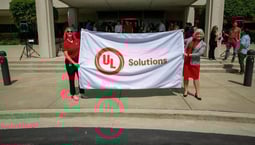







UL Solutions Offices
Hybrid Workspace
Employees engage in a combination of remote and on-site work.
Depending on the role we offer hybrid or remote opportunities.
