
A product information management (PIM) is a system and centralized hub for product descriptions, specifications and taxonomy, pricing, compliance docs, digital assets and more. It replaces the spaghetti system of spreadsheets, shared drives, manual notes and siloed knowledge that most companies don’t realize is costing them until it actually has.
Interestingly, though, PIM is rarely a technology decision. More often, it’s a business operations decision that happens to require a technology solution. The organizations that view the problem correctly are the ones that ultimately get it right.
This article is for company operators and technology consultants who want to understand what PIM actually is, whether they need one and how to get it right.
Product Information Management (PIM) Defined
Product information management (PIM) is a centralized system and hub used by organizations to manage product descriptions, specifications, pricing, compliance documents and digital assets. It replaces fragmented spreadsheets and disconnected systems to provide a single, accurate source of truth for enriching, governing and distributing product data across multiple sales channels.
How Does Product Information Management Work?
A PIM system centralizes all product information into a single hub and gives you the tools to enrich, validate and distribute the data where it needs to go.
At its core, a PIM handles four core functions.
Centralization
This is the foundation everything else depends on. All product data lives in one place. When someone updates a product description once, it updates everywhere.
Enrichment of Data
This is where a PIM stops being a database and starts being useful. PIM systems offer workflows for teams to add and improve their product data; writing descriptions, uploading media, tagging and compliance documentation are just a few examples of how data can be added to tell a better product story. Many PIMs include completeness scoring so you can see quickly which products are ready for publication and what gaps remain. More advanced systems support AI-assisted enrichment, including autocomplete functions, categorization suggestions and auditing inconsistencies or missing information that’s relevant to completing a holistic picture of the product.
Governance
PIMs offer validation rules, audit trails, RBAC (role-based access control) and approval workflows. This is where I see the most resistance to implementation because it means people have to give up control over their corner of the data.
Distribution
This is the payoff — everything upstream is pointless if the data doesn’t actually get where it needs to go. Once the data is finalized and approved, the PIM deploys the updates to your channels in the format each channel requires; they all get their own distribution, and everything stays in sync.
How Are PIM Systems Built?
Data Model
Flexible, attribute-based schema with support for product categorization, hierarchies, variants (size/color) and relationships (cross-sell, accessories, replacements).
You can think of it the way you think of a library catalog system. Every book (product) has a card with standard fields (title, author, ISBN), but different genres need different fields (a cookbook needs “cuisine type” while a textbook needs “grade level”). A PIM lets you define those fields sets per product type without rebuilding the system.
Storage
A hybrid approach is best, with a relational database for structured attributes, document store or object storage for media, faceted search index (like Elasticsearch or Solr) for catalog queries.
Localization
Multi-locale attribute support with fallbacks or inheritance (e.g. fall back to English if the Spanish translation is missing). If a local version doesn’t exist yet, the system defaults to the “home” or “main” version until someone provides one.
Integration Layer
Integrations between ERP/e-commerce/marketplace systems are API-driven via REST or GraphQL APIs (or SOAP for really old ones). Event-driven architecture via webhooks, message queues or websockets allows for near-time or real-time data propagation. APIs are the translators that let your systems talk to each other.
Workflow Engine
This is a configurable state (status) management and the rules that allow for those states to change. State machines manage data enrichment, approvals and publication triggers. This works similarly to how a newspaper article might move through an editorial pipeline before being published and syndicated: a writer drafts it, an editor reviews it, a fact-checker approves it, then it goes to print. A PIM enforces that same kind of structured review process for product data, which can be very helpful when multiple departments or business units are involved in managing parts of product data.
How to Know If You Need a PIM System
Not every organization needs a dedicated PIM system. Some genuinely operate with well-structured spreadsheets, disciplined project management process and a small set of custom automations or integration tools. But as complexity grows, more pain points arise. In fact, the PIM conversation doesn’t usually start with someone saying, “We need a PIM.” Rather, it starts with a list of problems that get so long that the issues can’t be ignored.
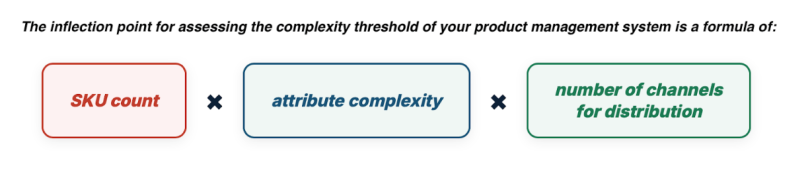
You Can’t Manage the Count/Complexity of Your Products
The same product has multiple descriptions across its different distributed channels. Customers are confused and not receiving products that match their expectations. Returns are difficult to track. No one knows which version of the data is “right” because the answer is dependent on who you ask and what tools they use. Once you’re managing thousands of SKUs — especially if there are bundles or customizations/ configurations — the overhead of manual management becomes unsustainable.
Planning for Growth That Your System Can’t Support
You want to expand into a new market or a new channel for B2B becomes apparent, but your team discovers that their product data isn’t structured in a standardized way that translates or integrates. What works in the current platform doesn’t map cleanly to the new channel taxonomy or attributes, and suddenly a three-month initiative becomes a six-month data cleanup project.
You Interact With Customers Across Multiple Channels
If your product data needs to live in several places and each one has a different taxonomy, attribute and format requirements, then you’re spending significant time on data transformation, migration or syncing. Once you have more than three different channels, manual entry and reconciliation starts to become a tedious and time consuming process that gets poorly maintained.
Multiple Teams Managing Product Data
When marketing teams, product management, compliance, inventory management and operations all contribute to product information, you need levers to manage access and department functions. You need governance. Without it, you get version conflicts, data quality degradation, data loss and no clear ownership over the product information.
Your Data Quality Is Impacting Revenue
This can look like a known issue where customers are returning products because descriptions don’t match what they received or your marketplace listings are getting suppressed because of incomplete data. It can also look more subtle, like sales teams sending out outdated spec sheets with their proposals or spending fewer hours thinking strategically and servicing customers and more time managing data inconsistencies to keep things afloat.
Compliance/Regulatory Pressure Surfaces
If you’re in a more regulated industry, you may face more strict requirements around labeling, safety sheets and ingredient disclosures. When that data lives in disconnected systems and has to be pieced together, a routine audit becomes a nightmare.
Before organizations officially adopt a PIM, they’re typically managing product data through some of the following:
Spreadsheets Reign Supreme
Excel files, Google sheets and Smartsheets that were originally a temporary solution are still your management system three years later. Multiple team members maintain their own versions. There’s a “master file,” but no one is confident that it’s actually up to date.
The ERP Is Doing 2 Jobs
Many companies assume their ERP (enterprise resource planning) handles product data and central record because it holds SKUs, pricing and inventory — and it does — but not for customers. ERPs aren’t designed to manage the marketing-focused product content that customers need to see: detailed descriptions, contextual imagery, comparison attributes, SEO metadata and more.
Tribal Knowledge and Channel Silos Create Disconnection
Of course, the knowledge of the long-term tenured team member is invaluable. It’s a huge asset — until it becomes a liability because there’s a pillar of knowledge that others can’t reach. For example, a product lead with a decade-long tenure may keep critical details in their head or personal notes and private automations. If they go on vacation or leave the company, the data goes with them.
And it’s not just individuals. Whole teams build their own parallel processes that drift apart over time. For example, say the e-commerce team manages data in Shopify. The marketplace team manages the data in the seller portal. The print catalog team manages it in their AdobeXD files. Each team has their own version of the truth, and they all sync data through manual copy-paste processes.
Benefits of a PIM
Consistent Customer and User Experiences
Customers see the same accurate information whether they’re on your website, a marketplace, a partner channel, in a store or working with sales. This consistency builds trust that directly reduces return and exchange rates driven by inaccurate listings.
Operational Efficiency
Teams stop spending time on manual data entry, copy-pasting between systems and resolving conflicting and missing versions of data. That time gets recycled back into the company and can be focused on strategy and customer experience.
Growth That Scales
Adding a new sales channel, entering a new territory or expanding your catalog becomes a configuration exercise instead of a crisis because your foundation and distribution pipelines are already in place.
Faster Time-to-Market
Products get from creation to published/syndication across all channels in days rather than weeks or months. Enrichment workflows, completeness scoring, AI suggestions and autocompletions, auditing tools to highlight gaps and automated distributions replace the manual assembly line. I’ve seen the results of this first-hand. For one client, this meant going from three weeks to four days for a new product launch.
Regulatory Compliance and Auditing Readiness
When regulatory requirements inevitably change, you can update product data once and propagate it everywhere with a full audit trail that documents who changed what and when. With role-based access and departmental restrictions for authoring and editing, you know that only the people that should have access to make changes that matter are the ones with access.
Analytics Inform Results and Opportunities
With clean, unified data, your category performance reports, conversion analytics and merchandising insights actually mean something because they are real and point to actionable steps. Consistent attributes make product data queryable and comparable across channels.
PIM vs. MDM vs. DAM: What’s the Difference?
These three acronyms often come up together, and the boundaries can feel blurry -- but there is a practical distinction.
PIM (Product Information Management)
A PIM manages product-specific data like descriptions, attributes, specs, pricing, categories, relationships, and channel-specific content. It’s focused on making product data accurate, complete and distributable across channels. The data model is product-centric.
MDM (Master Data Management)
An MDM is broader. It governs all master data across the organization. That means not just products, but customers, suppliers, locations, employees and more. MDM focuses on cross-domain data quality, deduplication and golden record management. A PIM can be thought of as a specialized domain within an MDM.
DAM (Data Asset Management)
A DAM manages digital files: images, videos, documents, PDFs, and other media. While a PIM may store a reference to a product image, the DAM is where that asset is stored, versioned, transformed (cropped, reformatted, resized), rights managed and tagged for retrieval.
In practice, if your primary pain is product data quality and multi-channel distribution, start with PIM. If your media library is ungoverned and costing you time, a DAM may be your first priority. If your data quality issues span into customer and supplier data, MDM may be the right frame. Many modern platforms like Pimcore combine two or three of these capabilities, which can reduce integration complexity but create the tradeoff of platform dependency.
Examples of PIM Software and Tools
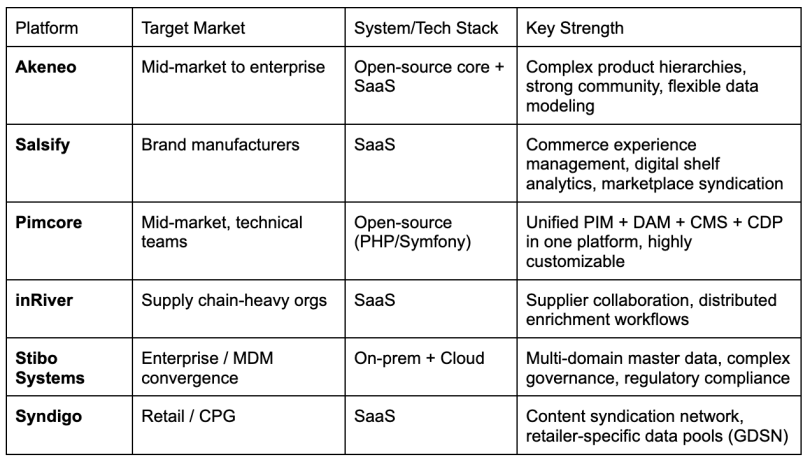
When picking a vendor, start with your integration requirements, your data model complexity, your team’s technical capacity and your growth trajectory. The best PIM for your organization is the one that fits your ecosystem.
Frequently Asked Questions
What is product information management used for?
PIM is used to unify, complete and distribute product data across all the channels and systems where the data is needed. It ensures that every team, tool and customer touchpoint has access to accurate, consistent and complete product information. Structured specifications, marketing copy and compliance documentation can all live within a PIM.
What types of companies need a PIM system?
Any company managing a significant number of products across multiple channels likely benefit. It’s most commonly adopted by retailers, distributors, manufacturers and e-commerce companies, particularly those that are experiencing growth in product SKU count, growth in channels or new business or geographic expansion. The determining factor isn’t usually industry. Instead, it usually comes down to how complex your products are, how many places you sell them and how many people touch the data.
What’s the difference between PIM and ERP?
An ERP manages the operational business data (financials, inventory, supply chain). A PIM manages the product content that customers and partners see (descriptions, images, specs, marketing attributes).
Think of your ERP as the kitchen in a restaurant that’s keeping track of ingredients, costs and inventory. The PIM is the menu that handles what the customer sees, optimized for where they are viewing it (in restaurant vs. delivery app vs. website). They complement each other, and most PIM implementations offer bidirectional ERP integration as a core requirement.
Is a PIM system worth it for small businesses?
It depends on complexity, not size. A small business with 300 SKUs sold through one or two channels probably doesn’t need a dedicated PIM. A small business with 2,000 SKUs across five marketplaces and a DTC (direct-to-consumer) site probably does. Open-source options like Akeneo or Pimcore can lower the entry cost, though the implementation and integration process is still a larger undertaking.
How long does a PIM implementation take?
It varies widely based on data complexity, integration scope and organization readiness. A focused implementation covering core product categories and a few channel integrations takes about three to six months on average. Enterprise-scale implementations with complex data migration, multiple ERPs and a multinational rollout can take a year to 18 months. Phased approaches consistently deliver better than big-bang launches and have much less troubleshooting post-launch.
Can non-developers use business rules engines?
Modern PIM systems are designed for business users, including product managers, merchandisers and marketing teams. In these cases, technical administration and setup is just handled separately. Look for a PIM with an intuitive UI for data enrichment, configurable workflows through UI (not coded) and admin-friendly data modeling tools. The goal is that day-to-day product management doesn’t require engineering involvement.
Does a PIM fix all data problems for a growing company?
A PIM won’t fix broken organizational ownership of data or a culture that doesn’t value data quality. It won’t automatically make bad data good data. It’s an enabler, but it’s not a magic wand. Setting that expectation up front is important. Organizations that get the most value from PIM are the ones who took the PIM implementation as an opportunity for full operational transformation rather than just a software purchase.