
Semantic segmentation is a computer vision task in which every pixel in an image is assigned a class label. Semantic segmentation gives each part of the image a specific meaning like “road,” “vehicle,” “pedestrian,” or “lane marking.” The word “semantic” here refers to this assigned meaning.
The model isn’t just finding edges or shapes, foreground or background. Instead, it’s understanding what each region of the scene represents. The output is a dense, fully-labeled map where pixels of the same category share a label.
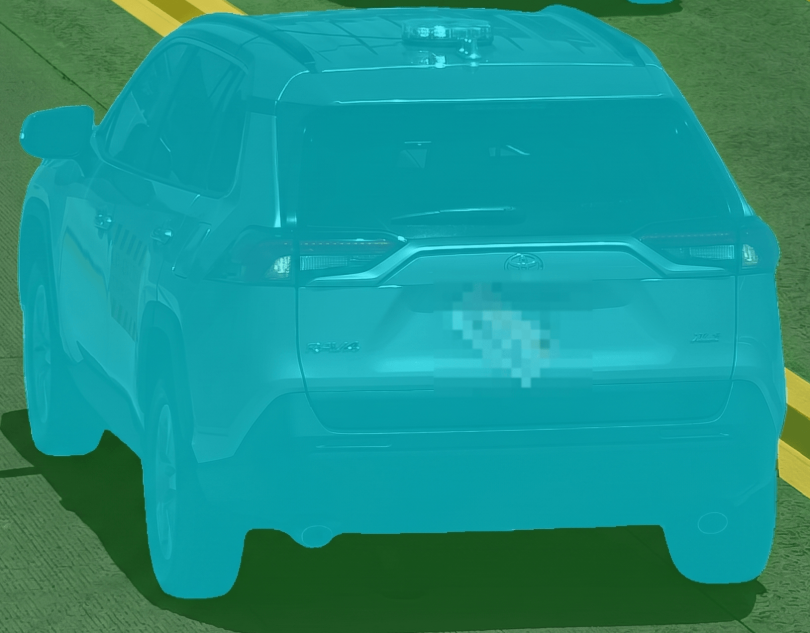
One important note: Semantic segmentation treats all instances of a class as one. If three vehicles are in frame, all three will share the same “vehicle” label. They aren’t separated individually. That’s what sets it apart from instance segmentation.
What is semantic segmentation?
Semantic segmentation is a computer vision task that assigns a class label to every pixel in an image, producing a dense, pixel-level map of what each part of a scene represents.
How Semantic Segmentation Works
At its core, semantic segmentation is a pixel-wise classification problem. The model takes an image as input and produces an output of the same width and height where each pixel holds a class label. Getting to this output requires the model to understand both the fine details made up by individual pixels and the broader context of the scene around them.
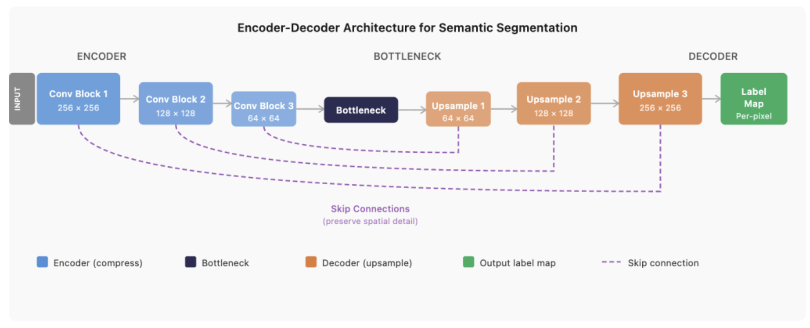
Most modern semantic segmentation models use an encoder-decoder architecture. The encoder acts as a feature extractor, progressively compressing the image into a compact representation that captures high-level patterns. The decoder then works in reverse, upsampling those extracted shapes, textures, and object types back to the original image resolution and assigning a the most likely class to each pixel.
Semantic Segmentation vs Other Computer Vision Tasks
Semantic segmentation sits within a broader family of computer vision tasks, each offering a different level of scene understanding. Knowing where it stands clarifies both what it’s built for and when another approach might be a better fit.
Image Classification
Image classification is the most basic of the group. It looks at an image and outputs a single label like, “This image contains the digit three.” MNIST, one of the most widely used data sets in machine learning, is a classic classification task where models learn to recognize handwritten characters. That same foundational logic (i.e., assign a label to what's in the image) underpins modern license plate recognition systems, where a cropped plate image is classified character by character to produce a readable plate number.
Object Detection
Object detection adds location to the task of image classification. Object detection models predict bounding boxes around objects along with their class labels. A roadside detector might draw a box around every vehicle in frame and label each one. Object detection is more informative than classification, but these models can only make rectangular approximations to the position of the object. These bounding boxes include background pixels and can’t follow the true contours of an object.
Semantic Segmentation
Semantic segmentation goes beyond object detection by labeling at the pixel level. Instead of a box around a truck, every pixel that is truck gets the truck label. The tradeoff is that all trucks in the scene share the same label. The model knows what things are, but not how many individual instances exist.
Instance Segmentation
Instance segmentation takes that a step further, giving each individual object its own unique mask. Two overlapping vehicles would each get a separate label, not a shared one. This approach is more powerful but also more computationally expensive.
Panoptic Segmentation
Panoptic segmentation combines both semantic and instance segmentation approaches. Panoptic segmentation applies semantic segmentation to “stuff” like road and sky, and instance segmentation to “things” like vehicles and pedestrians. It’s the most complete picture of a scene, and increasingly the direction state-of-the-art systems are heading.

Selecting the right approach for your application comes down to balancing accuracy and computational cost. Instance and panoptic segmentation offer richer scene understanding but demand significantly more from your hardware. Semantic segmentation hits a practical middle ground for many real-world systems where per-pixel class accuracy matters more than distinguishing individual instances. For roadside safety monitoring, detecting whether the shoulder is occupied and by what type of object could be defined as a semantic segmentation problem. Tracking three specific vehicles through a frame independently is a good fit for an instance segmentation model.
Common Semantic Segmentation Models
The field of semantic segmentation has produced a number of influential architectures, each tackling the core pixel-wise classification problem from a different angle. A few have become standard reference points that most practitioners work from today.
Fully Convolutional Network (FCN)
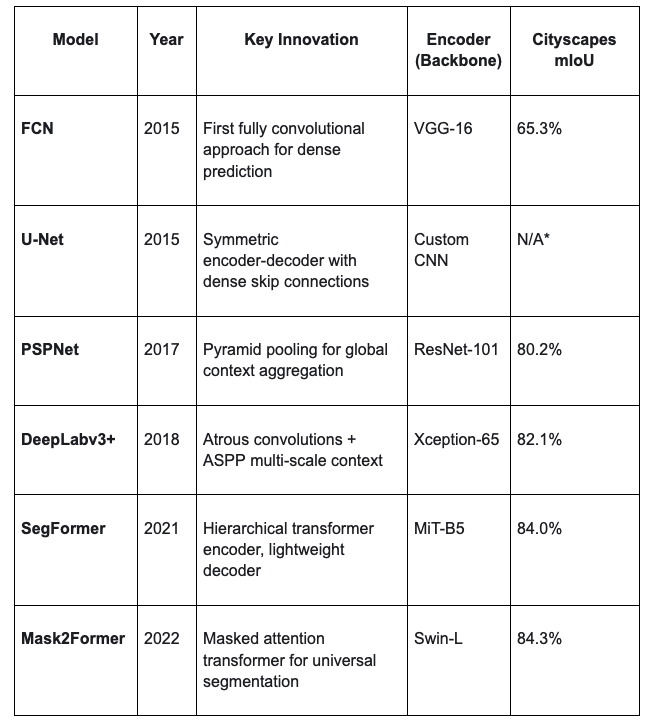
Fully Convolutional Network (FCN) is where modern semantic segmentation effectively began. Introduced in 2015, FCN adapted existing image classification networks by replacing their fully connected layers with convolutional ones, allowing the model to output a spatial label map rather than a single class score. It established the encoder-decoder paradigm that most architectures still follow.
U-Net
U-Net extended that foundation with a symmetric encoder-decoder structure and dense skip connections between the two halves. Originally developed for biomedical image segmentation, where labeled data is scarce and precision matters, U-Net proved so effective that it became widely adopted across domains. Its ability to produce accurate segmentations with relatively small training sets makes it a practical choice for specialized applications.
DeepLab (v3+)
DeepLab (v3+) introduced atrous convolutions, also called dilated convolutions, which expand the receptive field of the network without reducing spatial resolution or adding parameters. DeepLabv3+ pairs this with an Atrous Spatial Pyramid Pooling module that captures context at multiple scales simultaneously, making it particularly strong in scenes with objects of varying size.
PSPNet (Pyramid Scene Parsing Network)
PSPNet (Pyramid Scene Parsing Network) approaches the multi-scale problem differently, aggregating context from multiple pooling regions across the feature map before making predictions. It excels at parsing complex scenes where understanding the global context is as important as local detail.
More recently, transformer-based architectures like SegFormer and Mask2Former have pushed state-of-the-art benchmarks by applying attention mechanisms to capture long-range dependencies across the image. These models have largely displaced CNN-based approaches on standard benchmarks, though they typically require more data and compute to train effectively.
Data Sets for Semantic Segmentation
Training a semantic segmentation model requires pixel-level annotations, which makes data set construction significantly more expensive than image classification or object detection. Annotating a single image can take anywhere from 30 minutes to several hours depending on scene complexity. As a result, a handful of large, well-curated data sets have become the standard benchmarks the field builds from.
COCO (Common Objects in Context)
COCO (Common Objects in Context) is one of the most widely used benchmarks across computer vision tasks. With more than 200,000 labeled images spanning 80 categories, its scale and variety make it a strong general-purpose starting point for model development and comparison.
Cityscapes
Cityscapes is purpose-built for understanding urban street scenes, with high-quality pixel annotations across 19 categories including road, vehicle, pedestrian and sky. Captured from a forward-facing vehicle camera across 50 cities, it has become the primary benchmark for autonomous driving and roadside perception research. For applications involving shoulder-mounted cameras and traffic monitoring, cityscapes annotations translate directly to the kinds of distinctions a production system needs to make.
Mapillary Vistas
Mapillary Vistas extends that coverage with 25,000 street-level images annotated across 124 semantic categories. Its diversity in geography, weather and camera angle makes it particularly valuable for training models that need to generalize across real-world conditions rather than a controlled capture environment.
For most production applications, fine-tuning on a domain-specific data set built from your own camera setup will outperform any pre-trained model used out of the box. Public data sets establish a strong starting point, but the distribution shift between a benchmark data set and a shoulder-mounted roadside camera is real and worth accounting for in your training pipeline.
Evaluation Metrics for Semantic Segmentation
Evaluating a semantic segmentation model requires metrics that account for pixel-level predictions across every class in the scene. A few have become standard across research and production, each capturing a different dimension of model performance.
Mean Intersection Over Union (mIoU)
Mean Intersection over Union (mIoU) is the metric the field has largely converged on as the primary benchmark. For each class, it computes the ratio of the overlap between the predicted region and the ground truth region to their union, then averages that score across all classes. Because every class is weighted equally regardless of how many pixels it occupies, mIoU penalizes models that ignore rare but important categories.
Boundary F1 Score
Boundary F1 Score evaluates how precisely a model captures the edges between regions rather than just the regions themselves. It measures the balance between boundary precision and recall within a narrow pixel tolerance. In applications where accurate object contours matter, such as distinguishing a vehicle from the lane marking it’s straddling, boundary quality can be just as important as overall region accuracy.
Real-World Applications of Semantic Segmentation
Semantic segmentation has moved well beyond research benchmarks and into production systems across a wide range of industries. What these applications share is a need to understand not just what’s in a scene, but precisely where it is and how much of the frame it occupies.
Medical Imaging
Medical imaging is one of the earliest and most clinically significant applications. Segmentation models are used to delineate tumors, organs and tissue boundaries in MRI and CT scans, giving radiologists precise measurements and reducing the manual effort required for annotation. U-Net, discussed earlier, was originally developed for exactly this purpose.
Autonomous Vehicles
Autonomous vehicles represent the most visible deployment of semantic segmentation at scale. Onboard vision systems use pixel-level scene understanding to identify drivable surface, detect lane boundaries, and recognize pedestrians and cyclists in real time.
Tolling and Traffic Enforcement Systems
Tolling and traffic enforcement systems apply segmentation to classify vehicle types, verify axle counts and support license plate recognition workflows. Because these systems operate from a fixed vantage point in varying lighting and weather conditions, robust pixel-level classification is often more reliable than detection-only approaches that depend on clean bounding box proposals. Blissway builds vision-only traffic systems that apply similar segmentation approaches from fixed shoulder-mounted cameras, classifying vehicle types and monitoring traffic violations without requiring any instrumentation of the vehicles themselves.
Satellite and Aerial Imagery Analysis
Satellite and aerial imagery analysis uses segmentation to map land cover, track deforestation, monitor crop health and identify infrastructure changes over time. At the scale of a satellite image, pixel-level classification is the only practical way to extract meaningful spatial information from what can be billions of pixels per scene.
Challenges in Semantic Segmentation
Despite its capabilities, semantic segmentation comes with a set of practical challenges that any production deployment has to contend with. Understanding these limitations is as important as understanding the technology itself.
Annotation Cost
Annotation cost is the most immediate barrier. Pixel-level labeling is orders of magnitude more time-consuming than bounding box annotation or image-level labels. A single complex scene can take several hours to annotate accurately, which makes building large, domain-specific training data sets expensive and slow. For specialized applications with unique camera angles or environments, off-the-shelf public data sets rarely cover the distribution well enough to rely on alone.
Class Imbalance
Class imbalance compounds that problem. In most real-world scenes, background classes like road surface and sky dominate the pixel count while critical categories like pedestrians or debris occupy a fraction of the frame. Standard training objectives can produce models that optimize for common classes at the expense of rare ones, which is precisely backwards for safety-critical systems where the rare event is the one that matters most.
Domain Shift
Domain shift is a persistent challenge when moving from benchmark to production. A model trained on Cityscapes captured from a forward-facing vehicle camera in European cities will behave differently when deployed on a shoulder-mounted camera at a highway interchange in varying weather. The viewing angle, lens characteristics, lighting conditions and scene composition all shift the input distribution in ways that can meaningfully degrade performance.
Occlusion and Boundary Ambiguity
Occlusion and boundary ambiguity create inherent difficulty at the pixel level. When a pedestrian is partially obscured by a vehicle or when a road marking fades, the ground truth itself becomes ambiguous. Models tend to struggle at object boundaries and in heavily occluded scenes, which is often where the most consequential decisions need to be made.
Computational Cost
Computational cost remains a constraint for edge deployment. High-accuracy models like DeepLabv3+ and transformer-based architectures require significant GPU resources to run at the frame rates needed for real-time traffic monitoring. Lighter architectures exist but typically involve tradeoffs in accuracy that have to be evaluated carefully against the requirements of the application.
Best Practices for Building a Semantic Segmentation Model
Building a reliable semantic segmentation system involves more than selecting an architecture and training on available data. The decisions made around data, training objectives and evaluation have as much impact on production performance as model choice.
Start With a Pre-Trained Backbone
Training a segmentation model from scratch requires substantial data and compute. In practice, most successful deployments begin with an encoder pretrained on ImageNet or a similar large-scale data set, then fine-tune on domain-specific data. The pretrained backbone provides a strong feature extractor as a foundation; fine-tuning adapts it to the specific classes and visual conditions your system will encounter.
Invest in Annotation Quality Over Quantity
A smaller set of carefully annotated images will consistently outperform a larger set of noisy labels. For specialized deployments, it’s worth building an annotation pipeline that reflects the actual operating conditions of your system, including the camera angle, lens characteristics, lighting variations and weather conditions you expect in production.
Address Class Imbalance Explicitly
Relying on standard cross-entropy loss in imbalanced scenes will push the model toward majority classes. Weighted loss functions, focal loss or oversampling of underrepresented categories are practical tools for ensuring that rare but critical classes receive adequate gradient signal during training.
Use Aggressive Data Augmentation
Geometric transforms, color jitter, random cropping and synthetic weather effects like rain and fog overlays all help the model generalize to conditions it may not have seen in the training set. For fixed-camera systems, augmentations that simulate changes in lighting across the day and across seasons are particularly valuable.
Evaluate Against the Right Metrics
Pixel accuracy alone is not a sufficient measure of model performance in scenes with class imbalance. mIoU should be the primary benchmark, and per-class IoU scores should be reviewed individually to catch cases where the model is underperforming on important but infrequent categories.
Test on In-Distribution Data Before Benchmarking on Public Data Sets
Public benchmarks are useful for comparing architectures, but they don’t tell you how a model will perform in your deployment environment. Maintain a held-out validation set drawn from your own camera setup and treat performance on that set as the authoritative measure of readiness.
Plan for the Compute Constraints of Your Deployment Target
A model that achieves state-of-the-art mIoU on a benchmark is only useful if it can run within the latency and power budget of the system it is deployed on. Evaluate model efficiency early and consider techniques like quantization, pruning or knowledge distillation if edge deployment is a requirement.
Frequently Asked Questions
What is semantic segmentation?
Semantic segmentation is a computer vision task that assigns a class label to every pixel in an image, producing a dense, pixel-level map of what each part of a scene represents.
What is an example of semantic segmentation?
A shoulder-mounted roadside camera processing a live traffic scene is a practical example. The model labels each pixel as road surface, vehicle, pedestrian, lane marking or background, giving the system a deep understanding of what’s happening in the frame.
How is semantic segmentation different from image segmentation?
Image segmentation is a broad term that covers any technique dividing an image into meaningful regions. Semantic segmentation is a specific form of it that assigns a class label to every pixel based on what object or surface it belongs to. Other forms of image segmentation, like instance segmentation, go further by distinguishing between individual objects of the same class.
What are common semantic segmentation models?
The most widely used architectures include FCN, which established the encoder-decoder foundation the field builds on; U-Net, known for strong performance with limited training data; DeepLabv3+, which excels at capturing context across multiple scales; and more recent transformer-based models like SegFormer and Mask2Former, which currently lead on standard benchmarks.