

The public AI conversation still loves a scoreboard.
Which model is ahead this week? Which one writes better code? Which one reasons longer? Which one has the bigger context window, faster agents or better demo?
Models matter. Better models change what teams can build and automate. But model watching has become a weak substitute for AI strategy.
The real competition is moving across the full AI stack: energy, chips, memory, cloud capacity, data infrastructure, model builders, developer tools, agent operations, safety systems, applications and distribution. The most important question for tech leaders is no longer simply, “Which model should we use?” It’s, “Where are we dependent, where do we need control and which bottlenecks could shape our future economics?”
That is a more useful way to read the latest AI news. OpenAI and Anthropic are pushing deeper into enterprise deployment. Google and Anthropic are reportedly locking up massive compute capacity through SpaceX. Anthropic’s Fable and Mythos releases show safety, access and model routing becoming product architecture. Nvidia’s Rubin platform shows the infrastructure layer turning into a full-stack AI factory.
The pattern is clear: The model race is becoming a fight over control points.
Why AI Strategy Is Shifting Beyond Foundation Models
AI competition has moved past foundation model benchmarks to controlling the full technology stack, including power, chips, cloud capacity, data infrastructure and distribution. Rather than asking which model to use, tech leaders must identify their dependencies, protect core data and workflow logic and build control points where value and risk reside.
The Stack Starts Below the Model
Most people talk about AI as if the stack starts with foundation models. It doesn’t.
It starts with power.
Energy, cooling and grid access used to feel like background infrastructure. Now they’re strategic constraints. AI data centers need enormous electricity supply, reliable cooling, physical space and long-term power planning. If that layer is constrained, everything above it slows down.
Then come chips, memory and networking. GPUs get most of the attention, but memory bandwidth, advanced packaging, networking and interconnects are just as important. AI progress depends not only on smarter algorithms but on whether the physical system can move enough data fast enough at a cost enterprises can tolerate.
Above that sits compute capacity and AI cloud. This is where hyperscalers hold real power. Training and inference depend on GPU clusters, custom silicon, storage, networking and orchestration. Cloud providers don’t just rent infrastructure. Increasingly, they influence which models scale, which startups survive and which enterprise workflows become easy to deploy.
By the time you reach the model layer, a lot of power has already been decided.
Recent moves by OpenAI, Anthropic, Google and Nvidia reveal the same trend: AI companies are expanding beyond models into deployment, compute, safety and infrastructure. The race is increasingly about controlling the layers around the model, not just improving benchmarks.
The Middle of the Stack May Decide Who Wins
The middle layer is where many enterprise AI efforts either succeed or fall apart. This includes data platforms, retrieval systems, orchestration, evaluation, observability, fine-tuning, prompt management, agent frameworks, security and governance tooling. It sounds less glamorous than frontier models. It may matter more in production.
Companies don’t deploy AI into clean rooms. They deploy it into messy data environments, old workflows, broken permissions, duplicated systems and undocumented business logic. A powerful model without the right data layer can produce confident garbage. A slick agent without observability can take actions nobody understands. A chatbot without evaluation can look impressive in a demo and fail quietly in production.
This middle layer is also being squeezed from both directions. Model companies are pushing downward into tools. App platforms are pushing upward into workflow automation. Data companies are trying to become AI operating platforms. Developer tool companies are becoming agent platforms.
Everyone wants to own the control plane. That’s the layer that decides which model runs, what data it sees and what an agent is allowed to do. Own that, and you sit between every other layer and the customer, setting terms in both directions. That’s why the squeeze is happening from all sides at once.
Distribution Still Matters
At the top of the stack sit applications, devices and distribution. This is where AI reaches users: productivity software, CRM platforms, creative tools, service workflows, mobile devices, enterprise apps and consumer platforms.
Distribution matters because the best technology does not always win first. The technology already sitting inside someone’s workflow often does.
Microsoft, Google, Apple, Meta, Amazon, Salesforce, Adobe, ServiceNow and Oracle all have different kinds of distribution power. Some own enterprise workflows. Some own devices. Some own consumer attention. Some own cloud relationships. Some own the business systems where work actually happens.
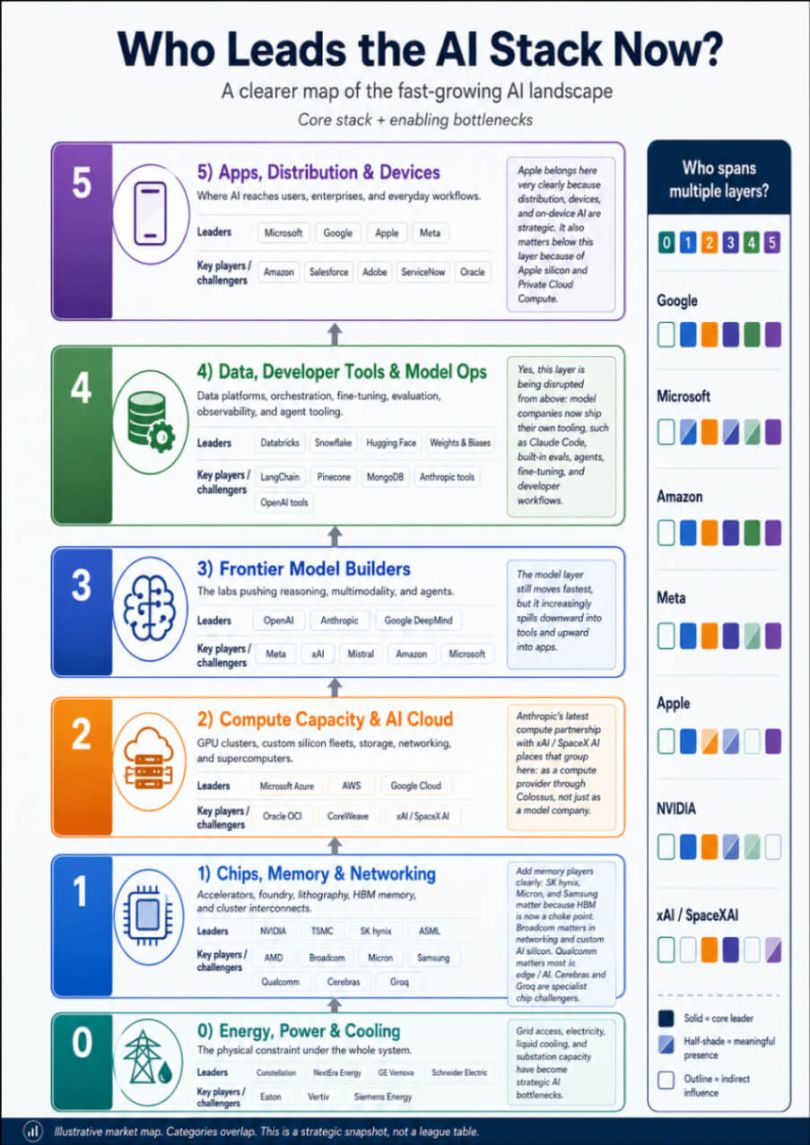
Apple is a useful example; its power comes from a different place than the model labs’. It doesn’t lead the frontier model benchmarks, and it doesn’t need to. What it owns is the layer that decides how AI reaches a billion people: the devices, the operating system, the silicon, the privacy architecture. That is a control point, and control points are critical.
Owning one changes the math. Apple can sit out the model race, letting the labs spend billions proving what works, then fold the winner into the iPhone on its own terms. The model layer gets cheaper and more capable every quarter. The path to the customer does not. Control the layer that stays scarce and you set the price for the ones that don’t.
That cuts both ways. The control point you don’t own is the one that can set your price. Apple’s leverage over the model labs is exactly the same leverage someone holds over you wherever you depend on a layer you can’t replace. Therefore, for your industry, you must recognize which layers can decide your economics.
What Tech Leaders Should Do Now
Most companies shouldn’t try to build the full AI stack. That would be wasteful and unrealistic. Instead, they should map their dependencies. Start with these questions:
- Where are we using frontier models and why?
- Which workflows depend on one model, cloud provider, data platform or agent framework?
- Where is our proprietary advantage: data, workflow knowledge, customer trust, regulatory expertise, domain logic or distribution?
- Which layers require portability, auditability or fallback options?
- Where could failure happen silently?
These questions shape vendor strategy, architecture, governance and cost controls. A healthcare company may need tighter control over data, evaluation and audit trails. A software company may care more about developer workflows and agent reliability. A financial services company may prioritize compliance, explainability and routing transparency.
The right answer depends on where value and risk live.
Picture a mid-size online retailer that has wired a frontier model into customer support for refunds, order changes, returns. Run it through the questions.
Where are we using a frontier model, and why? One place: the support agent, picked for tone and flexibility over a scripted bot.
What does that workflow depend on? A single model API, one cloud provider and a retrieval layer pointed at the returns policy and order history.
Where’s the proprietary advantage? Not the model because every competitor can rent the same one. It’s the order data, the returns history and the hard-won rules about which exceptions keep a customer and which invite fraud.
Which layer needs a fallback? The model. If that vendor changes pricing or deprecates the version overnight, support stops, so a second model kept warm is cheap insurance.
Where could failure happen silently? Right here. The agent could start approving refunds it shouldn’t. It may be polite, fast and wrong, and nobody notices until the chargeback numbers move.
The model and the cloud are rented, and both are swappable. The value and the risk sit elsewhere — in the order data, the refund rules, the backup model kept warm. Running the workflow through those five questions shows which layers to guard and which to rent.
Build, Buy and Partner With More Precision
The old build-versus-buy debate is too blunt for AI. A better guideline is this: buy commodity layers, configure control layers and build where the workflow creates durable advantage.
Buy infrastructure when someone else can run it better. Use third-party models when they meet your quality, cost and governance needs. Partner where speed matters.
But don’t outsource your learning on the parts of AI that define your business. If customer trust, domain-specific data, decision logic or workflow design is central to your advantage, you need internal muscle there.
Take a lending startup. It rents GPUs from AWS, reaches a frontier model through an API, and drops in Pinecone for retrieval — all commodity, all rentable. What it builds and guards is the logic deciding who gets approved, the record of how those borrowers actually repaid and the audit trail a regulator asks for when someone is turned down. Rented layers make the product possible. The owned ones are why the company survives an examiner or a lawsuit.
You don’t need to own every layer. You do need to know which layers could own you.
The Future Will Favor Stack Thinkers
The model race will stay loud because benchmarks are easy to compare and demos are easy to share.
But inside companies, durable advantage is moving elsewhere. It’s moving into the stack: the infrastructure, data, workflows, controls and distribution that turn raw model capability into business performance. So look for companies that understand where bottlenecks are forming and which dependencies could quietly shape their economics.
Use the best models. Watch the benchmarks. Experiment aggressively. But don’t confuse a model decision with an AI strategy.
The companies that win will understand the stack beneath the demo, the bottlenecks behind the pricing and the control points hiding inside the workflow.