Generative AI was supposed to be the ultimate catalyst for the Agile Manifesto. By automating code generation, large language models (LLMs) and tools like GitHub Copilot, Cursor and Claude promised to accelerate the technical “slowness” of development, freeing teams to focus on continuous delivery, user collaboration and product quality. Controlled studies initially heralded massive individual-level speedups, indicating that developers complete tasks up to 55 percent faster.
Yet, as these individual coding gains are introduced into team-based Agile workflows, a troubling paradox has emerged: Organizational velocity has stalled, and software delivery stability has declined. Google’s DevOps Research and Assessment (DORA) reports reveal a stark correlation: a 25 percent increase in AI adoption corresponds with a 7.2 percent decrease in delivery stability and a 1.5 percent decrease in overall delivery throughput. This correlation reveals that rushing to adopt AI coding tools without mature testing and verification pipelines actually backfires on organizations, resulting in more frequent software failures and a slower overall rate of delivering stable updates to users.
Why? The answer lies in a major point of friction where generative AI and Agile team dynamics collide: the peer code review and pull request (PR) process. What was once Agile’s primary mechanism for ensuring quality, maintaining collective code ownership and sharing tribal knowledge has become an unmanageable bottleneck. AI has dramatically accelerated the code production end of the pipeline while leaving the verification end fundamentally unchanged, burying engineering teams in what we can call comprehension debt.
What Is Comprehension Debt? How Do We Fix It?
Comprehension debt is the growing cognitive gap between what a development team understands about its codebase and what it actually needs to know to maintain, modify and debug it. It occurs when AI tool usage leads to merging complex code without engineers constructing a clear mental model of the system.
To solve it, teams should shift checks upstream, enforce strict pull request budgets, mandate comprehension checks and document all decisions.
The Mismatch: The Code Review Bottleneck
In a traditional, pre-AI Agile sprint, code production was the bottleneck. Typing and syntax execution took days, while code reviews (PRs) were lightweight coordination checkpoints where colleagues reviewed a few dozen lines of human-written code. This process served a vital dual purpose: It acted as a quality gate and an organic learning channel. Senior engineers caught edge cases and enforced architectural patterns, while the rest of the team absorbed context on why certain decisions were made. Knowledge was naturally distributed, preventing single points of failure.
AI completely inverts this dynamic. Although coding tasks now take just a few hours, every downstream activity remains unchanged. This execution compression pushes the system bottleneck directly into the review queue.
Telemetry analyzed by Faros AI across more than 10,000 developers reveals the sheer scale of this mismatch: teams with high AI adoption merge 98 percent more pull requests, but PR size has exploded by 154 percent and code review latency has spiked by 91 percent. This mismatch demonstrates that while AI allows developers to write and submit code at a much faster rate, it simultaneously creates a severe downstream bottleneck because human reviewers are overwhelmed by massive, complex code changes that take nearly twice as long to verify and approve.
Humans can’t review 1,000-line PRs generated in seconds. As PRs accumulate faster than reviewers can process them, developers experience reviewer fatigue. In response, a dangerous coping mechanism takes hold as reviews stop being meaningful assessments and become rubber stamps. Changes are merged with little to no human oversight, creating a silent collapse of software quality and team alignment.
The Core Problem: Comprehension Debt
When a team merges massive, complex codebases that no single human has fully digested, they incur what software engineering leaders call comprehension debt (CD). Coined by industry experts like Addy Osmani and Jason Gorman, comprehension debt is the growing gap between what a development team knows about its codebase and what it actually needs to understand to maintain, modify and debug it effectively.
Unlike traditional technical debt, which is structural and resides in code artifacts, comprehension debt is cognitive and resides in team psychology. Because the code is synthesized by a probabilistic AI assistant rather than designed by human reasoning, the engineers themselves never construct a mental model of the system.
This isn't just a theoretical worry. A randomized controlled trial conducted by Anthropic with 52 software engineers found that those using AI completed coding tasks at the same speed as the control group, but scored 17 percent lower on a subsequent comprehension quiz. The steepest decline was in their ability to debug the code afterward.
Comprehension debt breeds false confidence because the codebase looks clean and unit tests pass. The moment a defect arises in production or a requirement changes, however, the team becomes helpless. Lacking a mental model of the system, they ask the AI to fix it, creating a feedback loop of auto-generated patches that compound the debt until the code becomes unmaintainable.
The Tactical Realignment Framework
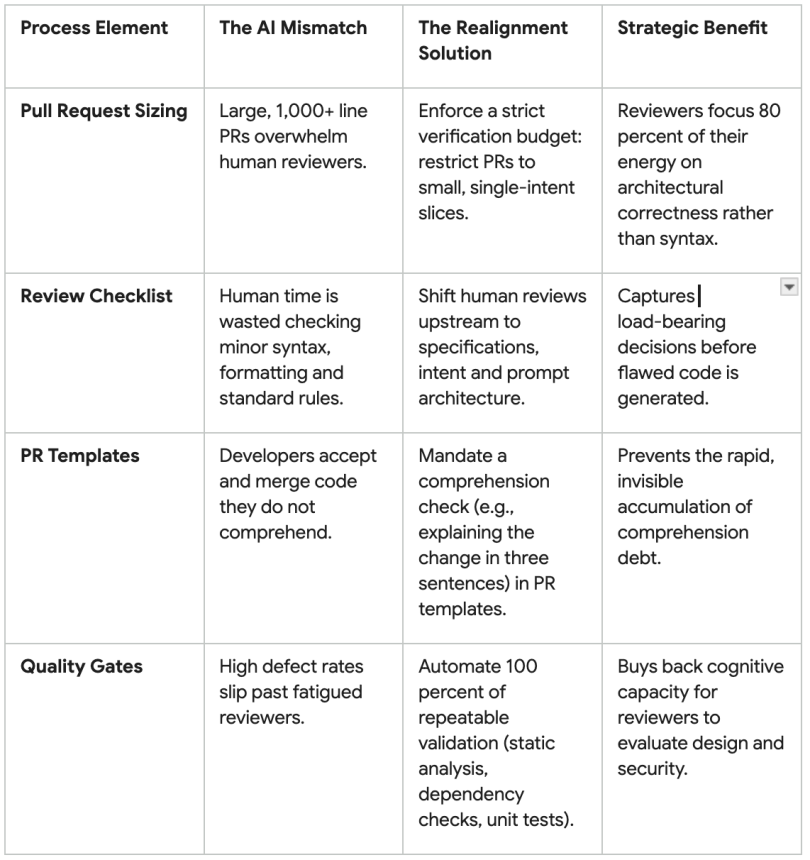
To resolve the Productivity-Reliability Paradox, organizations must redesign how they verify code. We cannot solve a tenfold increase in code production by simply demanding that developers review faster. Instead, Agile teams must pivot their verification loop from post hoc code auditing to upstream intent alignment and automated guardrails.
The following table outlines how teams can structurally realign their workflows:
3 Steps for Engineering Leaders to Fix Agile
1. Shift the Human Checkpoint Upstream
In a pre-AI world, writing code was slow, so we reviewed it afterward. In an AI world, generating code is instant, so we must review the intent before the code is generated.
Before prompting an LLM to implement a feature or refactor a service, developers should document an explicit execution plan, outlining requirements, constraints and success tests. This lightweight design contract should be reviewed by a peer. Once approved, the plan is supplied to the AI tool as context. This keeps developers firmly in control of the software architecture while letting the machine handle the keystrokes.
2. Enforce a Strict Verification Budget
Agile teams must treat code review capacity as a finite, precious resource. Developers should avoid generating massive PRs that combine boilerplate, refactoring and core logic. Reviewers should mandate stacked or sliced PRs, separating automated refactorings from new feature logic. Furthermore, if the review queue for a team exceeds one sprint’s worth of backlog, the team must pause code generation and pivot exclusively to verification.
3. Document Load-Bearing Decisions
Because PR comments are no longer the primary social space for knowledge sharing, other mechanisms must fill the gap. Teams should maintain a lightweight decisions.md file in their repository — a living document where they record exactly one sentence for every major structural choice the AI made on their behalf. This ensures that when the next sprint planning cycle begins, the team’s shared mental model remains fully intact.
Build Better Software Faster
The ultimate goal of Agile software development has always been the sustainable delivery of working, valuable software that satisfies the customer. AI has provided the engine to accelerate code production, but without a corresponding upgrade to our verification processes, we are simply driving faster toward a cliff of unmaintainable complexity.
By realigning the pull request workflow, moving reviews upstream to intent and maintaining active cognitive checking, Agile teams can break the Productivity-Reliability Paradox. The engineering organizations that win the AI era won’t be the ones that ship the most lines of code; they will be the ones whose engineers actually understand the software they deploy.