


GitLab is the intelligent orchestration platform for DevSecOps. GitLab enables organizations to increase developer productivity, improve operational efficiency, reduce security and compliance risk, and accelerate digital transformation. More than 50 million registered users and more than 50% of the Fortune 100* trust GitLab to ship better, more secure software faster.
The same principles built into our products are reflected in how our team works: we embrace AI as a core productivity multiplier, with all team members expected to incorporate AI into their daily workflows to drive efficiency, innovation, and impact. GitLab is where careers accelerate, innovation flourishes, and every voice is valued. Our high-performance culture is driven by our values and continuous knowledge exchange, enabling our team members to reach their full potential while collaborating with industry leaders to solve complex problems. Co-create the future with us as we build technology that transforms how the world develops software.
*Fortune 500® is a registered trademark of Fortune Media IP Limited, used under license. Claim based on GitLab data. Fortune 100 refers to the top 20% ranked companies in the 2025 Fortune 500 list, published in June 2025. Fortune and Fortune Media IP Limited are not affiliated with, and do not endorse products or services of GitLab.
An overview of this role
As a Staff Backend Engineer, you'll set the technical direction for our instrumentation platform, guide architecture for a foundational service, and mentor engineers across the company. You'll establish patterns that help teams build reliable, scalable instrumentation that improves billing accuracy, product insights, and long-term growth.
What you’ll do- Architect and guide the design of a unified Go-based instrumentation service, setting the technical direction to replace multiple language-specific SDKs and maintain reliable, high-performance instrumentation across the company.
- Own the strategy for handling, validating, and improving instrumentation data quality across the system, increasing billing accuracy and strengthening product planning.
- Coordinate mentorship and training initiatives with product development teams across the company, improving adoption of instrumentation best practices and raising the quality and consistency of feature instrumentation.
- Set reliability and turnaround standards for systems that enable usage billing and instrumentation, contribute to critical-incident on-call coverage, and coordinate post-incident improvements that reduce recurring issues.
- Coordinate cross-functional initiatives across research and development teams and the enterprise data organization, aligning evolving requirements and delivering solutions that serve multiple stakeholders across the company.
- Own key architectural choices that balance ease of use for product teams with reliability and correctness for data consumers, establishing patterns that scale the system as a foundational service for company-wide growth.
- Extensive production experience with Go, with a proven track record of architecting and shipping large-scale services used by multiple teams.
- Demonstrated ability to design and own backend systems that scale, with experience shaping architectural choices that influence multiple engineering teams.
- Deep expertise in infrastructure concerns including system reliability, performance optimization at scale, data quality, and observability; proven ability to set standards and mentor others in these areas.
- Proven experience designing and owning APIs (REST, gRPC, or similar) that scale to serve multiple internal teams, with the ability to evolve designs based on diverse stakeholder needs.
- Experience coordinating initiatives across functional boundaries, influencing product teams, data consumers, and other stakeholders through technical vision and mentorship.
- Deep expertise in instrumentation, analytics, data systems, or similar foundational infrastructure; demonstrated impact building systems that become critical to company operations.
Our team is part of the Data Engineering organization and runs a foundational service used by all research and development teams at GitLab. We manage the systems that send, transport, and validate instrumentation data across the company, giving us visibility into customer usage patterns across GitLab SaaS and Self-Managed deployment environments. This data informs usage billing and product planning. We're building a unified, Go-based instrumentation service that replaces multiple language-specific SDKs, making it easier for teams to instrument their features while ensuring data integrity for billing and analysis. As a distributed team working asynchronously across multiple time zones, we work closely with product and engineering teams across the company and provide guidance on instrumenting features effectively.
- Benefits to support your health, finances, and well-being
- Flexible Paid Time Off
- Team Member Resource Groups
- Equity Compensation & Employee Stock Purchase Plan
- Growth and Development Fund
- Parental Leave
Please note that we welcome interest from candidates with varying levels of experience; many successful candidates do not meet every single requirement. Additionally, studies have shown that people from underrepresented groups are less likely to apply to a job unless they meet every single qualification. If you're excited about this role, please apply and allow our recruiters to assess your application.
Country Hiring Guidelines: GitLab hires new team members in countries around the world. All of our roles are remote, however some roles may carry specific location-based eligibility requirements. Our Talent Acquisition team can help answer any questions about location after starting the recruiting process.
Privacy Policy: Please review our Recruitment Privacy Policy. Your privacy is important to us.
GitLab is proud to be an equal opportunity workplace and is an affirmative action employer. GitLab’s policies and practices relating to recruitment, employment, career development and advancement, promotion, and retirement are based solely on merit, regardless of race, color, religion, ancestry, sex (including pregnancy, lactation, sexual orientation, gender identity, or gender expression), national origin, age, citizenship, marital status, mental or physical disability, genetic information (including family medical history), discharge status from the military, protected veteran status (which includes disabled veterans, recently separated veterans, active duty wartime or campaign badge veterans, and Armed Forces service medal veterans), or any other basis protected by law. GitLab will not tolerate discrimination or harassment based on any of these characteristics. See also GitLab’s EEO Policy and EEO is the Law. If you have a disability or special need that requires accommodation, please let us know during the recruiting process.
What the Team is Saying


GitLab Compensation & Benefits Highlights
-
Leave & Time Off Breadth — Flexible PTO has no set annual cap and encourages roughly 25 days per year and at least two consecutive weeks, with clear guidance for coordination and coverage. Longer stretches are allowed within documented guardrails, supporting extended rest while maintaining team continuity.
-
Parental & Family Support — Paid parental leave is set at 16 weeks globally at full pay, with a toolkit and re‑entry support that ease transitions. Policies explain coordination with statutory programs where applicable to keep pay whole.
-
Healthcare Strength — U.S. offerings include multiple medical options (Cigna nationwide and Kaiser in select states), plus dental, vision, EAP, Modern Health, HSAs/FSAs with employer contributions, and a travel HRA. Benefits are organized for an all‑remote workforce with clear, self‑serve handbook guidance.
GitLab Insights
Similar Jobs

What We Do
GitLab is the Intelligent Orchestration Platform where software teams and their AI agents stay in flow to amplify their capacity for innovation. Together, they automate repetitive tasks to plan, build, secure, test, deploy and maintain software. With GitLab, software teams spend less time on coordination overhead and more time on the next big idea. What started in 2011 as an open source project to help one team of programmers collaborate is now the intelligent orchestration platform millions of people use to deliver software faster, more efficiently, while strengthening security and compliance. Since the beginning, we've been firm believers in remote work, open source, DevSecOps, and iteration. We get up and log on in the morning to work alongside the GitLab community to deliver new innovations every month that help teams and their AI agents ship great code faster.
Why Work With Us
GitLab is where careers accelerate, innovation flourishes, and every voice is valued. Co-create the future with us as we build technology that transforms how the world develops software.
Gallery

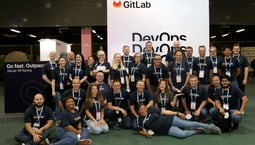







.jpeg)
GitLab Teams

GitLab Offices
Remote Workspace
Employees work remotely.
All-remote means that each individual in the organization is empowered to work and live where they are most fulfilled; it makes it clear that every team member is equal. No one, not even the executive team, meets in-person on a daily basis.
