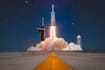
Our modern way of life relies on space more than we think. GPS satellites alone are used to timestamp financial transactions, track products moving through the supply chain, synchronize telecommunications systems and much more. There are also weather satellites, research satellites and military intelligence satellites. If these systems were disabled, the United States would be left in the dark, facing serious economic and national security risks.
What Is the U.S. Space Force?
The Space Force, established in December 2019, is the sixth branch of the U.S. military. The service branch operates and defends the satellites and systems that underpin modern military operations, such as GPS, communications, missile warning and space surveillance.
The U.S. Space Force was established in December 2019 to prevent that from happening. The Air Force Space Command had previously been monitoring space activities, detecting missiles and overseeing satellites that power GPS and military communications, but officials say other countries’ space activities warranted a new agency specifically dedicated to preserving the United States’ interests in space — and transitioning into a “warfighting service.”
In this article, we’ll explain what the Space Force does, how it’s different from NASA and other government agencies, and all the ways it is being used to respond to an increasingly contentious space environment.
What Is the U.S. Space Force?
The U.S. Space Force is a branch of the military responsible for protecting the United States’ interests in space, which includes overseeing satellites, tracking items in orbit, defending American space assets from potential attacks and warning about missiles aimed at the country, its troops or its allies.
The Space Force was established under President Donald Trump in December 2019, creating a sixth branch of the U.S. military. It is organized under the Department of the Air Force, operating with an equal level of authority as the Air Force — similar to how the Marine Corps is organized under the Department of the Navy.
The Space Force is the smallest branch of the armed forces with roughly 14,000 military and civilian service members, both of which are referred to as “Guardians.”
What Is the Mission of the U.S. Space Force?
The stated mission of the U.S. Space Force is to “secure our nation’s interests in, from and to space.” Although it’s a short phrase, those three prepositions carry a lot of meaning:
- In space: The Space Force protects the United States’ space infrastructure from threats and prevents other nations’ space assets, like China’s alleged “kill web,” from hurting America.
- From space: The Space Force supports the satellite technologies that are critical to the American economy and military. For example, its reconnaissance satellites provide battlespace awareness to the military, its satellite communications allow troops to exchange information and its space-based infrared systems detect missile launches.
- To space: The Space Force facilitates civil, commercial and military access to space through its launch, range and control network infrastructure.
Why Was the Space Force Created?
The Space Force was created out of recognition that the United States’ economy and military have become increasingly reliant on satellite technology, and that the country’s space assets must be protected against attack. The U.S. is most concerned about China and Russia, both of which have military space agencies that have enhanced their capabilities for surveillance, weapons and other techniques — like GPS jamming and satellite shadowing — that interfere with American satellite operations.
These acts of aggression started in 2007, when China used an anti-satellite weapon to destroy one of its defunct weather satellites. This created more than 3,000 pieces of space debris that are now whizzing through space seven times faster than a bullet, endangering other space infrastructure. Then in 2021, Russia shot a missile into an old Soviet spy satellite, creating more than 1,500 pieces of trackable debris. In both instances, China and Russia signaled that they are capable of destroying other satellites in lower-Earth orbit, which is home to much of the United States’ most valued orbital infrastructure.
China in particular has rapidly expanded its space presence in recent years. And U.S. officials say its network of more than 500 surveillance satellites are connected to weapons systems, creating a “kill web” or “kill mesh” that can quickly and precisely target American troops from long distances. Russia, meanwhile, is reportedly planning to put a nuclear weapon in space that could disable nearby satellites, which would violate the Outer Space Treaty adopted by the United Nations in 1967.
In creating the Space Force, U.S. officials saw an opportunity to create a unified, focused branch of the military that integrated existing space-related duties previously overseen by the Air Force while also adding new capabilities to address these emerging threats.
What Does the Space Force Do?
The Space Force covers a wide range of missions, but these are the most prominent themes.
GPS and Military Communications
The Space Force operates jam-resistant GPS satellites that ensure military navigation systems can guide aircraft, vehicles and missiles. It also supports jam-resistant satellite communication channels that allow other branches of the military to share information.
Space Domain Awareness
The Space Force is responsible for tracking the roughly 46,000 objects in orbit through its network of radar, telescopes and satellites known as the Space Surveillance Network. They track the movement of space debris and satellites to avoid potential collisions, but also to determine what other countries are launching into orbit and why they are positioning them where they are.
Missile Warning and Tracking
The Space Force can detect missile launches through its space-based infrared satellites. They can then warn military leaders about incoming attacks and provide tracking data for missile intercept systems.
Facilitating Space Launches
The Space Force is responsible for supporting commercial launches carrying military payloads, including those conducted by companies like SpaceX and Blue Origin.
Counterspace Operations
As a “warfighting” service, the Space Force is prepared to use offensive and defensive actions to defend its “space superiority.” This could include orbital warfare, which could mean anything from a satellite maneuver to an attack on an enemy’s satellite. The Space Force also uses electromagnetic attacks — like jamming satellite transmissions — or cyber warfare, which targets the networks and software that control adversarial space systems.
How Is the Space Force Organized?
Although the Space Force is overseen by the Office of the Secretary of the Air Force, it is considered a distinct military branch. Its head office, the Office of the Chief of Space Operations, is headquartered at the Pentagon in Washington, D.C. Beneath the headquarters office, the Space Force is organized into three field commands:
- Combat Forces Command (CFC): Headquartered at Peterson Space Force Base in Colorado, the CFC was previously known as Space Operations Command, but was redesignated in November 2025 to reflect the Space Force’s “evolution as a warfighting service.” By far the largest of the three commands, it’s responsible for intelligence, cyber, space and combat operations.
- Space Systems Command (SSC): Headquartered at Los Angeles Air Force Base, SSC is responsible for the acquisition, development and sustainment of space systems and technologies. It also manages space launches for civil, commercial and military missions at Vandenberg Space Force Base in California and Patrick Space Force Base in Florida.
- Space Training and Readiness (STAR) Command: STAR Command, headquartered at Patrick Space Force Base in Florida, oversees training and education programs. It also develops warfighting doctrine, techniques and procedures, as well as testing and evaluation of the Space Force’s capabilities.
Each of these three commands is divided into “deltas” that oversee mission areas, such as missile warning, satellite communications or launch operations. These deltas are further divided into squadrons that are tasked with specific missions activities.
Two smaller organizations report directly to the Chief of Space Operations, and both are responsible for acquisitions. The first, the Space Development Agency, is responsible for quickly delivering disruptive space technologies. The second, the Space Rapid Capabilities Office, focuses on speedy acquisitions for more secretive missions.
How Is the Space Force Different From NASA?
NASA is a civilian government agency dedicated to space research, exploration and education. The Space Force, on the other hand, is a military service focused on America’s national security interests, such as supporting other branches’ military operations and defending the country’s space infrastructure and operations from foreign interference.
How Is the Space Force Different From Other Military Branches?
Aside from the fact that Space Force is primarily concerned with space, whereas other branches are focused on more terrestrial activities, Space Force stands apart from its military peers in several ways.
Smaller, More Technical Workforce
The Space Force is a smaller, specialized service with a higher proportion of roles that require expertise in aerospace engineering, computer science and other technical fields. A college degree is not required to enlist, but high school graduates are more likely to be accepted if they took STEM classes. Officers are typically required to have a bachelor’s degree, preferably in a field related to science, technology, engineering or mathematics.
Supports Joint Infrastructure
While other branches of the military certainly work together, the Space Force plays a more critical role in supporting other military branches through GPS, satellite communications and battlefield intelligence, providing the infrastructure those services need to operate effectively.
More Classified Projects
The Space Force is known for being secretive, which makes sense considering its work in reconnaissance satellites, intelligence gathering and the development of advanced technologies. A security analyst told The New York Times in 2023 that the Space Force has a larger portion of its budget dedicated to classified spending than any other military branch.
Notable U.S. Space Force Developments
The Space Force has rapidly evolved into a critical U.S. military branch, as seen by its historic organizational impacts and contributions to America’s space program.
U.S. Air Force Announces Space Force Has Launched Weapons Into Space (September 2026)
During a keynote address at AFA’s 2026 Air, Space & Cyber Conference, U.S. Air Force Secretary Troy Meink acknowledged for the first time that the U.S. Space Force has operational weapons stationed in space. He stated that the U.S. military possesses “on-orbit space control weapons” designed to defend the Joint Force against hostile actions from adversaries. This capability forms part of a broader strategy by the U.S. Department of the Air Force to innovate rapidly and build cost-effective, scalable combat power to counter evolving technology threats.
SpaceX Awarded $6.45 Billion in U.S. Space Force Contracts (May 2026)
The Space Force awarded SpaceX a $2.29 billion contract on May 26, 2026 and a $4.16 billion contract on May 29, 2026, totaling $6.45 billion in funding ahead of a prospective SpaceX IPO. The first contract was awarded for SpaceX to develop a communications network in space as part of the Space Data Network (SDN) Backbone program, while the second contract was awarded for SpaceX to build satellites for the Space-Based Airborne Moving Target Indicator (SB-AMTI) program.
U.S. Space Force Takes Over All U.S. Army and Navy Satellite Communications Control (June 2022 and August 2022)
The U.S. Army and Navy transferred all satellite communications (SATCOM) billets, funding and mission responsibility to the Space Force in 2022. The Naval Satellite Operations Center was transferred to the Space Force in June 2022, and Army SATCOM missions were transferred to the Space Force in August 2022. These transfers put all U.S. Department of Defense SATCOM functions under one military branch for the first time.
U.S. Space Force Launches Its First Rocket Mission (March 2020)
On March 26, 2020, the United Launch Alliance (ULA) launched an Atlas V rocket carrying an Advanced Extremely High Frequency (AEHF) communications satellite, marking the Space Force’s first mission. The satellite was the sixth and final AEHF spacecraft launched for the organization’s Space and Missile Systems Center, providing global communications capabilities for military strategy and tactical warfighters operating on ground, sea and air platforms.
U.S. Space Force Established (December 2019)
The U.S. Space Force was established on December 20, 2019 following the signing of the National Defense Authorization Act for Fiscal Year 2020 by President Donald Trump. The Act officially redesignated the United States’ Air Force Space Command as the United States Space Force (USSF), with intention to help the country “deter aggression and control the ultimate high ground.” The Space Force’s establishment in 2019 marked the first time a new branch of the U.S. armed services was created in 73 years.
Frequently Asked Questions
Is the Space Force Part of the U.S. Air Force?
No, the Space Force is an independent military branch organized under the Department of the Air Force — similar to the relationship the Marine Corps has with the Department of the Navy. It has its own leadership, ranks and budget, but shares a civilian secretary with the Air Force.
How many people serve in the Space Force?
Roughly 14,000 people serve in the Space Force, including 9,400 active-duty members and roughly 4,600 civilian employees.
Why does the United States have a Space Force?
Mainly because space became too contested to manage as a secondary Air Force mission. China and Russia have developed anti-satellite weapons, jamming systems, and other capabilities that directly threaten U.S. assets in orbit. A dedicated branch was created to focus exclusively on defending those assets and, if necessary, fighting back.