

A sales leader asks, “What were our top-selling products in the Midwest last quarter?” An AI system translates the question into SQL, queries governed data and returns a chart. The experience feels intelligent, but it is not necessarily agentic. It may simply be a well-designed prompt connected to trusted data and tools.
Now change the request: “Investigate why Midwest revenue declined, test possible explanations across sales, inventory and promotions and recommend the next action.” The system must decide where to begin, run several queries, use intermediate findings to revise its plan and determine when the investigation is complete. That is where an agent may earn its complexity.
The distinction matters because “agent” is rapidly becoming the default label for almost any AI system that uses tools.
McKinsey’s 2025 global survey found that 23 percent of respondents were scaling an agentic AI system somewhere in their organizations. That headline is impressive, but it also raises a design question: When does a task really need agentic behavior, and when is a simpler approach the better engineering choice?
The core principle here is that the best AI architecture is not the most autonomous one. It is the least complex system that completes the task reliably, repeatedly and safely.
Prompt, Skill or Agent: What’s the Difference?
- Prompt: A single instruction that tells a model what to do for one request.
- Skill: A prompt packaged for reuse of the rules, examples and context bundled so a recurring task is handled the same way every time.
- Agent: A system that plans its steps, choosing what to do next based on what it learns, until it decides the goal is met.
AI Complexity Is a Ladder, Not a Destination
We can break AI complexity down into three abstractions that reflect three levels of uncertainty. Note that these are not three stages of maturity:
Prompt
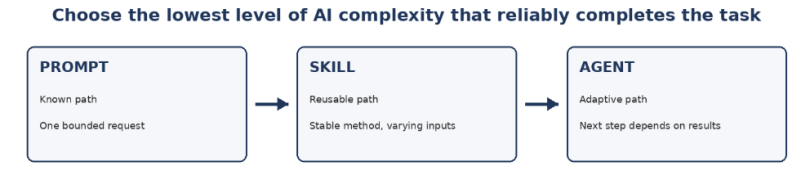
A prompt is a single instruction that tells a model what to do for one request.
Skill
A skill is a prompt packaged for reuse of the rules, examples and context bundled so a recurring task is handled the same way every time.
Agent
An agent is a system that plans its steps, choosing what to do next based on what it learns, until it decides the goal is met.
A prompt is not an unfinished agent. A skill is not a less ambitious system. Each one is appropriate for a different kind of work.

A useful shorthand: Use a prompt when the path is known and the request changes. Use a skill when the path is known and the request repeats. Use an agent when the path itself must be discovered. Here is a visualization that summarizes that progression.

1. Use a Prompt When the Work Is Bounded
A prompt is enough when the user can define the input, transformation and expected output before execution. For example: “Calculate net revenue by region for Q2, exclude returns and sort the result from highest to lowest.” The model may generate SQL, call a query engine and format the result. Tool use alone does not make the system an agent. The workflow remains bounded because the model does not need to invent a strategy or decide what to investigate next.
As a test, ask if you can state the data source, business rule and expected output before the request runs. If yes, begin with a prompt and evaluate its real failure cases.
When to Choose a Prompt
- One query or a small number of predictable operations can answer the question.
- The data source and business definitions are known.
- The output is informational or reviewed by a person.
- The task does not need to decide its own next step.
2. Build a Skill When Prompts Start Repeating
A successful prompt often turns into an unofficial process. One analyst saves it, another copies it, a third changes the wording and soon the same task produces different results. At that point, the challenge is not model intelligence. It is repeatability.
A reusable skill packages the approved way to perform a task. The implementation varies by platform, but the concept is consistent: combine instructions, business rules, examples, tools, input requirements and output checks into a reusable capability. The model can still interpret natural language, but it should not reinvent the procedure each time.
When to Choose a Skill
- The inputs vary but the method stays stable.
- The task occurs frequently across users or teams.
- Consistency, versioning and testing matter.
- Subject-matter experts can describe the correct procedure.
- A prompt is becoming long because it repeatedly restates the same context.
A warning sign appears when the skill fills with exceptions: “Use workflow A unless source B is missing, except for product launches, unless the request includes a forecast.” When the system must decide which procedure applies and adapt after seeing results, the task may be moving beyond a fixed skill.
3. Use an Agent When the Path Is Unclear
An agent is justified when the user provides an outcome but cannot completely specify the steps. The defining feature is not merely that the model calls tools. A deterministic workflow can call tools. The agentic feature is that the model uses intermediate results to decide what to do next, whether to revise its plan and when to stop. This follows the practical principle in OpenAI’s agent-building guidance: Use agents where flexible decision-making is required, not merely because tools are available.
When to Choose an Agent
- The request is a goal rather than a procedure.
- Several valid investigation paths exist.
- The system must formulate and test hypotheses.
- Tool selection depends on intermediate findings.
- The workflow must recover from missing information or failed actions.
- Success and stopping conditions can still be evaluated.
Why Agents Everywhere Create Architecture Debt
Agents expand what an AI system can do, but they also expand what can go wrong. Every additional reasoning step introduces another opportunity for an incorrect assumption, invalid query, failed tool call, permission issue or unnecessary loop. More autonomy also requires more tracing, evaluation, access controls, cost limits and human-approval design.
A simplified reliability example shows the compounding effect. If an eight-step workflow has a 95 percent probability of success at each independent step, the probability that every step succeeds is approximately 0.95⁸, or 66 percent. Production agents can retry, validate and self-correct, so this is not a deployment formula. It is a reminder that small per-step weaknesses become meaningful in long workflows.

The same principle applies to cost and latency. A prompt may require one model response. A skill may add retrieval, validation and a few tool calls. An agent may generate a plan, execute multiple calls, inspect results, revise the plan and repeat. That overhead can be worthwhile for ambiguous investigations, but wasteful for a weekly report whose steps are already known.
Also, don’t confuse intelligence with autonomy. A system can be technically sophisticated without being agentic. Strong retrieval, governed semantic definitions, deterministic tools and rigorous evaluation may create more business value than an autonomous loop.

Build Upward Only When the Evidence Requires It
A practical development path begins with the smallest useful system. First, validate the task with a prompt. Measure answer quality, latency, cost and failure patterns. Next, standardize what works by moving repeated context and business logic into skills, templates or deterministic functions. Add bounded tool use where necessary, but keep the sequence explicit.
Only introduce agentic planning when realistic tests show that fixed workflows repeatedly fail because the path cannot be known in advance. Then expand autonomy gradually: answer, recommend, draft, execute with approval and only later execute autonomously. Not every workflow should reach the final stage.