
For a while, prompt engineering felt like a game of finding the perfect phrase: add a role, include a few-shot example, ask for JSON and hope the answer improves. That still matters. But in production environments, the prompt is only one layer in a much larger system. This shift applies broadly to teams building AI into products, internal tools, customer support workflows, analytics systems, and enterprise automation. It is especially visible in software and data teams, but the lesson is not limited to software engineering: useful AI depends on the system around the model.
The teams that build the strongest AI products aren’t just asking, “How do I prompt the model better?” Instead, they’re asking several interrelated questions: “What context does the model need? How do we evaluate it? What guardrails apply? and Where should humans stay involved?” That is the real shift from prompt engineering to AI system design.
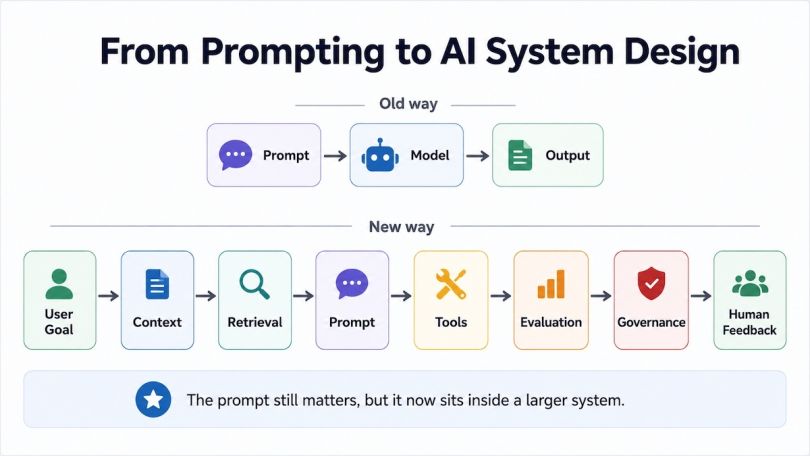
Prompt Engineering vs. AI System Design
While prompt engineering focuses on the specific wording given to an AI model to improve its answer, AI system design focuses on the entire environment surrounding the model. System design connects the AI to current data, evaluates its accuracy through structured testing, applies safety guardrails and integrates human-in-the-loop workflows to ensure the tool is safe, useful and measurable in production.
Why Clever Prompts Are No Longer Enough
A well-written prompt can guide a model, but it cannot automatically know your company’s latest policy, verify whether a source is outdated or decide when a high-risk output needs human review. Those are system design problems, not wording problems. That’s why modern AI work increasingly spans retrieval, testing, controls and workflow fit.
Consider a customer support team using AI to draft refund responses. In the older prompt engineering approach, the team might write: “Act as a customer support expert and write a polite refund response.” If the answer sounds too generic, they may add more instructions, such as “be empathetic” or “use a professional tone.” That can improve the wording, but it does not solve the real production problem.
In an AI system design approach, the team would first connect the assistant to the latest refund policy, customer account details, order history and escalation rules. The system would retrieve the relevant policy section, generate a draft response, check whether the recommendation follows company rules and route higher-risk cases to a human before sending. The prompt still matters, but it is only one part of a larger workflow designed for accuracy, safety and business fit.
Prompt Thinking vs. System Thinking
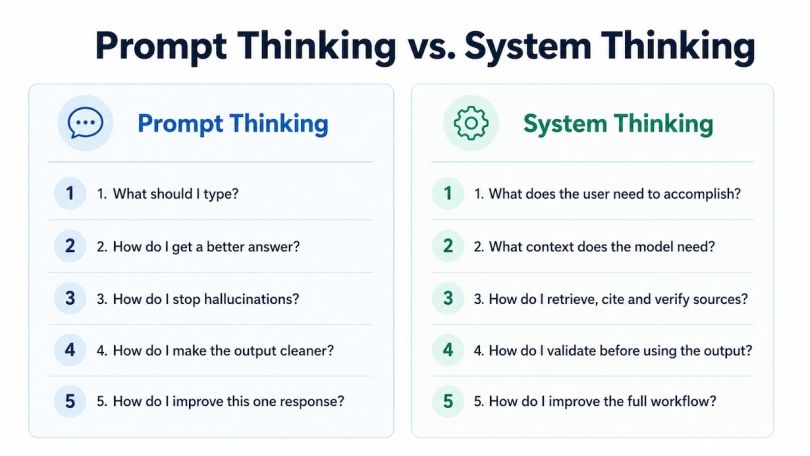
Prompt thinking focuses on the sentence you give the model. System thinking focuses on the environment that makes the model useful, trustworthy and measurable.
The shift from prompt thinking to system thinking is best understood through the questions teams ask. Prompt thinking asks, “What should I type so the model gives a better answer?” System thinking asks, “What does the user need to accomplish, and what information, checks and workflow steps are required for the AI to help safely?”
For example, if an analyst asks AI to summarize a sales trend, prompt thinking focuses on wording the request clearly. System thinking asks whether the model has access to the latest sales data, whether the data is complete, whether the answer should include assumptions, and whether the output belongs in a dashboard, report or decision meeting.
What Does An AI System Actually Need?
1. Context
Many AI failures are context failures. A model can only reason based on the information it receives. If it lacks current policies, product documentation, customer history or business rules, no amount of prompt polishing will fully solve the issue.
2. Retrieval
Retrieval-augmented generation helps by separating “finding information” from “generating the answer.” The system first searches approved sources, such as policy documents, knowledge bases, product documentation or customer records. It then ranks the most relevant passages and passes only that context to the model. If the system cannot find a reliable source, it should tell the model to say so instead of guessing. This makes the answer more grounded and gives teams more control over which sources the AI is allowed to use.
3. Evaluation
If teams only test prompts by asking whether the answer “looks good,” they may miss real production failures. In early AI experiments, “looks good” often means someone reads a few responses and decides they sound fluent or helpful. But AI systems can behave differently when the request is vague, context is missing, documents conflict or a user tries to override the rules.
A stronger approach is to create repeatable test cases for normal requests, ambiguous requests, missing-context scenarios and adversarial prompts, then score each output for accuracy, policy compliance, citation quality, safety and escalation behavior. This is where OpenAI’s evals guidance and evaluation best practices are useful for moving from subjective review to structured testing.
4. Governance
Good systems define what the model may do, what it must not do and when it needs escalation. That includes access controls, citation expectations, safety rules and approval thresholds. Security guidance such as the OWASP Top 10 for Large Language Model Applications treats prompt injection and related LLM risks as application design issues, not just prompting issues.
5. Workflow Fit
An AI assistant that writes a perfect three-page response may still fail if the user only needs a short summary inside a ticketing system. Great AI is not just about answer quality. It is about fitting the output to the way people actually work.
In this simplified Python code snippet below, generate_answer is where the prompt does its work. But the final quality also depends on retrieve_relevant_sources, which determines what information the model sees, and evaluate_answer, which checks whether the response is accurate, safe and useful. If either of those steps is weak, even a well-written prompt can produce a weak result.
def ai_assistant(user_question):
    context = retrieve_relevant_sources(user_question)
    answer = generate_answer(user_question, context)
    score = evaluate_answer(answer)
    return answer, score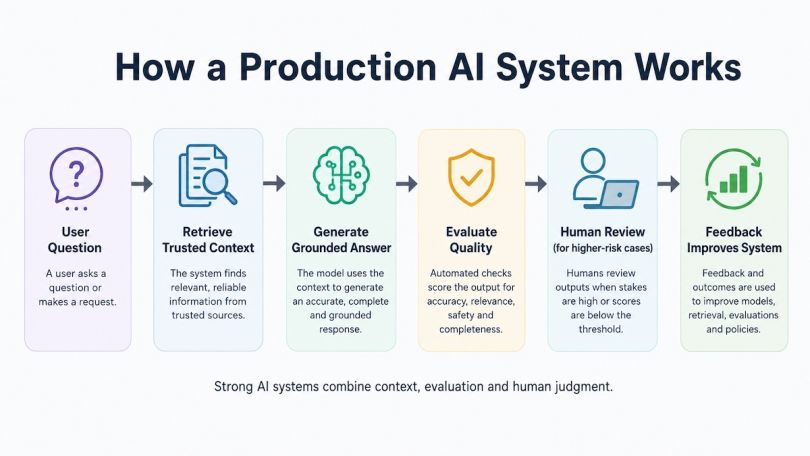
A Practical Framework for AI System Design
A practical AI system design process can start with five layers.
Define the Task
What exactly should the AI do? For example, instead of asking AI to “help with tickets,” define the task as “summarize the ticket, classify the issue and suggest the next approved action.”
Define the Context
What information does the AI need? For a support assistant, that may include policies, customer history, product documentation and prior actions.
Define the Controls
What should the AI avoid or escalate? For example, it should avoid unsupported claims, sensitive data exposure and policy exceptions.
Define Evaluation
How will we measure quality? Useful measures may include accuracy, citation quality, user satisfaction, escalation rate and hallucination rate.
Define the Workflow
Where does the output go, and who approves it? The answer may be a draft email, an internal note, a dashboard update or a human review queue.
Managing Risk With Human Involvement
Human involvement should rise as the impact of a decision increases. Low-risk work like note summaries can be largely automated. Medium-risk work like drafting customer responses usually needs human approval or editing. High-risk domains such as legal, medical, financial or HR decisions should use AI as an assistant, not a final decision-maker. This aligns with risk-based guidance such as the NIST AI Risk Management Framework, which emphasizes managing AI risks across design, deployment and monitoring.
What Is the Future of Prompt Engineering?
Prompt engineering is not going away. It’s growing up. The next generation of prompt engineers will still care about clarity and structure, but they will also need product thinking, retrieval design, evaluation discipline and governance awareness. The best prompt will not be the cleverest sentence. It will be the one inside a system that knows what the user needs, retrieves the right context and improves over time.