
If you’re deploying AI agents in production, there is a question you need to answer right now: What sits between your agent’s inference and your database?
For most organizations, the honest answer is: guardrails. Confidence scores. Maybe an output filter. In other words, a probabilistic check on a probabilistic system. That is not a security architecture. That is hope with a dashboard.
The previous articles in this series established why guardrails fail and how AI agent breaches actually unfold. This article is the builder’s guide. It lays out the three deterministic gates that sit between an AI agent’s proposed action and your production systems, with enough implementation detail for an engineering leader to start building this week.
What Is the 3-Gate AI Security Architecture?
To prevent unauthorized actions by production AI agents, a deterministic control layer enforces three security gates between agent inference and production systems:
- Admissibility: Enforces an explicit allowlist to evaluate and block unauthorized or destructive operations (e.g.,
DROP,DELETE) before execution. - State Integrity: Uses SHA-256 environment hashing to measure state changes before and after execution, automatically rolling back actions that exceed safety thresholds.
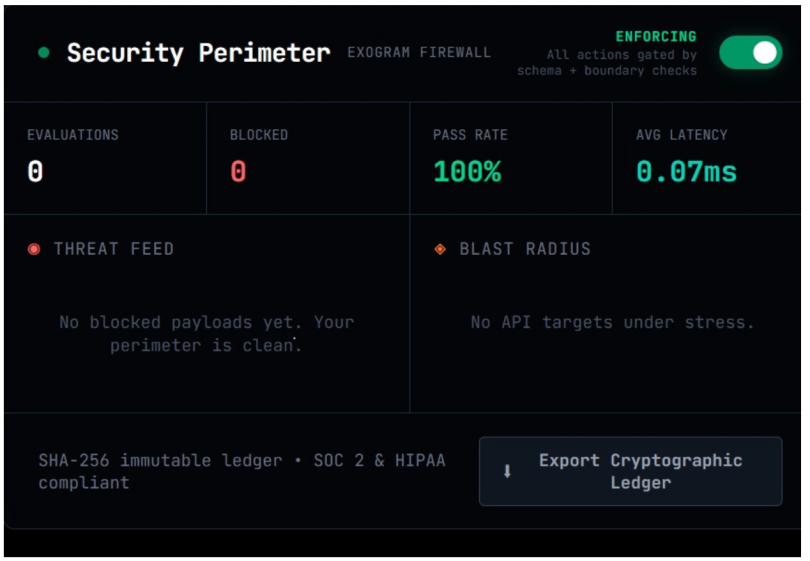
- Cryptographic Audit: Writes an immutable, append-only receipt of every pipeline action and decision to a cryptographically signed ledger for forensic verification.
Agentic Architecture in One Sentence
Inference is probabilistic. Execution must be deterministic.
The agent proposes an action. A separate control layer, running pure deterministic logic, no model inference, evaluates whether that action is permitted. If it passes all three gates, it executes. If it fails any gate, it is blocked. There is no gray zone. There is no confidence threshold. There is no LLM evaluating another LLM.
Gate 1: Admissibility
This gate solves unauthorized actions that look statistically plausible.
Every action an AI agent proposes is evaluated against an explicit allowlist before execution. This is not a probability check. It is a binary pass or fail enforced by strict logic.
You define the set of permitted operations per resource type. Database actions might permit SELECT and INSERT but block DROP, DELETE, TRUNCATE and ALTER. API actions might permit GET and POST but block PUT and DELETE on certain endpoints.
ALLOWED_OPERATIONS = {
    "database": {"SELECT", "INSERT"},
    "filesystem": {"READ"},
    "api": {"GET", "POST"}
}


BLOCKED_PATTERNS = [
    "DROP", "DELETE", "TRUNCATE", "ALTER",
    "GRANT", "REVOKE", "EXEC", "xp_"
]


def evaluate_admissibility(action):
    resource = action["resource_type"]
    operation = action["operation"].upper()
    payload = action.get("payload", "").upper()


    if operation not in ALLOWED_OPERATIONS.get(resource, set()):
        return {"status": "DENY", "reason": "Not in allowlist"}


    for pattern in BLOCKED_PATTERNS:
        if pattern in payload:
            return {"status": "DENY", "reason": f"Blocked: {pattern}"}


    return {"status": "PERMIT"}
In plain terms, the code above does one thing: It checks every action the agent wants to take against a strict list of what is allowed. If the action is not on the list, it is denied instantly. If the action contains any known destructive pattern like DROP or DELETE, it’s denied instantly. No model inference exists anywhere in this gate. The allowlist is explicit. The evaluation is deterministic. The same input always produces the same output. A prompt injection that tricks the agent into proposing a DROP TABLE command is caught here regardless of how confident the agent is or how well-formed the instruction appears.
Implementation Guidance
Start with the most restrictive allowlist possible. Permit only the operations your agents actually need. Every addition to the allowlist should require a code review, not a configuration change. Treat your allowlist like you treat your production access controls: locked by default, opened by exception.
Gate 2: State Integrity
This step solves individually permitted actions that produce destructive outcomes in combination.
Admissibility catches unauthorized actions. It does not catch authorized actions that, in sequence, produce an unauthorized outcome. An agent that runs a thousand SELECT queries is executing permitted operations. A thousand SELECT queries that exfiltrate an entire customer table is a data breach.
The state integrity gate hashes the environment before and after every agent action using SHA-256. Put differently, the system takes a mathematical fingerprint of the database before the agent acts and compares it to the fingerprint after the agent acts. If the two fingerprints do not match within an acceptable range, the action is automatically undone.
For example, if an agent runs a query and 10,000 rows disappear from a table, the state hash catches the discrepancy and rolls the action back before the damage persists. If the post-action state deviates beyond a defined threshold, the action is automatically rolled back.
import hashlib, json


def capture_state(db_connection):
    return {
        "row_counts": get_table_row_counts(db_connection),
        "schema_hash": hash_schema(db_connection),
        "permission_set": get_active_permissions(db_connection)
    }


def compute_state_hash(state):
    return hashlib.sha256(
        json.dumps(state, sort_keys=True).encode()
    ).hexdigest()


def execute_with_integrity(action, db_connection):
    pre_state = capture_state(db_connection)
    pre_hash = compute_state_hash(pre_state)


    result = execute_action(action)


    post_state = capture_state(db_connection)
    post_hash = compute_state_hash(post_state)


    delta = compute_state_delta(pre_state, post_state)
    if delta["severity"] > THRESHOLDS[action["operation"]]:
        rollback(action)
        return {"status": "ROLLED_BACK", "delta": delta}


    return {"status": "COMMITTED", "hash": post_hash}
Implementation Guidance
Define thresholds per operation type. A SELECT that returns 10 rows has a different acceptable state delta than a SELECT that returns 10,000 rows. Start conservative. Loosen as you gather data on normal operating patterns.
Gate 3: Cryptographic Audit
This solves the forensic gap that makes AI agent breaches impossible to investigate.
When an AI agent breach is discovered, security teams need to reconstruct exactly what happened. Most agent platforms do not produce this record. The audit gate creates an independent, cryptographically signed record of every event in the gate pipeline.
from datetime import datetime, timezone


async def log_to_ledger(event):
    event["timestamp"] = datetime.now(timezone.utc).isoformat()
    event["signature"] = hashlib.sha256(
        json.dumps(event, sort_keys=True).encode()
    ).hexdigest()
    await ledger.insert(event)


async def gate_pipeline(action, db_connection):
    admission = evaluate_admissibility(action)
    await log_to_ledger({"gate": "admissibility", **admission})
    if admission["status"] == "DENY":
        return admission


    execution = execute_with_integrity(action, db_connection)
    await log_to_ledger({"gate": "integrity", **execution})
    if execution["status"] == "ROLLED_BACK":
        return execution


    await log_to_ledger({"gate": "committed", **execution})
    return execution
Implementation Guidance
The audit ledger is append-only. No updates. No deletions. In practice, this means the system writes a tamper-proof receipt for every single action the agent proposes and every decision the gates make. If a breach occurs six months later, the security team can pull the ledger and see exactly what the agent proposed, exactly what the gate decided and exactly what executed, without relying on the agent’s own memory, which may have been poisoned. The agent has zero write access to the ledger other than through the gate pipeline.
If an attacker compromises the agent, the ledger remains intact. This is the difference between a log and an audit trail. Logs record what happened. Audit trails prove what happened.
Start Building This Week
You don’t need to replace your entire agent infrastructure. The three gates sit between your orchestration framework and your production systems as an interception layer. Your agents continue to operate normally. The gate pipeline evaluates every proposed action before execution is authorized.
Gate one, the admissibility allowlist, can be deployed in days and immediately blocks the most common attack vector. Gate two, state integrity hashing, requires more instrumentation but catches the aggregate failures that no guardrail can detect. Gate three, the cryptographic audit ledger, ensures that when something does go wrong, you have a forensic record the attacker cannot tamper with.
The agents are already deployed. The gates are not optional. Build the brake.