


GitLab is the intelligent orchestration platform for DevSecOps. GitLab enables organizations to increase developer productivity, improve operational efficiency, reduce security and compliance risk, and accelerate digital transformation. More than 50 million registered users and more than 50% of the Fortune 100* trust GitLab to ship better, more secure software faster.
The same principles built into our products are reflected in how our team works: we embrace AI as a core productivity multiplier, with all team members expected to incorporate AI into their daily workflows to drive efficiency, innovation, and impact. GitLab is where careers accelerate, innovation flourishes, and every voice is valued. Our high-performance culture is driven by our values and continuous knowledge exchange, enabling our team members to reach their full potential while collaborating with industry leaders to solve complex problems. Co-create the future with us as we build technology that transforms how the world develops software.
*Fortune 500® is a registered trademark of Fortune Media IP Limited, used under license. Claim based on GitLab data. Fortune 100 refers to the top 20% ranked companies in the 2025 Fortune 500 list, published in June 2025. Fortune and Fortune Media IP Limited are not affiliated with, and do not endorse products or services of GitLab.
As a Staff Backend Engineer, you will provide technical leadership across your team and adjacent teams, solving the highest-scope and most complex problems in your area. You will lead large, cross-cutting backend initiatives, drive our modular architecture strategy, and define the standards that let teams move faster without compromising quality, security, reliability, or operability.
This is a technical leadership role that combines deep backend expertise, systems judgment, product judgment, and influence across organizational boundaries. You will work with Product, Frontend, Infrastructure, Security, Data, Engineering Managers, and engineers across product groups, bringing subject matter expertise, and you will do it without relying on formal authority.
Why you’ll love this role- Leverage: Your work multiplies across teams. The platforms, standards, and architectural decisions you lead determine how quickly everyone else can ship.
- Genuinely Hard Problems: You’ll lead the modernization of a large monolith toward modular, reusable, appropriately independent systems — at the scale of a platform used by millions of users.
- Influence Without Bureaucracy: You’ll shape technical direction across teams through clear written proposals and decision records, and partner with Product and Engineering leadership on platform roadmap and investment trade-offs.
- Frontier AI Work: You’ll lead adoption of AI-assisted and agentic engineering workflows and define the review, quality, security, and privacy guardrails that make them safe to rely on.
- Autonomy: You’ll thrive in our remote-first, asynchronous organization, where clear written communication and self-direction are the pillars of success.
- Lead Cross-Cutting Initiatives: Lead the technical design and delivery of large backend initiatives that span teams, and identify and remove systemic bottlenecks across product and infrastructure groups.
- Own Architecture Strategy: Drive modular backend, service, data, and platform architecture. Lead modernization of the monolith and legacy backends toward modular, reusable, and appropriately independently operated systems — while preventing fragmentation and service sprawl.
- Set the Standards: Define and improve standards for APIs, contracts, compatibility, schema evolution, testing, security, performance, observability, operability, and maintainability — plus the build, test, deploy, release, rollback, and production-readiness practices needed to operate modular features safely.
- Establish Shared Patterns: Create the patterns for dependency management, data ownership, eventing, failure isolation, service maturity, and operational documentation. Establish Go service patterns and Kubernetes operating practices where they matter to our production estate, and guide Rust adoption where it solves a real systems, security, performance, or supply-chain problem.
- Own What You Build in Production: Take part in on-call and incident response for the systems your teams own, act as a technical escalation point during complex incidents, and turn what you learn into architectural and operational improvements that prevent recurrence.
- Influence and Partner: Shape technical direction across teams without formal authority, and partner with Product and Engineering leadership on platform-level roadmap decisions and investment trade-offs.
- Grow Engineers: Mentor Senior and Intermediate engineers, shepherd technical debt reduction and reusable patterns that improve throughput, and raise the technical capability of the wider team.
- Lead AI Adoption: Lead team-level adoption of AI-assisted and agentic workflows, including the quality, security, privacy, and operational guardrails, and help engineers direct, validate, reject, and course-correct agent output.
- Cross-Team Technical Leadership: A sustained record of technical leadership across more than one team or a broad product area.
- Deep Architecture Experience: Deep backend architecture and production experience in complex applications, services, or platforms, including scaling or governing APIs, service platforms, data systems, modular monoliths, or shared backend components.
- Modularization in Production: Experience modernizing a monolith or legacy backend architecture in production, and with modular architecture such as bounded contexts, package encapsulation, ports and adapters, service extraction, event-driven boundaries, or an equivalent approach.
- Influence Without Authority: A strong ability to create alignment through clear written proposals and decision records, so decisions are documented, understood, and adopted without constant escalation.
- Product Judgment: The ability to balance customer outcomes, delivery speed, technical health, reliability, and long-term platform investment.
- Mentorship: Experience mentoring engineers and shaping standards through code review, documentation, and example.
- Agentic AI Leadership: Production experience with AI-assisted or agentic engineering workflows, including the ability to evaluate and improve how a team adopts them.
- Go services and APIs at scale.
- Kubernetes and cloud-native operations, including deployment, scaling, observability, rollback, and production readiness.
- Rust adoption or production ownership for systems, security, performance, or platform components.
- Ruby/Rails modularization and large-monolith modernization.
- PostgreSQL scaling, data partitioning, queues, messaging, or distributed systems.
- Security-sensitive product or software supply chain engineering.
- Experience across SaaS, single-tenant, self-managed, or air-gapped deployment constraints.
Poland base salary range: 328,000 PLN – 492,000 PLN
The base salary range for this role’s listed level is currently for residents of the EU, applicable in the specified country or countries only. Sales roles are also eligible for incentive pay targeted at up to 100% of the offered base salary. Grade level and salary ranges are determined through interviews and a review of education, experience, knowledge, skills, abilities of the applicant, equity with other team members, alignment with market data, and geographic location and having regard to any applicable collective agreements. The base salary range does not include bonuses, equity, or benefits.
- Benefits to support your health, finances, and well-being
- Flexible Paid Time Off
- Team Member Resource Groups
- Equity Compensation & Employee Stock Purchase Plan
- Growth and Development Fund
- Parental Leave
Please note that we welcome interest from candidates with varying levels of experience; many successful candidates do not meet every single requirement. Additionally, studies have shown that people from underrepresented groups are less likely to apply to a job unless they meet every single qualification. If you're excited about this role, please apply and allow our recruiters to assess your application.
Country Hiring Guidelines: GitLab hires new team members in countries around the world. All of our roles are remote, however some roles may carry specific location-based eligibility requirements. Our Talent Acquisition team can help answer any questions about location after starting the recruiting process.
Privacy Policy: Please review our Recruitment Privacy Policy. Your privacy is important to us.
GitLab is proud to be an equal opportunity workplace and is an affirmative action employer. GitLab’s policies and practices relating to recruitment, employment, career development and advancement, promotion, and retirement are based solely on merit, regardless of race, color, religion, ancestry, sex (including pregnancy, lactation, sexual orientation, gender identity, or gender expression), national origin, age, citizenship, marital status, mental or physical disability, genetic information (including family medical history), discharge status from the military, protected veteran status (which includes disabled veterans, recently separated veterans, active duty wartime or campaign badge veterans, and Armed Forces service medal veterans), or any other basis protected by law. GitLab will not tolerate discrimination or harassment based on any of these characteristics. See also GitLab’s EEO Policy and EEO is the Law. If you have a disability or special need that requires accommodation, please let us know during the recruiting process.
Skills Required
- Sustained technical leadership across more than one team or a broad product area
- Deep backend architecture and production experience with complex applications, services, or platforms
- Experience scaling or governing APIs, service platforms, data systems, modular monoliths, or shared backend components
- Production experience modernizing a monolith or legacy backend architecture
- Experience with modular architecture, such as bounded contexts, package encapsulation, ports and adapters, service extraction, or event-driven boundaries
- Ability to create alignment through written proposals and decision records without formal authority
- Ability to balance customer outcomes, delivery speed, technical health, reliability, and long-term platform investment
- Experience mentoring engineers and shaping standards through code review, documentation, and example
- Production experience with AI-assisted or agentic engineering workflows
- Experience with Go services and APIs at scale
- Experience with Kubernetes and cloud-native operations
- Rust adoption or production ownership for systems, security, performance, or platform components
- Ruby on Rails modularization and large-monolith modernization experience
- PostgreSQL scaling, data partitioning, queues, messaging, or distributed systems experience
- Security-sensitive product or software supply chain engineering experience
- Experience across SaaS, single-tenant, self-managed, or air-gapped deployment constraints
GitLab Compensation & Benefits Highlights
-
Healthcare Strength — Health coverage includes nationwide Cigna medical with Kaiser options in CA/HI, plus dental, vision, an Employee Assistance Program, and monthly HSA contributions for HDHP enrollees. Company‑paid life and AD&D at 2× base salary and employer‑paid short/long‑term disability further bolster financial protection.
-
Leave & Time Off Breadth — Time away policies feature Flexible PTO with no set accruals alongside sick time, caregiving sick time, bereavement, volunteer time, and public holidays. Guidance emphasizes coordinating coverage within an all‑remote, asynchronous model.
-
Parental & Family Support — Paid parental leave offers 16 weeks for birth or adoption, with planning and return‑to‑work toolkits. Family support is reinforced by programs such as backup care and tutoring via Vivvi in select regions.
GitLab Insights

What We Do
GitLab is the Intelligent Orchestration Platform where software teams and their AI agents stay in flow to amplify their capacity for innovation. Together, they automate repetitive tasks to plan, build, secure, test, deploy and maintain software. With GitLab, software teams spend less time on coordination overhead and more time on the next big idea. What started in 2011 as an open source project to help one team of programmers collaborate is now the intelligent orchestration platform millions of people use to deliver software faster, more efficiently, while strengthening security and compliance. Since the beginning, we've been firm believers in remote work, open source, DevSecOps, and iteration. We get up and log on in the morning to work alongside the GitLab community to deliver new innovations every month that help teams and their AI agents ship great code faster.
Why Work With Us
GitLab is where careers accelerate, innovation flourishes, and every voice is valued. Co-create the future with us as we build technology that transforms how the world develops software.
Gallery

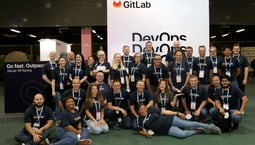







.jpeg)
GitLab Teams


GitLab Offices
Remote Workspace
Employees work remotely.
All-remote means that each individual in the organization is empowered to work and live where they are most fulfilled; it makes it clear that every team member is equal. No one, not even the executive team, meets in-person on a daily basis.
