

.png)
Order.co is the System of Action for the Office of the CFO, transforming the way businesses purchase and pay into an intuitive, B2C-like shopping experience. Order.co leverages embedded AI agents and embedded financial products to reinvent the way businesses connect with their vendors.
End users enjoy a seamless, zero-training buying experience, while finance and procurement leaders gain a single platform to orchestrate how the business “should operate”. The result is an all-in-one solution that serves as a gravitational pull for spend and data, automating and eliminating procurement and finance workflows from requisition to reconciliation along the way.
Order.co is on the cutting edge of B2B Agentic Commerce, poised to be the market leader in creating a more predictive, prescriptive, and personalized experience for users.
Founded in 2016 and headquartered in New York City, Order.co oversees nearly half a billion in annualized spend across hundreds of customers like WeWork, SoulCycle, Lume, and [solidcore]. Order.co has raised $75M in funding from industry-leading investors like MIT, Stage 2 Capital, Rally Ventures, 645 Ventures, and more. Order.co has been proudly named a 50 to Watch by Spend Matters and a Best Place to Work by BuiltIn and Inc. Magazine.
As a Senior Site Reliability Engineer on the Platform team, you will ensure that software systems are reliable, scalable, performant, and operationally efficient. You blend software engineering skills with infrastructure and operations expertise to keep critical systems running smoothly while enabling rapid product development.
ResponsibilitiesReliability Engineering & Infrastructure Ownership- Design, build, and operate highly available, scalable, and fault-tolerant infrastructure and platform services
- Own reliability, availability, latency, and operational excellence for critical production systems and services
- Define and maintain service level objectives (SLOs), service level indicators (SLIs), and error budgets across platform systems
- Lead incident response efforts for complex production outages; drive root-cause analysis and long-term remediation actions
- Build resilient systems that gracefully handle failures, traffic spikes, dependency degradation, and regional outages
- Continuously improve system reliability through automation, observability, performance tuning, and capacity planning
- Develop infrastructure automation and self-service tooling to reduce operational toil and improve engineering velocity
- Build and maintain CI/CD pipelines, deployment automation, and release engineering workflows
- Implement infrastructure as code (IaC) practices using tools such as Terraform, CloudFormation, and container orchestration
- Improve developer experience by building reliable internal platforms, operational tooling, and standardized deployment patterns
- Drive adoption of GitOps, immutable infrastructure, and automated remediation patterns
- Design and maintain comprehensive monitoring, logging, tracing, and alerting systems for distributed services
- Establish actionable alerting standards that reduce noise while improving incident detection and response times
- Analyze production trends, system bottlenecks, and failure patterns to proactively prevent incidents
- Lead operational readiness reviews, disaster recovery planning, and game-day exercises
- Improve mean time to detect (MTTD) and mean time to recovery (MTTR) through tooling, automation, and process refinement
- Participate actively in architecture and infrastructure design reviews
- Propose scalable and reliable platform designs that account for multi-region deployment, redundancy, failover, and security considerations
- Evaluate trade-offs between reliability, scalability, operational complexity, and engineering velocity
- Identify systemic risks and operational gaps before they become production incidents
- Partner with engineering teams to ensure services are designed with operability, observability, and resilience in mind from day one
- Approach infrastructure and operational practices with a strong security mindset
- Implement and maintain secure cloud networking, secrets management, IAM policies, and infrastructure hardening standards
- Partner with Security and Compliance teams to ensure systems meet organizational and regulatory requirements
- Drive operational best practices around vulnerability management, patching, and production access controls
- Scope and estimate infrastructure and reliability initiatives accurately
- Coordinate production rollouts, maintenance events, and reliability improvements across teams
- Communicate operational risks, dependencies, and incident impacts clearly to technical and non-technical stakeholders
- Collaborate closely with Software Engineering, Security, Product, and Operations teams to improve platform reliability and scalability
- Serve as a trusted escalation point during critical production incidents
- Mentor junior and mid-level engineers on reliability engineering principles, operational excellence, and infrastructure best practices
- Raise the operational maturity of the engineering organization through documentation, reviews, and technical guidance
- Drive improvements in team standards around observability, incident management, automation, and infrastructure design
- Influence technical decisions through credibility, operational expertise, and strong engineering judgment
- You are motivated by accountability — you own outcomes, not just tasks
- You are results-oriented and measure success by shipped, working software
- You are motivated by correctness in code that touches money — the consequences of a bug land on real customer balances, and you take that seriously
- You love helping people on your team grow and improve
- Writing tests is an integral part of your development process, not an afterthought
- You know how to design and build software incrementally — you don't need a complete spec to make progress
- Collaborating with the people around you to achieve a goal motivates you
- You are collaborative, open-minded, and actively developing your craft
- You are curious and pragmatic about AI-driven solutions — you apply them where they add real value and stay skeptical where they don't
- Familiarity with AI-assisted development tools — you understand how they work, where they help, and where they fail. Prior hands-on use is a plus; intellectual curiosity and the instinct to evaluate AI output critically are what matter
- Strong foundation in computer science fundamentals: data structures, algorithms, and system design
- Familiarity with building production-grade applications and services using Ruby and Ruby on Rails
- Deep expertise with Linux systems administration and production troubleshooting
- Strong experience operating cloud infrastructure at scale, particularly within AWS environments
- Experience with Kubernetes, container orchestration, and cloud-native infrastructure patterns
- Proficiency with infrastructure as code tools such as Terraform or CloudFormation
- Expertise designing and operating CI/CD pipelines and deployment automation systems
- Deep understanding of observability tooling including Datadog, OpenTelemetry, or similar platforms
- Strong knowledge of distributed systems reliability patterns including redundancy, failover, autoscaling, rate limiting, and graceful degradation
- Experience building automation and operational tooling using languages such as Python, Go, Bash, or Ruby
- Strong understanding of networking fundamentals including DNS, load balancing, TLS, VPNs, firewalls, and service discovery
- Hands-on experience with incident response, root-cause analysis, and production operations in high-availability environments
- Familiarity with SRE methodologies including SLOs, SLIs, error budgets, capacity planning, and operational maturity modeling
- Experience implementing secure infrastructure and cloud security best practices including IAM, secrets management, and vulnerability remediation
- Proven ability to design scalable, resilient, and maintainable platform systems and APIs
- Experience supporting distributed microservices architectures and event-driven systems
- Strong understanding of operational excellence principles including automation-first engineering and toil reduction
- Experience using AI-assisted engineering tools (e.g., Claude, GitHub Copilot) as force multipliers while applying sound operational and engineering judgment
- Excellent debugging and systems thinking skills across infrastructure, networking, application, and platform layers
A Senior Software Engineer on the Platform team who is thriving at this level demonstrates:
- Reliable delivery of complex work — consistently ships multi-part solutions on time with low defect rates
- Low defects in owned areas — proactively monitors and improves the quality of the systems they own; that means incident-free quarters in code paths that move funds and clean reconciliation against vendor reports
- Measurable mentorship impact — engineers around you write better code because of your reviews and guidance
"Someone we can depend on for the work that matters — especially the work that touches money."
Failure Modes We Screen AgainstWe actively evaluate candidates for the following anti-patterns during the interview process:
Failure Mode
What It Looks Like
Strong coder, weak owner
Ships code but doesn't manage to the task — owns the merge, not the outcome; hands off and moves on without monitoring or fixing post-release issues
Solo expert
Hoards knowledge instead of sharing — becomes a single point of failure and blocks team growth
Overconfident designer
Proposes solutions without considering trade-offs — jumps to conclusions, resists alternative approaches
Rubber-stamper
Produces AI-generated output without verifying it against the codebase, tests, or business context
Interview ProcessOur 5-round process is designed to evaluate you across all competency areas. AI tools are permitted in technical rounds.
Round
Format
What We Evaluate
1 — Hiring Manager Screen
60 min, conversational
Career trajectory, mentorship philosophy, technical influence examples, communication style
2 — Take-Home + PR Discussion
72h take-home + 60 min live
Navigating unfamiliar code, ownership and decomposition discipline visible in your PR, root-cause judgment, AI tool usage
3 — System Design + Artifact Critique
60 min, Miro board
Requirements gathering, schema/API design, trade-off articulation, calibrated code-review judgment on a teammate's PR
4 — Team Interview (conditional)
30 min, behavioral
Collaboration patterns, mentorship behavior, negotiation behavior with cross-functional partners
5 — Culture Add
30 min, People Team
Organizational values alignment
Round 4 is conditional: it runs when the team needs additional behavioral signal after Rounds 2 and 3, and is otherwise skipped. Your recruiter will tell you whether it's scheduled before your loop is finalized.
The Round 2 (Take-Home + PR Discussion) and Round 3 (System Design) exercises are drawn from real problems so the technical evaluation is grounded in the work you'd actually be doing.
- Competitive compensation
- Employer-sponsored 401(k) with match
- Comprehensive medical, dental, and vision coverage
- Flexible time off and hybrid work environment
The anticipated annual salary range for this role is $175,000 - $200,000. Actual compensation and title will be commensurate with experience, qualifications, knowledge, and skills.
Skills Required
- Experience in building production-grade applications and services using Ruby and Ruby on Rails
- Deep expertise with Linux systems administration and production troubleshooting
- Experience operating cloud infrastructure at scale, particularly within AWS environments
- Familiarity with infrastructure as code tools such as Terraform or CloudFormation
- Strong knowledge of distributed systems reliability patterns and engineering velocity
- Experience implementing secure infrastructure and cloud security best practices
What the Team is Saying





Order.co Compensation & Benefits Highlights
-
Healthcare Strength — Medical, dental, and vision coverage are presented as comprehensive, with HSA/FSA options available. Access to mental-health resources such as Talkspace and EAPs further bolsters the care offering.
-
Retirement Support — A 401(k) plan with employer match is consistently included, complemented by retirement planning tools and resources. This provides foundational long-term savings support.
-
Parental & Family Support — Parental leave is described as generous and available from day one for both birthing and non-birthing parents. Additional family-oriented benefits such as childcare and fertility support are also indicated.
Order.co Insights

What We Do
End users enjoy a seamless, zero-training buying experience, while finance and procurement leaders gain a single platform to orchestrate how the business “should operate”. The result is an all-in-one solution that serves as a gravitational pull for spend and data, automating and eliminating procurement and finance workflows from requisition to reconciliation along the way. Order.co is on the cutting edge of B2B Agentic Commerce, poised to be the market leader in creating a more predictive, prescriptive, and personalized experience for users. Founded in 2016 and headquartered in New York City, Order.co oversees nearly half a billion in annualized spend across hundreds of customers like WeWork, SoulCycle, Lume, and [solidcore]. Order.co has raised $75M in funding from industry-leading investors like MIT, Stage 2 Capital, Rally Ventures, 645 Ventures, and more. Order.co has been proudly named a 50 to Watch by Spend Matters and a Best Place to Work by BuiltIn and Inc. Magazine.
Why Work With Us
With our core values as our North star, Order.co and its team work tirelessly to foster an inclusive, psychologically safe environment where team members are empowered to do their best work. We pride ourselves on solving hard problems in order, with humility, and most importantly, together.
Gallery



.jpg)
.jpg)


.jpg)


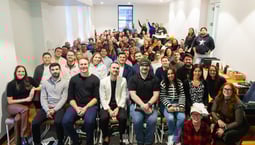
.jpg)


Order.co Offices
Hybrid Workspace
Employees engage in a combination of remote and on-site work.
Team members at Order.co are empowered to make the best decision for themselves regarding where they work, whether from home, the office, or otherwise!

