


We are looking for a Staff Platform Engineer to contribute to the Platform solutions and infrastructure that power Forge, the AI Factory. These components provide distributed runtime capabilities that enable teams to reliably orchestrate workloads, process data, and underpin the workflows of building an AI Pilot.
The Forge Platform Engineering team provides Kubernetes-native capabilities that support autonomy development, simulation, testing, training, evaluation, deployment, and operational workflows across commercial cloud, on-premises infrastructure, sovereign deployments, edge environments, and fully air-gapped systems.
This is a hands-on technical leadership role. You will define platform architecture, implement production software, establish reusable operational patterns, and partner with teams across autonomy, ML, simulation, test, infrastructure, and product engineering. Success requires balancing developer productivity, reliability, extensibility, performance, portability, and long-term operational maintainability.
What you'll do:
- Build Kubernetes-native platform services: Develop and operate Kubernetes-based services, controllers, operators, deployment patterns, and runtime integrations that support distributed workloads across multiple environments.
- Develop distributed orchestration capabilities: Design and build reusable primitives for authoring, scheduling, and scaling pipeline work.
- Build reliable data-processing infrastructure: Develop platform capabilities for data storage, ingestion, validation, transformation, and governance.
- Develop highly extensible platform components: The Forge Platform base provides standardized tooling around authentication, authorization, observation, networking, routing, secret management, and more to the services that are integrated on top of the ecosystem.
- Create reference architectures: Establish recommended deployment patterns, operating profiles, capacity guidance, benchmarks, reliability practices, and distribution approaches across cloud providers, on-prem, edge, and air-gapped environments.
- Advance observability and operability: Establish end-to-end metrics, logs, traces, structured events, dashboards, alerting, service-level objectives, operational diagnostics, and runbooks for workflows, pipelines, event streams, and platform services.
- Partner with downstream teams: Work directly with autonomy, ML Ops, simulation, test, infrastructure, product, and customer-facing teams to turn recurring distributed-systems problems into reusable platform capabilities.
Key Outcomes:
- The Forge Platform continues to improve in KPIs around reliability, scalability, operational use cases, and customer adoption.
- New services from downstream teams are guided to successful platform integration. Shared distributed services have clear ownership, repeatable deployment patterns, tested recovery procedures, practical observability, and well-defined operational standards.
- The Platform is demonstrated, evaluated, and benchmarked across a wide variety of operational environments.
- Interfaces are maintained for long periods of time to instill customer confidence and reduce upgrade burdens.
Required qualifications:
- Significant experience designing and operating production distributed systems, cloud-native platforms, backend infrastructure, or data-intensive services.
- Strong software engineering skills and a record of delivering production systems in Go and Python.
- Deep understanding of distributed-systems fundamentals, including failure handling, idempotency, consistency tradeoffs, retries, ordering, delivery semantics, backpressure, partitioning, state management, and fault tolerance.
- Experience designing or operating workflow orchestration, distributed job execution, asynchronous processing, event-driven systems, or long-running service workflows.
- Ability to define architecture and technical standards while remaining hands-on in implementation, production troubleshooting, performance analysis, and reliability improvement.
- Experience working across multiple teams to turn recurring infrastructure needs into reusable, well-documented platform capabilities.
- Clear technical communication and the ability to make complex distributed-systems architecture understandable to both specialists and downstream users.
Preferred qualifications:
- Kubernetes controllers, operators, Custom Resource Definitions, admission control, scheduling extensions, KubeRay, or workload-management systems.
- Distributed execution and workflow technologies such as Ray, Temporal, Argo Workflows, Flyte, Dagster, Airflow, Prefect, Kubernetes Jobs, or comparable systems.
- Durable messaging and event-streaming technologies such as NATS JetStream, Kafka, Redpanda, Pulsar, RabbitMQ, SQS/SNS, or comparable systems.
- ETL/ELT, batch processing, event-driven data pipelines, CDC, schema evolution, data validation, artifact processing, or large-file transfer workflows.
- Service networking technologies and practices such as Envoy, service meshes, Kubernetes networking, and CNI plugins.
- Observability software such as OpenTelemetry, Prometheus, Grafana, Loki, Tempo, Jaeger, distributed tracing, structured logging, SLOs, service-level indicators, alerting, and incident-management practices.
- Terraform, Helm, ArgoCD, GitOps, Kubernetes package management, repeatable platform distribution, and Infrastructure as Code.
Why join us:
Platform Engineering is foundational to how Shield AI develops, tests, evaluates, deploys, and operates autonomy systems. This role offers the opportunity to shape the distributed systems foundation used by engineering teams across the company and delivered into demanding customer environments.
Your work will determine how reliably data moves through the organization, how services coordinate across complex environments, how teams execute and recover long-running workflows, and how operators understand the health of mission-critical systems. You will work at the intersection of Kubernetes, distributed computing, event-driven architecture, data processing, networking, observability, and autonomy.
You will help establish reusable platform capabilities that allow specialized teams—including autonomy, simulation, test, ML Ops, and application engineering—to move faster while building on dependable operational foundations.
Skills Required
- Significant experience designing and operating production distributed systems, cloud-native platforms, backend infrastructure, or data-intensive services.
- Strong software engineering skills and a record of delivering production systems in Go and Python.
- Deep understanding of distributed-systems fundamentals, including failure handling, idempotency, consistency tradeoffs, retries, ordering, delivery semantics, backpressure, partitioning, state management, and fault tolerance.
- Experience designing or operating workflow orchestration, distributed job execution, asynchronous processing, event-driven systems, or long-running service workflows.
- Ability to define architecture and technical standards while remaining hands-on in implementation, production troubleshooting, performance analysis, and reliability improvement.
- Experience working across multiple teams to turn recurring infrastructure needs into reusable, well-documented platform capabilities.
- Clear technical communication and ability to explain complex distributed-systems architecture to specialists and downstream users.
- Experience with Kubernetes controllers, operators, Custom Resource Definitions, admission control, scheduling extensions, KubeRay, or workload-management systems.
- Experience with distributed execution and workflow technologies such as Ray, Temporal, Argo Workflows, Flyte, Dagster, Airflow, Prefect, Kubernetes Jobs, or comparable systems.
- Experience with durable messaging and event-streaming technologies such as NATS JetStream, Kafka, Redpanda, Pulsar, RabbitMQ, SQS/SNS, or comparable systems.
- Experience with ETL/ELT, batch processing, event-driven data pipelines, CDC, schema evolution, data validation, artifact processing, or large-file transfer workflows.
- Experience with service networking technologies and practices such as Envoy, service meshes, Kubernetes networking, and CNI plugins.
- Experience with observability software and practices including OpenTelemetry, Prometheus, Grafana, Loki, Tempo, Jaeger, distributed tracing, structured logging, SLOs, service-level indicators, alerting, and incident management.
- Experience with Terraform, Helm, ArgoCD, GitOps, Kubernetes package management, repeatable platform distribution, and Infrastructure as Code.
What the Team is Saying


What We Do
At Shield AI, you won't wait years to see your work reach the field. You'll build hardware and software that operates in the real world right now, in the hands of the people who depend on it. Hivemind, our AI pilot, has been flying since 2018. It has flown more than 30 platforms, including an F-16, and it now sits under a U.S. Air Force production contract for Collaborative Combat Aircraft. When you write code or shape a system here, you contribute to technology with a proven flight record and a clear production future. V-BAT flies intelligence, surveillance, and reconnaissance missions with an operational record that stretches from Ukraine to the Indo-Pacific. It delivers eyes where they matter most, in the most demanding conditions on earth. The teams behind it watch their work get tested where the stakes are real. X-BAT takes its first flight this year. It's an AI-piloted fighter that needs no runway, built to operate where traditional aircraft can't. Join now and you help shape a program at its earliest, most formative stage. That's the kind of ground-floor work that defines a career. Do the most impactful work of your life, on problems that matter. Autonomy at this level asks a lot of you. You'll take on problems in perception, planning, and control that few teams anywhere are equipped to solve. You'll work across disciplines, from aerospace and robotics to machine learning and systems engineering, alongside people who hold themselves to an exacting standard and expect the same from you. Our mission is clear: protect service members and civilians with intelligent systems. That purpose runs through every decision, every design review, and every deployment. It's why the work here carries a weight you can feel. Ready to join our mission? Explore our open roles and find where you fit.
Why Work With Us
Founded in 2015 by a former Navy SEAL, Shield AI builds AI pilots and uncrewed aircraft. Veterans aren't an afterthought here, they're at every level. It's why the work carries weight: AI pilots and uncrewed aircraft flying real missions, from Ukraine to the Indo-Pacific, protecting service members and civilians.
Gallery
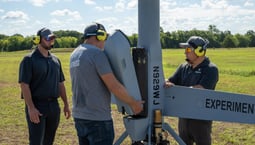
%203.jpg)

Shield AI Teams
.jpg)


Shield AI Offices
Hybrid Workspace
Employees engage in a combination of remote and on-site work.

