


GitLab is the intelligent orchestration platform for DevSecOps. GitLab enables organizations to increase developer productivity, improve operational efficiency, reduce security and compliance risk, and accelerate digital transformation. More than 50 million registered users and more than 50% of the Fortune 100* trust GitLab to ship better, more secure software faster.
The same principles built into our products are reflected in how our team works: we embrace AI as a core productivity multiplier, with all team members expected to incorporate AI into their daily workflows to drive efficiency, innovation, and impact. GitLab is where careers accelerate, innovation flourishes, and every voice is valued. Our high-performance culture is driven by our values and continuous knowledge exchange, enabling our team members to reach their full potential while collaborating with industry leaders to solve complex problems. Co-create the future with us as we build technology that transforms how the world develops software.
*Fortune 500® is a registered trademark of Fortune Media IP Limited, used under license. Claim based on GitLab data. Fortune 100 refers to the top 20% ranked companies in the 2025 Fortune 500 list, published in June 2025. Fortune and Fortune Media IP Limited are not affiliated with, and do not endorse products or services of GitLab.
As a Support Engineer at GitLab, you'll sit at the intersection of Support and Engineering, helping customers solve complex, real-world challenges while running GitLab in diverse and demanding environments. You'll join the Engineering department and work directly with customers as they encounter edge cases. You'll dig into Linux systems, logs, and our Ruby on Rails codebase to troubleshoot performance issues, reproduce bugs, and contribute merge requests that fix problems at the source.
You'll also improve our documentation, refine support processes in our issue tracker, and collaborate closely with Product, Development, Infrastructure, Customer Success, and Sales so customer feedback directly shapes our roadmap. In your first year, you'll build deep expertise across a range of GitLab implementations, strengthen our ability to keep customers productive on both self-managed GitLab and GitLab.com software as a service, and help create tools and content that make support more efficient and effective for the entire team.
Some examples of our projects:
- A tool to automatically check a GitLab Omnibus install for known issues
- A solution to capture the state of a customer’s server for easier troubleshooting
- A tool which turns log files into interactive tables to easily sort and filter columns
- A ChatOps feature that makes it easier to identify user accounts on GitLab.com
- Act as an escalation point for difficult customer interactions and lead the resolution of complex issues through Zendesk tickets, merge requests, email, and video calls.
- Mentor and guide teammates on complex troubleshooting and customer communication through pairing sessions and cross-team collaboration.
- Advocate for and drive improvements to support practices, product quality, and reusable documentation and support content that directly influence team objectives.
- Collaborate with Product, Development, Infrastructure, Customer Success, and Sales teams to shape product goals, roadmaps, and priorities while driving fixes and new features.
- Participate in regular weekday and weekend on-call rotations during daytime hours, providing emergency support for self-managed GitLab and software as a service customers and coordinating incident communications with the GitLab.com Production team.
- Participate in hiring by reviewing applications and assessments and joining interviews to help grow the Support team.
- Experience owning complex, customer-facing technical cases from initial contact through triage, reproduction, bug reporting, resolution, and clear customer communication, including difficult or escalated interactions.
- Strong experience with Linux systems administration, scripting, Git, and continuous integration and continuous delivery in production or customer environments, with the ability to investigate issues at both the infrastructure and application levels.
- Ability to mentor teammates on complex troubleshooting and customer communication through pairing sessions, case reviews, and cross-team collaboration.
- Experience collaborating with Product, Engineering, and Sales teams to turn customer feedback into product fixes, feature improvements, and roadmap priorities.
- Familiarity with DevOps practices and technologies such as Kubernetes and serverless computing, and an understanding of how different GitLab implementations operate and affect customers.
- Demonstrated ability to learn, collaborate across teams, and apply transferable skills from related technical support or engineering roles.
- Fluent Korean language skills (required)
We're a globally distributed group of Support Engineers across the Americas, Europe, the Middle East, and Africa, and Asia-Pacific. We work asynchronously and stay connected through pairing sessions, one-on-one meetings, coffee chats, and Slack. We structure our shifts to support our personal lives while meeting customer needs. Thanks to GitLab’s transparency value, you can see what we are working on and how we operate on our Support Team page.
- Benefits to support your health, finances, and well-being
- Flexible Paid Time Off
- Team Member Resource Groups
- Equity Compensation & Employee Stock Purchase Plan
- Growth and Development Fund
- Parental Leave
Please note that we welcome interest from candidates with varying levels of experience; many successful candidates do not meet every single requirement. Additionally, studies have shown that people from underrepresented groups are less likely to apply to a job unless they meet every single qualification. If you're excited about this role, please apply and allow our recruiters to assess your application.
Country Hiring Guidelines: GitLab hires new team members in countries around the world. All of our roles are remote, however some roles may carry specific location-based eligibility requirements. Our Talent Acquisition team can help answer any questions about location after starting the recruiting process.
Privacy Policy: Please review our Recruitment Privacy Policy. Your privacy is important to us.
GitLab is proud to be an equal opportunity workplace and is an affirmative action employer. GitLab’s policies and practices relating to recruitment, employment, career development and advancement, promotion, and retirement are based solely on merit, regardless of race, color, religion, ancestry, sex (including pregnancy, lactation, sexual orientation, gender identity, or gender expression), national origin, age, citizenship, marital status, mental or physical disability, genetic information (including family medical history), discharge status from the military, protected veteran status (which includes disabled veterans, recently separated veterans, active duty wartime or campaign badge veterans, and Armed Forces service medal veterans), or any other basis protected by law. GitLab will not tolerate discrimination or harassment based on any of these characteristics. See also GitLab’s EEO Policy and EEO is the Law. If you have a disability or special need that requires accommodation, please let us know during the recruiting process.
Skills Required
- Experience owning complex, customer-facing technical cases from initial contact through triage, reproduction, bug reporting, resolution, and communication
- Strong experience with Linux systems administration, scripting, Git, and CI/CD in production or customer environments
- Ability to investigate issues at both infrastructure and application levels
- Ability to mentor teammates on complex troubleshooting and customer communication
- Experience collaborating with Product, Engineering, and Sales teams to turn customer feedback into product fixes and roadmap priorities
- Familiarity with DevOps practices and technologies such as Kubernetes and serverless computing
- Understanding of self-managed GitLab and GitLab.com implementations and their customer impact
- Ability to learn, collaborate across teams, and apply transferable skills from related technical support or engineering roles
GitLab Compensation & Benefits Highlights
How does GitLab ensure its pay and bonus plans are competitive?
GitLab ensures competitive compensation through a standardized, market-aligned framework designed to reward performance. Base salaries are benchmarked using external compensation data (such as Radford), with most roles targeted at or above the 50th percentile of the software market and critical technical roles positioned closer to the 75th percentile. Compensation is structured around Total Target Cash (TTC)—which includes base salary plus variable pay—and is calibrated based on role, level, location, and scope. This approach ensures that pay reflects the local labor market while remaining competitive across regions in a globally distributed workforce.
Variable pay and bonus structures further reinforce this performance-driven model. Directors and above receive semi-annual bonuses tied to company performance, while sales roles operate on On-Target Earnings (OTE) with commission tied directly to quota attainment — offering upside for exceeding goals. GitLab also conducts an Annual Compensation Review (ACR) each year, where merit increases, equity refresh grants, and market adjustments are evaluated based on individual performance, growth potential, and company performance. This process is supported by structured budget guidelines (e.g., ~3.5% of total target cash globally) and includes pay equity audits to ensure fairness and consistency across teams.
Leadership reinforces transparency and trust in compensation by providing visibility into compensation ranges, job architecture, and compa-ratio positioning for all employees. Clear frameworks define how roles are leveled, how pay is benchmarked, and how increases are determined, giving employees a strong understanding of how compensation decisions are made. Equity compensation—through RSUs and ESPP participation—further aligns employee rewards with long-term company performance, reinforcing shared ownership and value creation.
Employee Perspective
“What really struck me early on was how GitLab genuinely cares about its employees as whole people, not just as resources. You’re not just another number here — there’s real investment in your success and well-being.”
— Shannon Maccado, Strategic Account Executive
At-a-Glance
- Market positioning: Targeted at ≥50th percentile (75th percentile for critical roles) using Radford data
- Comp structure: Base salary + variable pay (TTC/OTE) + equity (RSUs, ESPP)
- Bonus model: Semi-annual bonuses for Director+ roles; commission-based upside for sales roles
- Review process: Annual Compensation Review with merit increases, equity refresh, and pay equity audits
External Signals
- Employee recommendation sentiment: Employees rate GitLab’s culture highly, giving it an A+ on review sites — with employees highlighting the culture of transparency, remote work, and learning opportunities — earning it a status as a “Choice Employer.” (Comparably 2026)
- Competitive Benefits: Employees rate GitLab’s compensation and benefits highly, giving it an A+ on review sites, placing it in the top 5% of companies in its industry. In external surveys, 86% of employees say they are satisfied with their benefits, and describe the salary and PTO as “best in the industry.” (Comparably 2026).
- Fair Pay: In external surveys, 86% of employees say they are paid fairly, with reviewers describing it as both “competitive” and “fair and equitable.” (Comparably 2026).
GitLab Insights

What We Do
GitLab is the Intelligent Orchestration Platform where software teams and their AI agents stay in flow to amplify their capacity for innovation. Together, they automate repetitive tasks to plan, build, secure, test, deploy and maintain software. With GitLab, software teams spend less time on coordination overhead and more time on the next big idea. What started in 2011 as an open source project to help one team of programmers collaborate is now the intelligent orchestration platform millions of people use to deliver software faster, more efficiently, while strengthening security and compliance. Since the beginning, we've been firm believers in remote work, open source, DevSecOps, and iteration. We get up and log on in the morning to work alongside the GitLab community to deliver new innovations every month that help teams and their AI agents ship great code faster.
Why Work With Us
GitLab is where careers accelerate, innovation flourishes, and every voice is valued. Co-create the future with us as we build technology that transforms how the world develops software.
Gallery

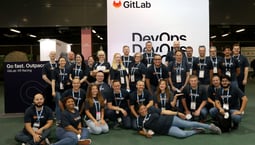





GitLab Teams


GitLab Offices
Remote Workspace
Employees work remotely.
All-remote means that each individual in the organization is empowered to work and live where they are most fulfilled; it makes it clear that every team member is equal. No one, not even the executive team, meets in-person on a daily basis.
