


In this role, you will design, implement, and flight-test autonomous shipboard recovery guidance for XBAT, with an emphasis on precision recovery to a moving ship in GPS-degraded and GPS-denied environments. Working within an established G&C team, you will own recovery guidance algorithms and their integration with relative navigation, flight controls, and recovery hardware.
We are seeking someone with direct experience taking shipboard recovery guidance from algorithm development through implementation and flight testing.
What you'll do:
- Design and implement ship-relative guidance for approach, station keeping, alignment, and terminal recovery.
Develop deck-motion compensation and landing-timing strategies that account for navigation uncertainty, aircraft response, control authority, and touchdown or capture constraints.
Work closely with state estimation and sensing teams to define relative-navigation requirements and ensure recovery guidance remains robust to measurement errors, latency, and intermittent sensor availability.
Implement recovery sequencing and contingency logic, including hold, wave-off, go-around, retry, and responses to degraded or lost navigation.
Develop and integrate real-time guidance software in C++, working with flight controls, autonomy, embedded software, and recovery-system teams.
Define recovery performance requirements and verify them through 6DOF simulation, Monte Carlo analysis, software-in-the-loop testing, and hardware-in-the-loop testing.
Support test planning, flight readiness assessments, and flight operations. Analyze test data, diagnose performance shortfalls, and drive improvements between tests.
Provide technical direction within the recovery-guidance effort, mentor engineers, and communicate design decisions, limitations, and test results across teams.
Required qualifications:
- Demonstrated hands-on experience designing, implementing, and flight-testing guidance laws for autonomous shipboard recovery, including recovery using relative navigation without GPS/GNSS.
Strong understanding of moving-platform guidance, ship-relative reference frames, deck motion, and terminal position, velocity, and attitude constraints.
Experience integrating guidance with relative-navigation systems and assessing the closed-loop effects of navigation bias, noise, latency, and dropouts.
Strong background in flight dynamics and guidance and control, including the relationship between guidance demands, aircraft tracking bandwidth, and available control authority.
Proficiency in C++ for real-time algorithm implementation and MATLAB/Simulink or Python for algorithm development and analysis.
Experience executing verification and validation through simulation, hardware integration, flight testing, and post-flight analysis.
Demonstrated ability to own a technical capability, resolve problems across subsystem boundaries, and work effectively with navigation, controls, software, and test engineers.
Ability to obtain and maintain a U.S. security clearance.
Preferred qualifications:
Full-scale, at-sea flight-test experience with autonomous shipboard recovery.
VTOL or rotorcraft experience involving precision recovery to constrained or significantly moving landing platforms.
Experience characterizing recovery performance across ship motion, wind over deck, ship airwake, turbulence, and degraded visibility.
Experience integrating vision, infrared, lidar, radar, or cooperative RF sensing into a relative-navigation and recovery system.
Experience supporting ship–aircraft dynamic-interface testing, recovery-envelope development, flight safety, or airworthiness.
Familiarity with Linux-based development, Git, automated testing, and CI/CD workflows.
Ability to obtain S//SAR access.
Skills Required
- 10+ years of experience in flight controls / GNC on real flight vehicles, with demonstrated ownership from design through flight test
- Demonstrated experience with control allocation design and implementation for over-actuated systems with saturation and failure accommodation
- Strong background in flight dynamics and 6DOF simulation
- Strong background in control theory and nonlinear systems
- Experience executing full V&V cycles, including pre-flight performance prediction, Monte Carlo analysis, flight readiness assessment, and post-flight analysis
- Proficiency in C++, MATLAB/Simulink, and/or Python, with experience deploying real-time algorithms
- Ability to obtain and maintain a U.S. security clearance
- Ability to obtain a S//SAR level security clearance
- VTOL or transition aircraft experience where control blending and allocation were critical
- Autonomous systems or missile/UAV GNC background
- Experience with flight safety, airworthiness, and mission assurance
- Familiarity with sensor and air data systems
- Familiarity with fault-tolerant or adaptive control
- Familiarity with CI/CD pipelines and modern DevSecOps practices
- Experience with HIL or integrated simulation/test environments and Linux-based development workflows (Git, etc.)
- Experience operating in rapid development environments with tight iteration loops between simulation and test
What the Team is Saying


What We Do
At Shield AI, you won't wait years to see your work reach the field. You'll build hardware and software that operates in the real world right now, in the hands of the people who depend on it. Hivemind, our AI pilot, has been flying since 2018. It has flown more than 30 platforms, including an F-16, and it now sits under a U.S. Air Force production contract for Collaborative Combat Aircraft. When you write code or shape a system here, you contribute to technology with a proven flight record and a clear production future. V-BAT flies intelligence, surveillance, and reconnaissance missions with an operational record that stretches from Ukraine to the Indo-Pacific. It delivers eyes where they matter most, in the most demanding conditions on earth. The teams behind it watch their work get tested where the stakes are real. X-BAT takes its first flight this year. It's an AI-piloted fighter that needs no runway, built to operate where traditional aircraft can't. Join now and you help shape a program at its earliest, most formative stage. That's the kind of ground-floor work that defines a career. Do the most impactful work of your life, on problems that matter. Autonomy at this level asks a lot of you. You'll take on problems in perception, planning, and control that few teams anywhere are equipped to solve. You'll work across disciplines, from aerospace and robotics to machine learning and systems engineering, alongside people who hold themselves to an exacting standard and expect the same from you. Our mission is clear: protect service members and civilians with intelligent systems. That purpose runs through every decision, every design review, and every deployment. It's why the work here carries a weight you can feel. Ready to join our mission? Explore our open roles and find where you fit.
Why Work With Us
Founded in 2015 by a former Navy SEAL, Shield AI builds AI pilots and uncrewed aircraft. Veterans aren't an afterthought here, they're at every level. It's why the work carries weight: AI pilots and uncrewed aircraft flying real missions, from Ukraine to the Indo-Pacific, protecting service members and civilians.
Gallery
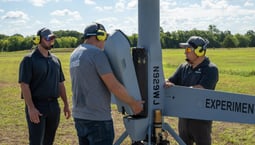


Shield AI Teams


Shield AI Offices
Hybrid Workspace
Employees engage in a combination of remote and on-site work.

