


Join Shield AI’s Hivemind SDK State Estimation and Vision team to build the tools that help engineers develop, understand, and validate autonomous navigation systems. You will turn complex sensor data and estimator behavior into reproducible experiments, clear diagnostics, and actionable performance insights.
Your work will span data ingestion, sensor replay, visualization, calibration workflows, automated evaluation, and regression testing. Working closely with state estimation, vision, simulation, and flight test engineers, you will shorten the path from discovering an issue in real-world data to understanding its cause and validating a fix.
What you'll do:
- Build and maintain tools for ingesting, inspecting, synchronizing, and replaying camera, IMU, GNSS, and other navigation sensor data.
- Develop visualization and diagnostics for trajectories, coordinate frames, uncertainty, estimator residuals, feature tracks, and sensor health.
- Create reproducible evaluation workflows that track datasets, software versions, calibration, and configuration.
- Build automated benchmarks and regression tests for estimation accuracy, drift, robustness, runtime, and resource usage.
- Enable batch experiments, parameter sweeps, and comparisons across algorithm versions, datasets, and operating conditions.
- Help engineers diagnose failures involving timestamp alignment, calibration, frame conventions, data quality, and estimator behavior.
- Integrate tooling into SDK APIs, command-line interfaces, and continuous integration workflows, with clear documentation and examples.
- Partner with tool users to identify workflow bottlenecks and deliver reliable, maintainable solutions.
Required qualifications:
- A degree in computer science, robotics, electrical engineering, aerospace engineering, or a related field, or equivalent practical experience.
- Strong software engineering skills in Python and modern C++, with the ability to work effectively in both.
- Experience building developer tools, data processing pipelines, test infrastructure, or analysis software for robotics, autonomy, computer vision, or a related technical domain.
- Working knowledge of linear algebra, probability, 3D geometry, and coordinate transformations.
- Familiarity with state estimation concepts such as sensor fusion, filtering, nonlinear optimization, visual odometry, or SLAM.
- Ability to work with time-series and sensor data, including timestamps, units, reference frames, missing measurements, and data quality.
- Experience developing on Linux using version control, automated testing, debugging, and profiling tools.
- Ability to design usable interfaces, write maintainable code, and communicate technical findings clearly.
Preferred qualifications:
- Experience with visual-inertial odometry, SLAM, factor graphs, bundle adjustment, Kalman filtering, or navigation in GNSS-degraded environments.
- Experience with camera and IMU calibration, temporal synchronization, sensor noise characterization, or ground-truth alignment.
- Familiarity with libraries such as Eigen, OpenCV, Ceres, or GTSAM.
- Experience with robotics data formats and visualization tools such as ROS/ROS 2, MCAP, Foxglove etc.
- Experience building interactive 2D/3D visualization, dashboards, or browser-based engineering tools.
- Experience with simulation, software-in-the-loop or hardware-in-the-loop testing, and flight-log analysis.
- Familiarity with dataset versioning, experiment tracking, distributed evaluation, or large-scale data processing.
- Experience profiling numerical software on embedded or resource-constrained systems.
- Experience shipping SDKs, Python bindings, reusable libraries, or tools used by external developers.
Skills Required
- Degree in computer science, robotics, electrical engineering, aerospace engineering, or a related field, or equivalent practical experience.
- Strong software engineering skills in Python and modern C++.
- Experience building developer tools, data processing pipelines, test infrastructure, or analysis software for robotics, autonomy, computer vision, or a related technical domain.
- Working knowledge of linear algebra, probability, 3D geometry, and coordinate transformations.
- Familiarity with state estimation concepts such as sensor fusion, filtering, nonlinear optimization, visual odometry, or SLAM.
- Ability to work with time-series and sensor data, including timestamps, units, reference frames, missing measurements, and data quality.
- Experience developing on Linux using version control, automated testing, debugging, and profiling tools.
- Ability to design usable interfaces, write maintainable code, and communicate technical findings clearly.
- Experience with visual-inertial odometry, SLAM, factor graphs, bundle adjustment, Kalman filtering, or navigation in GNSS-degraded environments.
- Experience with camera and IMU calibration, temporal synchronization, sensor noise characterization, or ground-truth alignment.
- Familiarity with Eigen, OpenCV, Ceres, or GTSAM.
- Experience with robotics data formats and visualization tools such as ROS, ROS 2, MCAP, or Foxglove.
- Experience building interactive 2D/3D visualization, dashboards, or browser-based engineering tools.
- Experience with simulation, software-in-the-loop or hardware-in-the-loop testing, and flight-log analysis.
- Familiarity with dataset versioning, experiment tracking, distributed evaluation, or large-scale data processing.
- Experience profiling numerical software on embedded or resource-constrained systems.
- Experience shipping SDKs, Python bindings, reusable libraries, or tools used by external developers.
What the Team is Saying


What We Do
At Shield AI, you won't wait years to see your work reach the field. You'll build hardware and software that operates in the real world right now, in the hands of the people who depend on it. Hivemind, our AI pilot, has been flying since 2018. It has flown more than 30 platforms, including an F-16, and it now sits under a U.S. Air Force production contract for Collaborative Combat Aircraft. When you write code or shape a system here, you contribute to technology with a proven flight record and a clear production future. V-BAT flies intelligence, surveillance, and reconnaissance missions with an operational record that stretches from Ukraine to the Indo-Pacific. It delivers eyes where they matter most, in the most demanding conditions on earth. The teams behind it watch their work get tested where the stakes are real. X-BAT takes its first flight this year. It's an AI-piloted fighter that needs no runway, built to operate where traditional aircraft can't. Join now and you help shape a program at its earliest, most formative stage. That's the kind of ground-floor work that defines a career. Do the most impactful work of your life, on problems that matter. Autonomy at this level asks a lot of you. You'll take on problems in perception, planning, and control that few teams anywhere are equipped to solve. You'll work across disciplines, from aerospace and robotics to machine learning and systems engineering, alongside people who hold themselves to an exacting standard and expect the same from you. Our mission is clear: protect service members and civilians with intelligent systems. That purpose runs through every decision, every design review, and every deployment. It's why the work here carries a weight you can feel. Ready to join our mission? Explore our open roles and find where you fit.
Why Work With Us
Founded in 2015 by a former Navy SEAL, Shield AI builds AI pilots and uncrewed aircraft. Veterans aren't an afterthought here, they're at every level. It's why the work carries weight: AI pilots and uncrewed aircraft flying real missions, from Ukraine to the Indo-Pacific, protecting service members and civilians.
Gallery
%203.jpg)

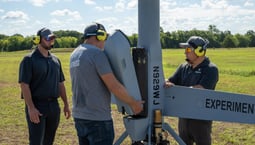
Shield AI Teams
.jpg)


Shield AI Offices
Hybrid Workspace
Employees engage in a combination of remote and on-site work.

