


The Human Machine Teaming (HMT) Group within Hivemind Solutions’ Strategic Product Development department at Shield AI is hiring an Engineer II or Senior Engineer to build out our developer experience and development capabilities. At Shield AI, HMT refers to the design, development, management, and assurance of the adaptive relationships between end users and the systems they operate—not just an interface problem, or a function-allocation exercise. As part of the HMT group, this role will work with SDK and HMI development teams and product managers across Shield AI to enable effective product design, and to ensure the end product will satisfy customer and market needs before its developed.
Working alongside the HMT Design, Experimentation, and Operations Leads, you will interact with developers as a user population. You will elicit how they build, evaluate, and deploy autonomy using SDK tools such as Forge and Commander, and characterize the requirements their tooling has to meet. You are the conduit between the engineers who build development tools and HMIs, the HMT capabilities that define what effective teaming requires, and the customers whose operational needs we serve.
If you have developed software yourself and would rather raise the HMT quality of everything the organization ships than own a single service, this is your opportunity to make a lasting impact.
What you'll do:
- Become a skilled user of the Hivemind SDK and its autonomy modules, building with the same tools the development teams and our customers do.
- Conduct knowledge elicitation and applied human factors and front-end analysis with developers as users of the Hivemind SDK, tools such as Forge and Commander, and with other HMIs.
- Translate developer, operator, and customer needs into design and development requirements that SDK and HMI teams can implement and test.
- Specify HMT requirements for developer-facing and operator-facing interfaces, and review proposed designs against them.
- Assess whether delivered tools, code, and systems satisfy the stated user and HMT requirements, and document gaps with recommended remedies.
- Define acceptance criteria and evaluation methods for HMT requirements, and maintain traceability from developer and operational need through requirement, acceptance and robustness testing.
- Develop and maintain HMT design and development guidance, documentation, and training materials that developers can apply without you in the room.
- Represent HMT in design reviews, architecture decisions, and trade-off discussions, making the HMT case in engineering terms.
- Convert recurring friction in the development toolchain and the HMIs it produces from one-off complaints into durable, prioritized requirements.
- Roll up your sleeves and work alongside the development team as needed, implementing requirements in the code yourself, and working through integration and API issues alongside them, so that effective HMT is built into the user experience from the outset.
- Feed implementation constraints and technical realities back into HMT design and experimentation, so that requirements stay buildable.
- Support field events and operator engagements, and carry what you learn there into requirements for the development teams.
- Travel to company, test, demonstration, and customer locations to conduct project work (approximately 40%).
Required qualifications:
- Engineer II: typically requires a minimum of 2 years of related experience with a Bachelor's degree; or 0 years and a Master's degree; or a PhD without experience. Senior Engineer: typically requires a minimum of 3–5 years of related experience with a Bachelor's degree; or 2–4 years and a Master's degree; or 2 years with a PhD; or equivalent work experience.
- A degree in computer science, software engineering, a related field, or equivalent practical experience, with a minor in human factors engineering, cognitive systems engineering, or human-computer interaction.
- Hands-on software development experience sufficient to earn credibility with engineers, reason about feasibility and cost, and read the code and interfaces under discussion.
- Proficiency in Python and C++, and familiarity with at least one other relevant language and tools, such as JavaScript, C#, HMTL, CSS, or docker.
- Demonstrated experience eliciting user needs, translating them into design or development requirements that an engineering team implemented, and assessing whether the delivered system met them.
- Working knowledge of human machine teaming and human factors concepts, including collaborative work requirements, and ability to reason about operator-autonomy interaction, not screens alone.
- Appreciation for the methods and contributions of human factors practitioners, designers, and operators, and the ability to act as a conduit between engineering, HMT, and customer audiences.
- Experience in multidisciplinary settings, and ability to work in complex, ambiguous problem spaces and produce clear and structured artifacts.
- Strong teamwork and collaboration skills, and written and verbal communication skills.
- U.S. DoD Secret clearance is required, with the ability to obtain and maintain Top Secret, SCI, and/or SAP-level access. U.S. citizenship required.
Preferred qualifications:
- Experience in an applications, integration, or solutions engineering role, working between customers and product engineering.
- Experience with autonomy, robotics, or simulation software, and with build, simulation, and test toolchains.
- Hands-on experience with human machine teaming, MUM-T, human-robot interaction, or applied artificial intelligence, specifically in mission autonomy applications such as UAV Groups 3–5.
- Experience with mission planning, C2, and battle management concepts, processes, and doctrine, and with ground control stations or HMIs.
- Experience with developer-experience research, developer productivity measurement, or qualitative study of how engineering work gets done.
- Familiarity with developer platforms and workflows, such as Git, GitLab, CI/CD, or cloud-native development practices.
- Familiarity with traceability methods, or with AI assurance frameworks.
- Willingness to use agentic AI to speed the path from design concept to fielded product.
Skills Required
- Bachelor's degree in human factors engineering, psychology, cognitive systems engineering, applied cognitive science, industrial and systems engineering, or a related field
- Engineer II: minimum 2 years of related experience with a bachelor's degree, or 0 years with a master's degree, or a PhD without experience
- Senior Engineer: 3-5 years of related experience with a bachelor's degree, 2-4 years with a master's degree, 2 years with a PhD, or equivalent experience
- Experience translating operational human-machine teaming experimentation into design guidance and system requirements
- Working knowledge of human-machine teaming, human factors, human performance theory and measurement, cognitive task analysis, and knowledge elicitation
- Experience with quasi-experimental or experimental design and human participants research
- Proficiency with multivariate statistical analyses and tools such as SPSS, R, or Python
- Experience working in multidisciplinary settings and producing clear, structured artifacts in complex and ambiguous problem spaces
- Strong teamwork, collaboration, written communication, and verbal communication skills
- Hands-on experience with human-machine teaming, MUM-T, human-robot interaction, or applied artificial intelligence in mission autonomy applications
- Experience with human-machine interface design and Figma or an equivalent prototyping toolset
- Experience in scenario design and modeling and simulation tools and methods
- Experience with mission planning, C2, battle management, ground control stations, or HMIs
- Experience authoring design standards, style guides, or review criteria adopted by other teams
- Familiarity with traceability methods or AI assurance frameworks
- Willingness to use agentic AI
- Prior work with military operators, pilots, or subject matter experts, or an aircrew background
- U.S. DoD Secret clearance eligibility and ability to obtain and maintain Top Secret, SCI, and/or SAP-level access
- U.S. citizenship
What the Team is Saying


Shield AI Compensation & Benefits Highlights
-
Healthcare Strength — Company materials highlight comprehensive medical, dental, and vision coverage with mental-health support and an EAP. Third-party benefits summaries also portray health coverage as a strong component of the package.
-
Retirement Support — Offerings include a 401(k) with employer matching, cited on the careers page and independent benefits directories. Multiple sources indicate a match exists, though exact formulas have varied over time and warrant confirmation.
-
Equity Value & Accessibility — Company communications describe equity for all full-time hires and stock benefits as part of total rewards. Independent listings also note company equity/RSUs as a standard element.
Shield AI Insights

What We Do
At Shield AI, you won't wait years to see your work reach the field. You'll build hardware and software that operates in the real world right now, in the hands of the people who depend on it. Hivemind, our AI pilot, has been flying since 2018. It has flown more than 30 platforms, including an F-16, and it now sits under a U.S. Air Force production contract for Collaborative Combat Aircraft. When you write code or shape a system here, you contribute to technology with a proven flight record and a clear production future. V-BAT flies intelligence, surveillance, and reconnaissance missions with an operational record that stretches from Ukraine to the Indo-Pacific. It delivers eyes where they matter most, in the most demanding conditions on earth. The teams behind it watch their work get tested where the stakes are real. X-BAT takes its first flight this year. It's an AI-piloted fighter that needs no runway, built to operate where traditional aircraft can't. Join now and you help shape a program at its earliest, most formative stage. That's the kind of ground-floor work that defines a career. Do the most impactful work of your life, on problems that matter. Autonomy at this level asks a lot of you. You'll take on problems in perception, planning, and control that few teams anywhere are equipped to solve. You'll work across disciplines, from aerospace and robotics to machine learning and systems engineering, alongside people who hold themselves to an exacting standard and expect the same from you. Our mission is clear: protect service members and civilians with intelligent systems. That purpose runs through every decision, every design review, and every deployment. It's why the work here carries a weight you can feel. Ready to join our mission? Explore our open roles and find where you fit.
Why Work With Us
Founded in 2015 by a former Navy SEAL, Shield AI builds AI pilots and uncrewed aircraft. Veterans aren't an afterthought here, they're at every level. It's why the work carries weight: AI pilots and uncrewed aircraft flying real missions, from Ukraine to the Indo-Pacific, protecting service members and civilians.
Gallery
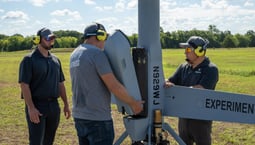
%203.jpg)

Shield AI Teams
.jpg)


Shield AI Offices
Hybrid Workspace
Employees engage in a combination of remote and on-site work.

