


Shield AI develops intelligent autonomous systems that protect service members and civilians. The X-BAT Engineering team is building a next-generation autonomous aircraft for demanding and contested environments.
We are seeking an RF and Microwave Hardware Design Engineer to design and deliver compact, high-performance RF modules for airborne and ground systems. You will design and mature active and passive RF circuits, PCB assemblies, packaging interfaces, laboratory verification, and transition to production. The center of gravity of this position is hands-on module design rather than top-level communications architecture, waveform development, or link-budget ownership.
This position may be filled at the Engineer II (L2) or Senior Engineer (L3) level. The selected level will reflect the candidate's demonstrated technical depth, independence, scope, and impact.
What you'll do:
- Design RF and microwave modules from requirements and architecture through schematic capture, component selection, layout, bring-up, verification, qualification, and production release, with scope and independence appropriate to level.
- Design active and passive RF circuits such as low-noise amplifiers, power amplifiers, filters and multiplexers, RF switches, limiters, couplers, attenuators, power detectors, and frequency-conversion stages.
- Develop RF front-end assemblies that meet gain, noise figure, output power, linearity, compression, efficiency, harmonic and spurious-emission, stability, isolation, and out-of-band rejection requirements.
- Perform circuit and electromagnetic analysis using tools such as Keysight ADS, Cadence AWR, HFSS, or CST, and correlate models with measured hardware performance.
- Create and review RF and mixed-signal PCB designs, including controlled-impedance routing, grounding, shielding, stack-up definition, power distribution, and placement of sensitive or high-power components.
- Plan and execute laboratory characterization using network analyzers, spectrum analyzers, signal generators, noise-figure analyzers, power meters, oscilloscopes, and automated test equipment.
- Diagnose difficult hardware issues involving instability, oscillation, intermodulation, self-interference, desense, thermal drift, mismatch, leakage, and electromagnetic coupling.
- Work closely with mechanical, thermal, avionics, communications, antenna, manufacturing, and test engineers to integrate RF hardware into size-, weight-, power-, cooling-, and environmental constraints.
- Develop verification methods, production test strategies, calibration approaches, and clear technical documentation that make designs repeatable and manufacturable.
- Support environmental and electromagnetic qualification, supplier engagements, hardware integration, ground test, and flight test as needed.
- Contribute to design reviews, share technical knowledge, and support the growth of interns and less-experienced engineers at a level appropriate to the position.
- Perform other duties as assigned.
Required qualifications:
- Bachelor's degree in Electrical Engineering, Applied Physics, or a related field, or equivalent practical experience.
- Typically 1 or more years of relevant post-undergraduate experience for L2, or 2 or more years for L3. Applicable graduate study and research may count toward experience. Demonstrated capability and scope are more important than years alone.
- Hands-on experience designing, building, or debugging an RF or microwave circuit, module, or PCB assembly through measured verification.
- Solid understanding of S-parameters, impedance matching, transmission lines, stability, gain and noise figure, linearity and compression, nonlinear products, isolation, and cascaded RF performance.
- Experience creating or reviewing RF PCB layouts with controlled impedance, grounding, shielding, component placement, and signal-integrity considerations.
- Proficiency with common RF laboratory instruments and calibration methods, with the ability to distinguish hardware behavior from measurement artifacts.
- Ability to use simulation and measured data to make sound design decisions, document tradeoffs, and close requirements with objective evidence.
- Clear written and verbal communication skills and the ability to work effectively with cross-functional engineering and manufacturing teams.
- Ability to work on-site in a laboratory and hardware-development environment.
Preferred qualifications:
- Experience with RF front ends for airborne, defense, space, robotics, or other high-reliability systems.
- Experience integrating GaN or GaAs power amplifiers, MMICs, LNAs, switches, limiters, frequency converters, or high-selectivity filter technologies.
- Experience designing for simultaneous transmit and receive operation, high-power RF, intermodulation control, adjacent-band rejection, or co-site interference and desense.
- Experience with Altium Designer and one or more RF or electromagnetic simulation environments such as ADS, AWR, HFSS, or CST.
- Working knowledge of thermal design, RF packaging, connector and cable interfaces, tolerance analysis, and design for manufacturability and test.
- Experience with EMI and EMC design and qualification for military or aerospace hardware.
- Experience developing automated characterization or data-analysis tools in Python, MATLAB, or a similar environment.
- Experience transitioning RF hardware from prototype through qualification and low-rate production.
- Ability to obtain an S//SAR level security clearance, if required by the program.
Skills Required
- Bachelor's degree in Electrical Engineering, Applied Physics, or a related field, or equivalent practical experience.
- Typically 1 or more years of relevant post-undergraduate experience for L2, or 2 or more years for L3; applicable graduate study and research may count.
- Hands-on experience designing, building, or debugging an RF or microwave circuit, module, or PCB assembly through measured verification.
- Understanding of S-parameters, impedance matching, transmission lines, stability, gain, noise figure, linearity, compression, nonlinear products, isolation, and cascaded RF performance.
- Experience creating or reviewing RF PCB layouts with controlled impedance, grounding, shielding, component placement, and signal-integrity considerations.
- Proficiency with common RF laboratory instruments and calibration methods.
- Ability to use simulation and measured data to make design decisions, document tradeoffs, and close requirements with objective evidence.
- Clear written and verbal communication skills and ability to work effectively with cross-functional engineering and manufacturing teams.
- Ability to work on-site in a laboratory and hardware-development environment.
- Experience with RF front ends for airborne, defense, space, robotics, or other high-reliability systems.
- Experience integrating GaN or GaAs power amplifiers, MMICs, LNAs, switches, limiters, frequency converters, or high-selectivity filters.
- Experience with simultaneous transmit and receive operation, high-power RF, intermodulation control, adjacent-band rejection, co-site interference, or desense.
- Experience with Altium Designer and RF or electromagnetic simulation environments such as ADS, AWR, HFSS, or CST.
- Working knowledge of thermal design, RF packaging, connector and cable interfaces, tolerance analysis, design for manufacturability, and design for test.
- Experience with EMI and EMC design and qualification for military or aerospace hardware.
- Experience developing automated characterization or data-analysis tools in Python, MATLAB, or a similar environment.
- Experience transitioning RF hardware from prototype through qualification and low-rate production.
- Ability to obtain an S//SAR-level security clearance if required by the program.
What the Team is Saying


Shield AI Compensation & Benefits Highlights
-
Healthcare Strength — Company materials highlight comprehensive medical, dental, and vision coverage with mental-health support and an EAP. Third-party benefits summaries also portray health coverage as a strong component of the package.
-
Retirement Support — Offerings include a 401(k) with employer matching, cited on the careers page and independent benefits directories. Multiple sources indicate a match exists, though exact formulas have varied over time and warrant confirmation.
-
Equity Value & Accessibility — Company communications describe equity for all full-time hires and stock benefits as part of total rewards. Independent listings also note company equity/RSUs as a standard element.
Shield AI Insights

What We Do
At Shield AI, you won't wait years to see your work reach the field. You'll build hardware and software that operates in the real world right now, in the hands of the people who depend on it. Hivemind, our AI pilot, has been flying since 2018. It has flown more than 30 platforms, including an F-16, and it now sits under a U.S. Air Force production contract for Collaborative Combat Aircraft. When you write code or shape a system here, you contribute to technology with a proven flight record and a clear production future. V-BAT flies intelligence, surveillance, and reconnaissance missions with an operational record that stretches from Ukraine to the Indo-Pacific. It delivers eyes where they matter most, in the most demanding conditions on earth. The teams behind it watch their work get tested where the stakes are real. X-BAT takes its first flight this year. It's an AI-piloted fighter that needs no runway, built to operate where traditional aircraft can't. Join now and you help shape a program at its earliest, most formative stage. That's the kind of ground-floor work that defines a career. Do the most impactful work of your life, on problems that matter. Autonomy at this level asks a lot of you. You'll take on problems in perception, planning, and control that few teams anywhere are equipped to solve. You'll work across disciplines, from aerospace and robotics to machine learning and systems engineering, alongside people who hold themselves to an exacting standard and expect the same from you. Our mission is clear: protect service members and civilians with intelligent systems. That purpose runs through every decision, every design review, and every deployment. It's why the work here carries a weight you can feel. Ready to join our mission? Explore our open roles and find where you fit.
Why Work With Us
Founded in 2015 by a former Navy SEAL, Shield AI builds AI pilots and uncrewed aircraft. Veterans aren't an afterthought here, they're at every level. It's why the work carries weight: AI pilots and uncrewed aircraft flying real missions, from Ukraine to the Indo-Pacific, protecting service members and civilians.
Gallery
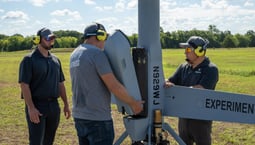
%203.jpg)

Shield AI Teams
.jpg)


Shield AI Offices
Hybrid Workspace
Employees engage in a combination of remote and on-site work.

