


Granica is building the efficiency and intelligence layer for enterprise AI.
Crunch makes massive enterprise data cheaper and easier to operate.
Large Tabular Models learn from structured data to support shared intelligence across many capabilities.
Myelin makes long-running AI agents more efficient and durable.
Granica has processed hundreds of petabytes of tabular data in production, and our research is led by Stanford Professor Andrea Montanari.
Location: Mountain View, CA (On-site)
OverviewMost of today's generative AI is built for text, images, and video.
Enterprise data isn't.
The world's most valuable data lives in tables: customer records, transactions, financial systems, telemetry, operational data, and business workflows. Today's generative AI stack wasn't designed to learn efficiently from this kind of information.
At Granica, we're building Large Tabular Models (LTMs)—foundation models that learn natively from structured and relational enterprise data.
Our research is led by Prof. Andrea Montanari (Stanford) and focuses on one central question:
How can we build generative AI that learns efficiently from tabular data?
That requires solving problems well beyond model architecture, including intelligent data selection, dataset augmentation, representation learning, and information-preserving compression.
If you're excited about inventing the algorithms that make Large Tabular Models possible, we'd love to talk.
What You'll Work OnDevelop new machine learning algorithms for Large Tabular Models.
Research methods for selecting, augmenting, and compressing training data without losing information.
Build representation learning techniques for structured and relational datasets.
Prototype and evaluate new approaches for generative modeling over enterprise data.
Design rigorous experiments and benchmarks to measure progress.
Collaborate closely with Prof. Andrea Montanari and Granica's research team to translate research into production systems.
PhD in Machine Learning, Computer Science, Statistics, Applied Mathematics, or a related field preferred; equivalent research and/or industry experience and demonstrated contributions to advancing state-of-the-art AI models will also be considered.
Strong research record in machine learning.
Experience developing new models or learning algorithms.
Hands-on experience with PyTorch or JAX.
Strong programming skills in Python.
Ability to turn research ideas into working systems.
Experience in structured learning, representation learning, generative modeling, probabilistic modeling, statistical learning, or scalable ML systems is particularly relevant.
Research on tabular, relational, or graph data.
Experience with diffusion or other generative modeling approaches.
Publications at NeurIPS, ICML, ICLR, COLT, KDD, or related venues.
Open-source or production ML systems experience.
Competitive salary, meaningful equity, and performance bonus for top performers
401(k) with company match, comprehensive health coverage, and unlimited PTO
Daily catered meals in our Mountain View office
Support for research, publication, and conference participation
At Granica, you'll help build the next generation of enterprise AI—from exabyte-scale data infrastructure, Large Tabular Models (LTMs), and stateful AI agents. Together, we're creating the infrastructure that enables enterprises to own their data, own the intelligence built on it, and scale both efficiently.
Skills Required
- PhD in Machine Learning, Statistics, Applied Mathematics, or related field
- Research or applied work in representation learning, generalization theory, probabilistic modeling, or foundational models
- Strong grounding in information theory, optimization, or statistical inference
- Hands-on experience with deep learning frameworks: PyTorch, JAX, or TensorFlow
- Proficiency in Python or Rust for large-scale experimentation
Granica Compensation & Benefits Highlights
-
Healthcare Strength — Public job materials describe premium medical, dental, and vision coverage, with some postings indicating fully covered employee premiums and dependent support. This positions healthcare as a robust anchor of the total rewards package.
-
Leave & Time Off Breadth — Listings consistently advertise unlimited PTO alongside paid holidays/sick time and quarterly company‑wide recharge days. Some sources also note guidance encouraging roughly four weeks of time off under the unlimited policy.
-
Equity Value & Accessibility — Employer pages and postings highlight meaningful equity as a core component of compensation. Equity is presented alongside competitive base pay as part of a comprehensive total‑rewards design.
Granica Insights

What We Do
Our mission is to remove inefficiency from the foundation of AI. By combining new research in information theory, probabilistic modeling, and distributed systems, we’re creating self-optimizing data infrastructure that continuously improves how information is represented and used by intelligent systems.
Why Work With Us
We’re a tight-knit team combining --> * Fundamental research in compression, data systems, and information theory * World-class systems engineering across storage, infrastructure, and research led by our Chief Scientist & Stanford Prof. Andrea Montanari * A shared obsession with performance, scale, and clean design
Gallery
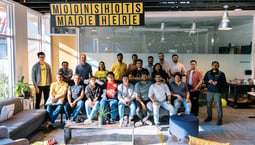




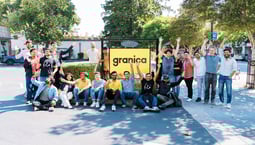
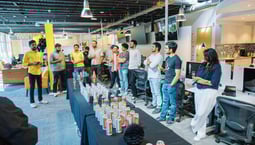


Granica Offices
OnSite Workspace
