


Location: Mountain View, CA — On-site
About GranicaGranica builds AI infrastructure for enterprises operating massive data environments.
Our platform helps data and engineering teams reduce storage and compute costs, improve performance and reliability, and prepare large datasets for analytics and AI.
Granica’s products include:
Crunch — continuous optimization for enterprise lakehouse data
Myelin — stateful infrastructure for long-running AI agents
Large Tabular Models — foundation models designed for enterprise tables
Together, we are building the infrastructure that enables enterprises to own their data, own the intelligence built on it, and scale both efficiently.
Granica has demonstrated approximately $200K in annualized value per petabyte and verified customer value within weeks.
About the RoleGranica is hiring a Senior Software Engineer to build foundational lakehouse systems for AI.
You will work on the core infrastructure behind Crunch, Granica’s continuous optimization product for enterprise lakehouse data. This includes systems for metadata management, transaction semantics, table maintenance, object-store-backed storage layouts, file optimization, and lakehouse cost/performance across petabyte- and exabyte-scale environments.
You will own core systems that directly affect customer infrastructure cost, query performance, table reliability, and the operational health of large lakehouse environments.
This is a hands-on systems role for engineers who have gone deep on lakehouse internals, table formats, metadata systems, storage layout, or distributed storage infrastructure.
What You’ll DoBuild metadata, transaction, and table-maintenance systems for large-scale lakehouse datasets
Work with Iceberg, Delta Lake, Hudi, manifests, snapshots, transaction logs, schema evolution, and garbage collection
Optimize compaction, clustering, file sizing, data skipping, pruning, and physical data layout
Improve performance and cost efficiency across Parquet/ORC and object stores such as S3, GCS, and ADLS
Debug and optimize bottlenecks across metadata, storage, table maintenance, object-store access, and query execution
Deep engineering experience in distributed systems, storage systems, databases, or data infrastructure
Production experience building, extending, or deeply optimizing lakehouse or table-format systems such as Iceberg, Delta Lake, Hudi, or similar technologies
Strong understanding of metadata architectures, transaction semantics, snapshots, manifests, schema evolution, and physical data layout
Hands-on experience with table maintenance, compaction, clustering, file sizing, Parquet/ORC, and cloud object stores such as S3, GCS, or ADLS
Strong programming skills in Java, Scala, Go, Rust, C++, or a similar systems-oriented language, with a pragmatic end-to-end builder mindset
Contributions to Iceberg, Delta Lake, Hudi, Parquet, ORC, Spark, Trino, Flink, Velox, DuckDB, DataFusion, or related systems
Experience with small-file optimization, metadata scaling, delete handling, catalog consistency, indexing, caching, compression, or storage-engine internals
Research or open-source contributions in distributed systems, databases, storage, compression, or data processing
Build foundational infrastructure for enterprise data and AI
Work on deep systems problems across lakehouse metadata, table formats, storage layout, and object-store behavior
Own meaningful parts of the architecture in a small, high-caliber engineering team
Work directly with Product, Engineering, and company leadership
Have direct impact on customer performance, infrastructure cost, product direction, and company growth
Competitive salary, meaningful equity, and performance bonus for top performers
401(k) with company match, comprehensive health coverage, and unlimited PTO
Daily catered meals in our Mountain View office
Support for research, publication, and conference participation
At Granica, you'll help build the next generation of enterprise AI—from exabyte-scale data infrastructure, Large Tabular Models (LTMs), and stateful AI agents. Together, we're creating the infrastructure that enables enterprises to own their data, own the intelligence built on it, and scale both efficiently.
Skills Required
- Strong engineering depth in distributed systems, storage systems, databases, or data infrastructure
- Production experience with modern data lake or lakehouse technologies such as Apache Iceberg, Delta Lake, Hudi, Spark, Trino, Presto, Flink, Hive Metastore, or Unity Catalog
- Hands-on experience with columnar formats such as Parquet or ORC
- Understanding of metadata-driven architectures, table formats, transaction semantics, query planning, and physical data layout
- Experience with table maintenance, compaction, clustering, file sizing, metadata pruning, snapshot expiration, or garbage collection
- Familiarity with cloud object storage systems such as S3, GCS, or ADLS and their performance tradeoffs
- Strong programming skills in Java, Scala, Go, Rust, C++, or similar systems-oriented languages
- Curiosity about compression, entropy, information theory, and data representation effects on AI efficiency
- Pragmatic builder mindset; rigorous, hands-on, and comfortable owning complex systems end to end
- Experience contributing to Apache Iceberg, Delta Lake, Apache Hudi, Spark, Flink, Trino, Presto, Velox, DuckDB, Polars, Parquet, ORC, or related systems
- Experience with manifests, snapshots, metadata catalogs, schema evolution, partition evolution, delete handling, transaction logs, or table garbage collection
- Experience solving the small-file problem or optimizing object-store access patterns at scale
- Background in storage engines, query engines, indexing, caching, encoding, compression, or adaptive query optimization
- Research or open-source contributions in distributed systems, databases, storage, compression, indexing, or data processing
- Interest in how physical data representation affects model training, inference, retrieval, and reasoning efficiency
Granica Compensation & Benefits Highlights
-
Healthcare Strength — Public job materials describe premium medical, dental, and vision coverage, with some postings indicating fully covered employee premiums and dependent support. This positions healthcare as a robust anchor of the total rewards package.
-
Leave & Time Off Breadth — Listings consistently advertise unlimited PTO alongside paid holidays/sick time and quarterly company‑wide recharge days. Some sources also note guidance encouraging roughly four weeks of time off under the unlimited policy.
-
Equity Value & Accessibility — Employer pages and postings highlight meaningful equity as a core component of compensation. Equity is presented alongside competitive base pay as part of a comprehensive total‑rewards design.
Granica Insights

What We Do
Our mission is to remove inefficiency from the foundation of AI. By combining new research in information theory, probabilistic modeling, and distributed systems, we’re creating self-optimizing data infrastructure that continuously improves how information is represented and used by intelligent systems.
Why Work With Us
We’re a tight-knit team combining --> * Fundamental research in compression, data systems, and information theory * World-class systems engineering across storage, infrastructure, and research led by our Chief Scientist & Stanford Prof. Andrea Montanari * A shared obsession with performance, scale, and clean design
Gallery
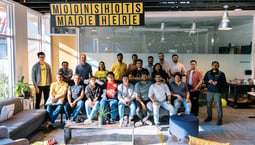




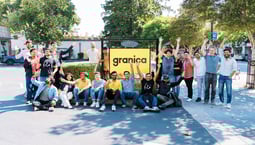
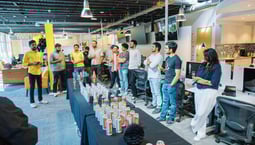


Granica Offices
OnSite Workspace
