Mastercard powers economies and empowers people in 200+ countries and territories worldwide. Together with our customers, we're helping build a sustainable economy where everyone can prosper. We support a wide range of digital payments choices, making transactions secure, simple, smart and accessible. Our technology and innovation, partnerships and networks combine to deliver a unique set of products and services that help people, businesses and governments realize their greatest potential.
Title and Summary
Lead Software Engineer
Overview:
Mastercard's Enterprise and Credit Risk team within Mastercard Services is seeking a Lead Software Engineer to play a critical role in advancing the capabilities of the Enterprise and Credit Risk Products and Architecture capabilities. This role emphasizes technical leadership in design and architecture to support continued growth and scalability. The Lead Software Engineer will operate as a hands-on technical contributor, collaborating with multiple scrum teams to design, build, deploy, and scale real time, interactive applications used by global clients. The role provides direct technical leadership through architectural decision making, design and code reviews, hands on code contributions, and the establishment of engineering standards. It also includes mentoring engineers, guiding them on modern technologies and AI-driven capabilities, and promoting a culture of innovation, engineering excellence, and continuous improvement. This individual will partner closely with other areas of the business to build and enhance solutions that drive value for our customers. This is a hybrid position based in our Pune tech hub requiring three days per week onsite.
Role:
Provide technical leadership by influencing architecture, design decisions, and long-term platform strategy.
Lead the design and development of large-scale, cross-functional initiatives with meaningful business impact.
Act as a hands-on individual contributor who tackles complex engineering challenges across front-end and back-end systems.
Define and guide architectural standards aligned with security, scalability, and performance requirements.
Contribute to the development of agentic AI capabilities as part of ongoing innovation.
Mentor engineers through code reviews, design reviews, and collaborative problem-solving.
Improve and maintain CI/CD pipelines to support reliable and efficient development and deployment workflows.
Drive automation and high-quality release practices to ensure stable and predictable production deployments.
Enhance system observability and monitoring through dashboards, alerts, metrics, and log analysis using tools such as Splunk and Dynatrace.
Lead incident resolution, troubleshooting, and root cause analysis (RCA) to strengthen Products stability and resilience.
Continuously improve engineering processes, coding standards, and architectural best practices across teams.
All About You:
Demonstrated progression in software engineering roles with increasing technical leadership and system ownership.
Strong hands-on experience designing and building large-scale distributed systems.
Expertise in modern programming languages such as Java (preferred), .NET/C#, or Python
Strong knowledge of microservices architecture, API design, and event-driven systems.
Familiarity with distributed system patterns including idempotency, retries, circuit breaking, and backpressure.
Experience working with cloud-native technologies and enterprise platforms, including PostgreSQL, Splunk, and Dynatrace.
Experience developing and maintaining CI/CD pipelines (e.g., Jenkins).
Proven ability to influence technical direction without direct authority.
Experience working with AI-driven systems or agentic architectures (e.g., LLM integrations, AI-enabled automation, or intelligent agents) is a strong plus.
Strong decision-making skills related to technology evaluation, architecture, and framework selection.
Excellent communication and stakeholder management skills, with the ability to clearly explain technical tradeoffs, business value, and ROI.
Bachelor's degree in computer science, Engineering, Information Systems, or equivalent practical experience.
Corporate Security Responsibility
All activities involving access to Mastercard assets, information, and networks comes with an inherent risk to the organization and, therefore, it is expected that every person working for, or on behalf of, Mastercard is responsible for information security and must:
- Abide by Mastercard's security policies and practices;
- Ensure the confidentiality and integrity of the information being accessed;
- Report any suspected information security violation or breach, and
- Complete all periodic mandatory security trainings in accordance with Mastercard's guidelines.
#BI-Hybrid
Skills Required
- Progressive software engineering experience with increasing technical leadership and system ownership
- Hands-on experience designing and building large-scale distributed systems
- Expertise in Java
- Expertise in .NET / C#
- Expertise in Python
- Knowledge of microservices architecture, API design, and event-driven systems
- Familiarity with distributed system patterns (idempotency, retries, circuit breaking, backpressure)
- Experience with cloud-native technologies and enterprise platforms including PostgreSQL, Splunk, and Dynatrace
- Experience developing and maintaining CI/CD pipelines (e.g., Jenkins)
- Experience working with AI-driven systems or agentic architectures (LLM integrations, intelligent agents)
- Mentoring engineers, conducting code and design reviews, and driving engineering best practices
- Bachelor's degree in Computer Science, Engineering, Information Systems, or equivalent practical experience
- Excellent communication and stakeholder management skills
What the Team is Saying


Mastercard Compensation & Benefits Highlights
-
Retirement Support — Careers materials and job postings advertise a “best‑in‑class” 10% retirement match (401k or equivalent). Public-facing benefits pages consistently position this as a standout element of the U.S. package.
-
Leave & Time Off Breadth — Recent U.S. postings list 25 vacation days, 5 personal days, 10 paid holidays, up to 20 days of bereavement, and 80 hours of sick/safe time. The combined time‑off framework is described as well above typical U.S. baselines.
-
Parental & Family Support — Company materials specify a minimum of 16 weeks paid new‑parent leave and inclusive family‑building support, with financial assistance for adoption, fertility, and surrogacy where allowed. Impact/ESG reporting also notes coverage enhancements for gender‑affirming care in North America.
Mastercard Insights

What We Do
Mastercard powers economies and empowers people in 200+ countries and territories worldwide. Together with our customers, we’re building a resilient economy where everyone can prosper. We support a wide range of digital payments choices, making transactions secure, simple, smart and accessible. Our technology and innovation, partnerships and networks combine to deliver a unique set of products and services that help people, businesses and governments realize their greatest potential.
Why Work With Us
We live the Mastercard Way: creating value in the communities we touch, growing together through the opportunities we see, and moving fast to innovate and scale. Our collaborative culture and our passionate people are the key to what we do, driving meaningful change as one team and connecting everyone to priceless possibilities.
Gallery









Mastercard Teams


.jpg)

Mastercard Offices
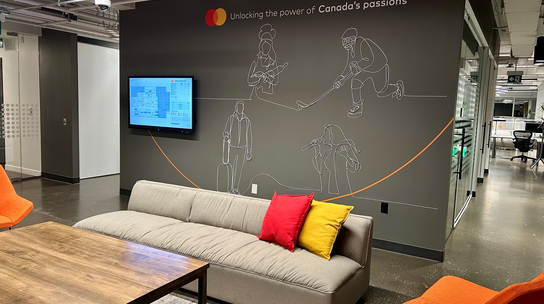
Hybrid Workspace
Employees engage in a combination of remote and on-site work.
In our ongoing workplace evolution, we’ve introduced hybrid work, Work-From-Elsewhere Weeks and Meeting-Free Days.