It’s not hard to see how the mission impacts the product at financial tech company Upside.
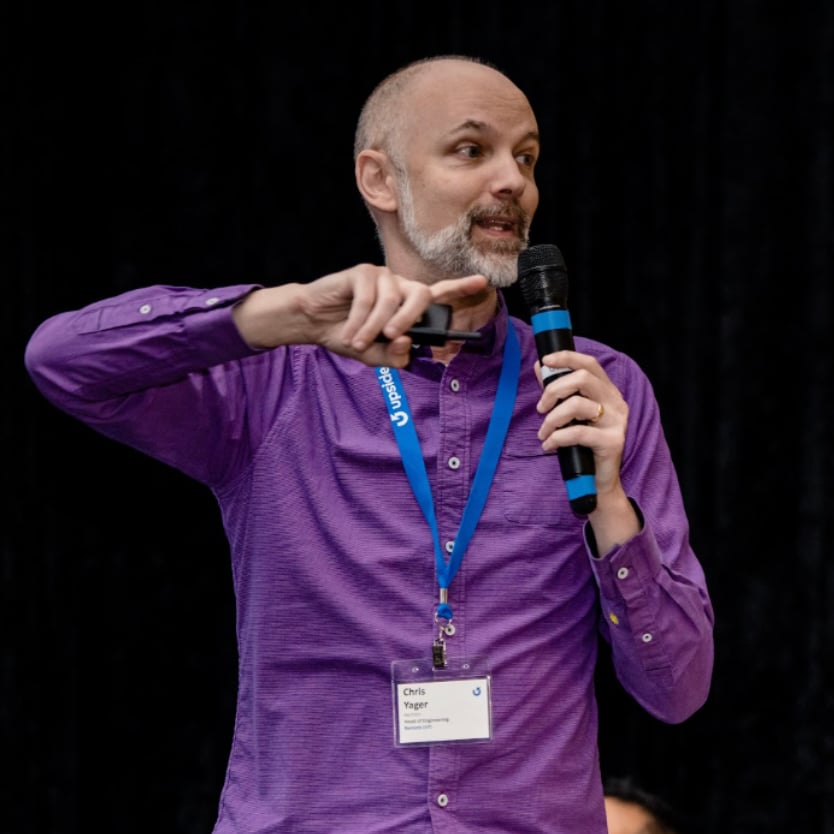
Just ask Chris Yager, head of engineering.
“If you look at our entire product roadmap, it is the mission,” Yager said.
According to Yager, Upside only works if they are benefiting both sides of the equation — the consumer and the retailer.
“So every piece of software we ship is making the merchant experience better, making the consumer experience better or making us more effective at delivering on those promises,” he said.
Upside employees are in good company. Researchers found that half of all employees who feel a strong work purpose — through the company mission and impact they can make alongside it — are reportedly engaged with their work.
Yager shared how the engineering team at Upside stays connected to the company mission in everything they do — from building better products for consumers and business owners to creating internal rituals that celebrate hard work.

Upside is a financial tech company behind the Upside platform, which gives consumers cash back and helps brick-and-mortar businesses earn measurable profit.
How does your team’s work connect to your company’s purpose?
One of the best parts about Upside is that everything we build goes directly to the mission. Upside only works if we’re benefiting both sides of the equation — the consumer and the retailer. So every piece of software we ship is making the merchant experience better, making the consumer experience better or making us more effective at delivering on those promises.
On the merchant side, a lot of partners tell us, “We need more control over what we offer in Upside.” So we’ve built functionality to allow them to shift offers depending on the time of day and time of week. That lets them maximize what they’re offering in a way that makes sense for their unique business, and we’ll keep building more functionality for each merchant we partner with.
On the consumer side, when we get it right, it’s frictionless. Someone thinks, “I went here, I clicked a button, and I got money for doing what I would have done anyway.” That’s when they tell their friends, start using it in more places and the money builds up and starts to make a difference in their lives. Engineering builds the software that makes that happen. That’s the driving force behind everything we do.
What product decisions reflect your organization’s mission?
If you look at our entire product roadmap, it is the mission. Everything on it is either adding more value for the consumer, adding more value for the merchant or making us more stable, secure and resilient so the whole experience holds up. Upside doesn't make money unless we bring value to both the consumer and the merchant, so everything we build naturally falls into those categories.
That includes the trade-off between a new feature and reliability. Both bring value, a feature gives people something new and reliability means the system is up more often and works better. We just have to ask which one will be most beneficial for the vast majority of people using Upside. Sometimes it's one, sometimes it's the other. That's the art of software development.
One I'm especially proud of is still in beta, joining teams through Upside. Today, Upside is about earning personal cash back. But imagine you could send some of that to a local charity you care about and partner with other people to raise money together. We've launched this with a few partnerships. One is local to me; I've joined the team and sent some of my cash back their way, and it's incredibly rewarding.
How do you bring values into day-to-day engineering?
To me, that question is really asking about culture, because culture is simply your day-to-day decisions and how you interact with your teammates, big and small.
Our mission is so integral to the work that it feels natural here. Everyone can look at what they’re building and know how it benefits the consumer or the retailer and get behind it. They also know that if they don’t do a great job, we won’t help those people as well as we could. We regularly remind ourselves of the mission. Even though we know it, it’s important to say it out loud often.
It starts on day one. I just had a new hire start, and the first things they received were our mission and values. My first conversation with them was about what lens to look through as they join.
And it shows up in small ways. Last year, a group of engineers and product managers raised their hands to define what values we should celebrate within R&D. As silly as it sounds, we created custom emojis and little prizes for it and it’s become integral to how we recognize each other. We serve millions now, but we still operate like a smaller, nimbler org, with a lightness and sense of fun in how we work.