
For the past few years, the AI conversation has revolved around one recurring debate: Whose model is better? OpenAI or Anthropic? GPT-5 or Claude?
It’s a fun argument if you’re deep in the ecosystem, but it’s also becoming a distraction from the thing that actually matters to people building or deploying AI systems in the real world. What counts most is whether the infrastructure around these models is reliable, easily accessible and affordable enough to build on scale.
What Is an Agent Harness?
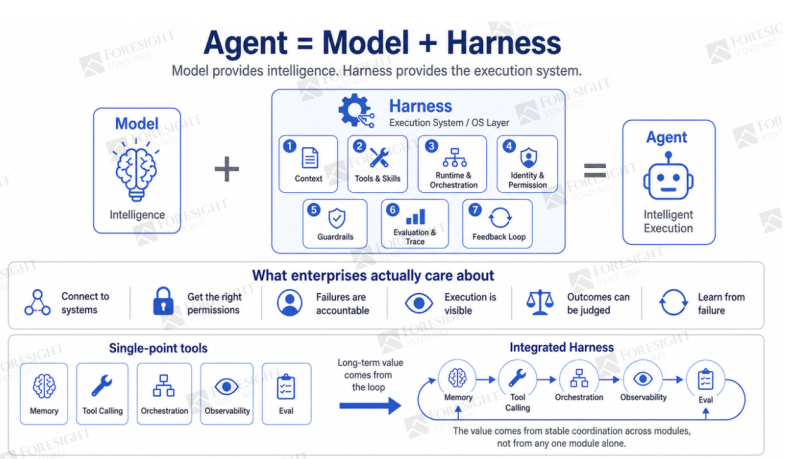
An agent harness is the infrastructure surrounding an AI model that turns it into a reliable operational system. It handles execution details, such as permissions, tool access, runtime analysis, guardrails and audit trails, allowing AI agents to safely take actions across tools, APIs, and databases without causing operational failures.
From Chatbots to Agentic Action
The first wave of generative AI, popularized by OpenAI’s ChatGPT in 2022, was defined by chatbots. You asked a question, the model answered it. Sometimes brilliantly. Sometimes confidently wrong. But the interaction mostly ended there. These systems lived inside chat interfaces, where the downside of failure was usually limited to bad output or an awkward hallucination.
That phase is on its way out now. AI is now moving away from being about chatbots and toward agents that can take actions across tools, APIs, databases and business systems. They can send emails, trigger workflows, move information between platforms, file documents and execute tasks without waiting for constant human input.
While a bad answer from a chatbot is frustrating, a bad action from an AI agent can create compliance problems, operational failures or financial losses that take days to untangle.
Model Strength Alone Doesn’t Solve the Problem
The shift exposes a problem the industry still does not talk about enough: Intelligence alone is not the relevant metric anymore.
A model can correctly identify the next step in a process and still fail completely in production because the surrounding system is weak. Maybe the agent lacks the right permissions or can’t recover from an error halfway through a workflow.
It might so happen that sometimes the model works perfectly while the infrastructure around it quietly collapses. This is where an agent harness becomes important.
Defining Agent Harness
Agent harness is not another chatbot layer or productivity wrapper. It’s the infrastructure that turns a model into a reliable operational system. The harness handles the messy but necessary parts of execution.
These include access to the right tool, having the right permission controls, performing runtime analysis, doing audit trails and evaluation systems that stop agents from doing things they shouldn’t do.
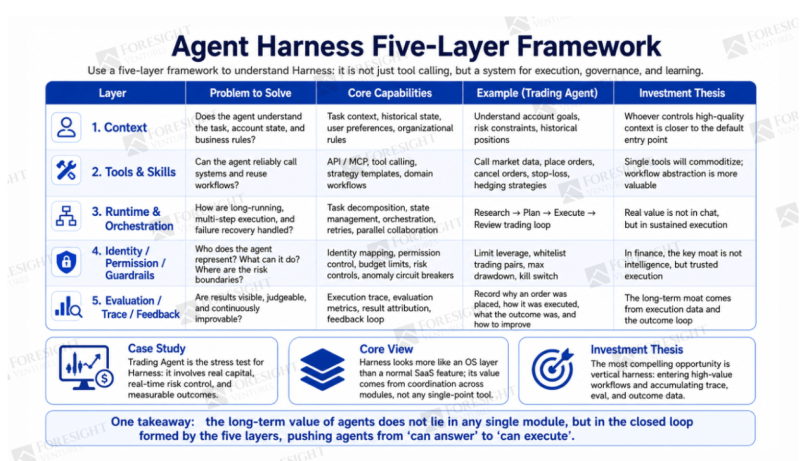
The simplest way to think about it is by using a workplace example. A highly capable fresh hire can cause trouble if nobody explains which systems they’re permitted to access, what the escalation ladder looks like or how their actions should be recorded. Intelligence matters, but structure is what makes that intelligence usable inside a real organization.
Agent Harness and Agentic Workflows
Earlier, much of the AI market was built around wrappers following a clear modus operandi: Take a strong model, add a clean interface and ship a product around it. That strategy worked when access to advanced models was limited and capabilities were improving dramatically every few months.
But in 2026, model access is rapidly commoditizing. As a result, the defensible layer is shifting elsewhere.
The advantage now comes from owning execution inside a specific workflow. Coding agents are an early example of this shift. Their value does not come only from generating code. They become powerful because they can access development environments, understand a codebase, use tools, run tests, recover from errors and continuously improve through feedback from completed tasks. The workflow infrastructure around the model is what allows intelligence to become reliable execution. It comes from integrating deeply into operational systems, managing permissions correctly, understanding domain-specific edge cases and accumulating real execution data over time.
The teams building durable products aren’t necessarily the ones with the smartest models. They’re the ones making those models reliable inside messy environments where failure actually matters.
Introducing the To-Agent Idea
Traditional software was built primarily for humans. Interfaces with eye-pleasing visual workflows made sense because the user was expected to click through every step manually. But AI agents don’t navigate software the way humans do, as they rely on APIs, structured schemas, permission layers and machine-readable outputs.
This is where the idea of “To-Agent” software starts gaining prominence. Just as the industry evolved around To-Business and To-Consumer products, a growing category of software will now need to be designed for agents acting on behalf of users.

Products that are difficult for agents to discover, interpret or execute against may eventually become invisible inside automated workflows, regardless of how polished their user interface looks.
Where This Becomes High Stakes
Agent harness matters most in environments where mistakes are costly. Legal systems warrant every step to be traceable, while the most minute error in healthcare can adversely impact someone’s well being. In cybersecurity, agents may operate with privileged access. In chip design and engineering, small mistakes can snowball into large failures.
In all these domains, what matters is whether the agent’s behavior can be constrained and verified. The harness layer provides this through permissions, necessary guardrails, risk limits and the ability to audit its action. Without it, deploying AI agents in high-stakes environments is not only inefficient, but also unsafe.
For example, a trading agent operating with real capital cannot simply generate a good idea and act freely. It must operate within exposure limits, follow strict permissions and produce a traceable record of how every decision was made. The model handles the reasoning, but the surrounding harness determines whether that reasoning can be executed safely.
Execution Data as the New Moat
Enterprises aren’t just asking whether an AI system is intelligent. They’re asking whether it is auditable, recoverable and controllable once deployed inside real operations.
That’s why execution data may become one of the most important moats in the next phase of AI.
Traditional AI systems learned primarily from human behavior — clicks, prompts and engagement patterns. Agentic systems generate something far more valuable, which is execution trajectories. They capture what the agent attempted, where it failed, how it recovered and which workflows consistently broke under real conditions.
Over time, that operational feedback becomes difficult to replicate. The companies collecting rich execution data from real deployments aren’t just improving model quality They’re also improving reliability in ways existing benchmark scores can’t measure.
The winners in this next phase may not be the loudest model companies. They may be the quieter infrastructure players building the systems that finally make AI trustworthy enough to act.