


Snap Inc is a technology company. We believe the camera presents the greatest opportunity to improve the way people live and communicate. Snap contributes to human progress by empowering people to express themselves, live in the moment, learn about the world, and have fun together.
The Company operates Snapchat, a visual messaging app that enhances your relationships with friends, family, and the world, and Specs Inc., a wholly-owned subsidiary dedicated to making computing more human, in addition to Bitmoji, Saturn, and other digital services.
The Spectacles team is pushing the boundaries of technology to bring people closer together in the real world. Our fifth-generation Spectacles, powered by Snap OS, showcase how standalone, see-through AR glasses make playing, learning, and working better together.
Snap’s camera supports real friendships through visual communication, self expression and storytelling. Moving forward, our camera will play a transformative role in how people experience the world around them, combining what they see in the real world, with all that’s available to them in the digital world.
We are looking for a Machine Learning/ Software Engineering thesis student to join our team at Snap Inc!
What you’ll do
Project background & research context:
Conventional frame-based pipelines and large neural networks are often too slow and power-hungry for always-on, real-time AR. They process every frame exhaustively, move large amounts of data through memory, and quickly hit strict latency, energy, and bandwidth limits on embedded hardware. Event-based sensing and processing, combined with other efficiency-oriented techniques, open up a fundamentally different design space. By exploiting temporal and spatial sparsity, we can:
Turn always-on perception into something that fits within strict power budgets
Push more intelligence closer to the sensor, reducing latency and data movement
Co-design models and systems that are built for edge hardware, rather than shrinking down server-scale architectures
In this project, you will explore how to combine modern deep learning with event-based and embedded processors to push the limits of what AR glasses can do on-device. You will help answer questions such as:
How can we architect models that are both accurate and ultra-efficient for real-world AR tasks on event-driven or low-power hardware?
What are the right trade-offs between accuracy, latency, memory, and energy for different AR scenarios?
How do we turn promising research ideas into practical, measurable improvements on realistic platforms and workloads?
Your work will directly inform how future AR experiences can run locally, responsively, and efficiently on next-generation devices
As a thesis student, you will define and drive a focused research direction in efficient on-device ML for AR, with a particular emphasis on event-driven or embedded processors. Possible directions within this space include:
Design and prototype ML models tailored to AR use cases under embedded constraints (e.g., event-based vision models, lightweight CNNs/Vision Transformers, or hybrid frame+event pipelines).
Set up datasets and baselines relevant to AR tasks (e.g., detection, tracking, segmentation, gesture/interaction), and define evaluation metrics across accuracy, latency, memory usage, and energy.
Implement and train models in PyTorch, including data pipelines, training loops, and evaluation scripts that are easy to extend and reproduce.
Explore efficiency techniques such as sparsity, pruning, quantization (PTQ/QAT), or event-based representations, and study their impact on performance–efficiency trade-offs.
Profile models under embedded-like conditions using simulators, profiling tools, or edge accelerators to understand system-level behavior (e.g., FLOPs, latency, memory footprint, bandwidth).
Communicate your findings through ablation studies, a clear thesis report (and optionally a paper-style write-up), and a reproducible codebase with pre-trained checkpoints.
Expected Outcomes
By the end of the project, you are expected to:
Demonstrate proof-of-concepts on AR hardware (e.g., Spectacles) showcasing real-world impact
Deliver measurable improvements in runtime performance, efficiency, and adaptability for representative AR tasks
Provide insights into model–system co-design for low-power, on-device ML
Contribute to ML frameworks, tooling, or deployment strategies for embedded AR systems
Produce a high-quality thesis report (and optionally a paper-style write-up) with reproducible code and results
Minimum qualifications
Currently enrolled in a Master’s program (e.g., Computer Science, Electrical/Computer Engineering, Artificial Intelligence, Robotics, or a related field).
Degree program allows a Master’s thesis / graduation project in collaboration with an external organization.
Strong background in:
Linear algebra, probability, and optimization
Deep learning fundamentals, including backpropagation, regularization, and basic model architectures
Hands-on experience training deep learning models for computer vision, including:
Experience with PyTorch (preferred) or a similar framework
Comfort implementing and training CNNs and/or vision transformers
Proficiency in Python and standard ML tooling (e.g., NumPy, PyTorch, Git, basic experiment management).
Interest in turning research ideas into robust, reproducible codebases that others can build on.
Preferred qualifications
Experience with one or more of:
Event-based or streaming vision, or other non-conventional sensor modalities
Model compression techniques: pruning, sparsity, quantization, or knowledge distillation
Efficient architectures for embedded or real-time applications (e.g., lightweight backbones, dynamic computation, conditional execution)
Familiarity with embedded / on-device ML toolchains (e.g., TensorFlow Lite, ONNX Runtime, or similar frameworks).
Experience with AI-assisted development and research tools (e.g., experiment tracking, ML tooling, or LLM-based coding and analysis assistants).
Exposure to performance profiling and basic systems concepts: FLOPs, latency, memory access patterns, and bandwidth.
Practical details
Project type: Master’s Thesis / Graduation Project
Focus: Efficient on-device ML for AR applications on embedded and/or event-driven processors
Duration & scope: Minimum of 8 months, up to 12 months, aligned with university and team requirements
Location: Eindhoven, the Netherlands, with a minimum of 4 days per week in the office
Start date: Flexible, to be agreed based on candidate and university timelines
If you have a disability or special need that requires accommodation, please don’t be shy and provide us some information.
"Default Together" Policy at Snap: At Snap Inc. we believe that being together in person helps us build our culture faster, reinforce our values, and serve our community, customers and partners better through dynamic collaboration. To reflect this, we practice a “default together” approach and expect our team members to work in an office 4+ days per week.
At Snap, we believe that having a team of diverse backgrounds and voices working together will enable us to create innovative products that improve the way people live and communicate. Snap is proud to be an equal opportunity employer, and committed to providing employment opportunities regardless of race, religious creed, color, national origin, ancestry, physical disability, mental disability, medical condition, genetic information, marital status, sex, gender, gender identity, gender expression, pregnancy, childbirth and breastfeeding, age, sexual orientation, military or veteran status, or any other protected classification, in accordance with applicable federal, state, and local laws. EOE, including disability/vets.
Our Benefits: Snap Inc. is its own community, so we’ve got your back! We do our best to make sure you and your loved ones have everything you need to be happy and healthy, on your own terms. Our benefits are built around your needs and include paid parental leave, comprehensive medical coverage, emotional and mental health support programs, and compensation packages that let you share in Snap’s long-term success!
Skills Required
- Currently enrolled in a Master's program in Computer Science, Electrical/Computer Engineering, or related field
- Strong background in linear algebra, probability, and optimization
- Hands-on experience training deep learning models for computer vision
- Experience with PyTorch or a similar framework
- Proficiency in Python and standard ML tooling
What the Team is Saying







.png)


.png)


Snap Inc. Compensation & Benefits Highlights
-
Parental & Family Support — Parental leave offers up to 28 weeks with a return-to-work program, alongside adoption, surrogacy, infertility, and fertility-preservation support via partners like Carrot. Additional resources such as backup child care, caregiver assistance (Wellthy), lactation rooms, and breast-milk shipping further strengthen family support.
-
Healthcare Strength — Comprehensive medical, dental (including orthodontia), and vision (including LASIK and a frame/contact allowance) coverage is paired with free One Medical membership, virtual physical therapy, and well-being reimbursements. Mental-health access includes 15 annual Lyra sessions for employees and dependents.
-
Retirement Support — A 401(k) with immediate vesting and a match of 100% up to 3% plus 50% on the 4th and 5th percent is complemented by pre-tax, Roth, and after-tax contributions including a Mega Backdoor Roth option. HSAs/FSAs, financial education, Rocket Lawyer access, and employee equity round out the financial benefits.
Snap Inc. Insights

What We Do
We contribute to human progress by empowering people to express themselves, live in the moment, learn about the world, and have fun together.
Gallery

Snap Inc. Teams


Snap Inc. Offices
Hybrid Workspace
Employees engage in a combination of remote and on-site work.
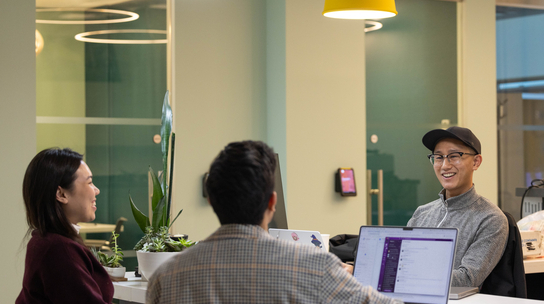
Our “default together” approach is an 80/20 model where we are asking team members to spend 80% of the time, on average, in the office, with the remaining 20% of the time spent remote.
