

Deepgram is the leading platform underpinning the emerging trillion-dollar Voice AI economy, providing real-time APIs for speech-to-text (STT), text-to-speech (TTS), and building production-grade voice agents at scale. More than 200,000 developers and 1,300+ organizations build voice offerings that are ‘Powered by Deepgram’, including Twilio, Cloudflare, Sierra, Decagon, Vapi, Daily, Cresta, Granola, and Jack in the Box. Deepgram’s voice-native foundation models are accessed through cloud APIs or as self-hosted and on-premises software, with unmatched accuracy, low latency, and cost efficiency. Backed by a recent Series C led by leading global investors and strategic partners, Deepgram has processed over 50,000 years of audio and transcribed more than 1 trillion words. There is no organization in the world that understands voice better than Deepgram.
Company Operating RhythmAt Deepgram, we expect an AI-first mindset—AI use and comfort aren’t optional, they’re core to how we operate, innovate, and measure performance.
Every team member who works at Deepgram is expected to actively use and experiment with advanced AI tools, and even build your own into your everyday work. We measure how effectively AI is applied to deliver results, and consistent, creative use of the latest AI capabilities is key to success here. Candidates should be comfortable adopting new models and modes quickly, integrating AI into their workflows, and continuously pushing the boundaries of what these technologies can do.
Additionally, we move at the pace of AI. Change is rapid, and you can expect your day-to-day work to evolve just as quickly. This may not be the right role if you’re not excited to experiment, adapt, think on your feet, and learn constantly, or if you’re seeking something highly prescriptive with a traditional 9-to-5.
About the RoleDeepgram's speech models are among the fastest and most accurate in the world, and we have deep machinery for running them on NVIDIA GPUs. Our customers need them on everything else: non-NVIDIA accelerators, embedded SoCs, mobile application processors, DSPs and NPUs, and purpose-built devices with tight memory, compute, thermal, and power budgets. When a target platform's standard kernels and runtime can't run a Deepgram model well enough, someone has to go below them. That is this role.
As an Embedded AI Engineer on the Partner Platform Engineering team, you work at the lowest layer of our edge stack. You write and optimize custom kernels and operators for specific hardware, collapse models onto device-specific execution units, and do the target-side quantization and assembly-level tuning that standard toolchains can't. You hand what you build up to Applied ML Engineers, who fit Deepgram models to your kernels. Your work is what makes a new hardware platform viable for Deepgram at all.
This role is a great fit for a senior embedded engineer who has spent their career close to the metal and wants to point that at speech AI, or a staff-level engineer who wants to define how Deepgram's models get onto new silicon. We'll set the level to your experience.
What You'll DoWrite and optimize custom kernels and operators (C, C++, Rust, and platform assembly or intrinsics) for non-NVIDIA accelerators, embedded SoCs, DSPs, and NPUs where the vendor's standard operator set is insufficient for Deepgram models.
Own target-side optimization: collapse models onto device execution units through quantization, operator fusion, memory layout, and architecture-specific compilation to meet latency, memory, power, and thermal budgets.
Integrate with vendor NPU/DSP toolchains and edge inference runtimes, and extend them with custom operators when the graph doesn't map cleanly.
Deliver kernels and runtime components as reusable building blocks that Applied ML Engineers can target when adapting models, with clear interfaces and documented constraints.
Build performance-critical runtime code for embedded environments, including embedded Linux, bare-metal, and RTOS targets.
Establish per-platform benchmarking and validation for latency, accuracy, power, memory footprint, and utilization, and catch regressions before they ship.
Partner with silicon and platform vendors on SDK integration and low-level performance tuning for new chipsets and reference platforms.
Feed hardware constraints back to Applied ML and Research so model designs are easier to land on constrained targets.
Find deep satisfaction in making a large model run on hardware that was never meant to run it, and still hitting accuracy and latency targets.
Reach for the profiler and the ISA manual before you reach for a bigger chip.
Would rather write the kernel than wait for the vendor to ship it.
Care about the details that don't show up in a cloud benchmark: cold start, power draw, thermals, memory fragmentation, cache behavior.
Prefer hard, constrained, ship-it problems over open-ended research.
Care about the details that don't show up in a cloud benchmark: cold-start time, power draw, thermals, and memory fragmentation.
Experience delivering production systems on resource-constrained hardware — embedded systems, mobile, edge AI, or small low-power devices.
Strong proficiency in C, C++, and/or Rust, with experience writing performance-critical code for constrained environments.
Hands-on experience with model optimization for on-device deployment, including quantization, pruning, knowledge distillation, or architecture-specific compilation.
Familiarity with edge inference runtimes (e.g., ONNX Runtime, TensorRT, TFLite, ExecuTorch) and/or vendor-specific NPU/DSP toolchains.
A strong understanding of hardware-software interaction — CPU/GPU/NPU/DSP architectures, memory hierarchies, fixed-point/integer arithmetic, and power management — and how they affect inference performance.
Experience working close to the metal: bare-metal or RTOS environments (e.g., FreeRTOS, Zephyr), embedded Linux, or microcontroller and edge SoC development.
Strong communication skills and a builder mindset — you can scope an ambiguous optimization problem, drive it to a measurable result, and explain the tradeoffs clearly.
Experience with real-time audio processing on embedded platforms — DSP pipelines, audio codec optimization, wake-word or always-on listening, or streaming inference on microcontrollers and edge SoCs.
Depth in ML optimization techniques — custom quantization schemes, mixed-precision inference, or neural architecture search for edge targets.
Background in hardware evaluation and benchmarking — systematically comparing accelerators, SoCs, or GPUs for specific workload profiles.
Experience shipping AI features in consumer products at scale, and the instinct for what "production quality" means on a battery-powered device.
Familiarity with model compilation and optimization toolchains and their tradeoffs across hardware targets.
Experience with secure, robust on-device deployment practices — code signing, encrypted model storage, and safe update mechanisms.
Notice: We're aware of individuals impersonating Deepgram recruiters. All legitimate Deepgram recruiting communication comes from an @deepgram.com email address. If you've received a message claiming to be Deepgram, please forward it to [email protected].
Skills Required
- Experience delivering production systems on resource-constrained hardware (embedded systems, mobile, edge AI, low-power devices).
- Strong proficiency in C, C++, and/or Rust with performance-critical embedded code experience.
- Hands-on experience with model optimization for on-device deployment: quantization, pruning, knowledge distillation, operator fusion, or architecture-specific compilation.
- Familiarity with edge inference runtimes (ONNX Runtime, TensorRT, TFLite, ExecuTorch) and/or vendor-specific NPU/DSP toolchains.
- Strong understanding of hardware-software interaction: CPU/GPU/NPU/DSP architectures, memory hierarchies, fixed-point/integer arithmetic, and power management.
- Experience with bare-metal or RTOS environments (e.g., FreeRTOS, Zephyr), embedded Linux, or microcontroller/edge SoC development.
- Strong communication skills and ability to scope ambiguous optimization problems and deliver measurable results.
- Experience with real-time audio processing on embedded platforms (DSP pipelines, audio codecs, wake-word, streaming inference).
- Depth in ML optimization techniques (custom quantization schemes, mixed-precision inference, neural architecture search for edge targets).
- Background in hardware evaluation and benchmarking of accelerators, SoCs, or GPUs.
- Experience shipping AI features in consumer products at scale and understanding production-quality constraints on battery-powered devices.
- Familiarity with model compilation and optimization toolchains and tradeoffs across hardware targets.
- Experience with secure on-device deployment practices: code signing, encrypted model storage, safe OTA update mechanisms.
What the Team is Saying




.jpeg)


.jpeg)
Deepgram Compensation & Benefits Highlights
-
Healthcare Strength — Health coverage is described as comprehensive, including medical, dental, vision, mental health, and life/short- and long-term disability insurance. Feedback suggests this, paired with a wellness stipend, provides robust core protection.
-
Leave & Time Off Breadth — Time off is positioned as generous with unlimited PTO, paid U.S. holidays, flexible schedules, and paid parental leave. Feedback suggests these policies support work-life balance, especially in a remote-friendly setup.
-
Wellbeing & Lifestyle Benefits — Stipends for wellness, home-office setup, and quarterly productivity, plus learning/education support and ERGs, are highlighted. Feedback suggests these lifestyle and development perks enhance the overall total rewards experience.
Deepgram Insights

What We Do
Deepgram is the leading voice AI platform for developers building speech-to-text (STT), text-to-speech (TTS) and full speech-to-speech (STS) offerings. 200,000+ developers build with Deepgram’s voice-native foundational models – accessed through APIs or as self-managed software – due to our unmatched accuracy, latency and pricing. Customers include software companies building voice products, co-sell partners working with large enterprises, and enterprises solving internal voice AI use cases. The company ended 2024 cash-flow positive with 400+ enterprise customers, 3.3x annual usage growth across the past 4 years, over 50,000 years of audio processed and over 1 trillion words transcribed. There is no organization in the world that understands voice better than Deepgram.
Why Work With Us
Our culture, like our product, is constantly learning and evolving, but the heart of our team is enduring. We are a self-motivated, positive, passionate, and competitive group of people. At Deepgram, we put an emphasis on being ourselves, being curious, growing together, and being human. We are a unique bunch who celebrate our differences.
Gallery


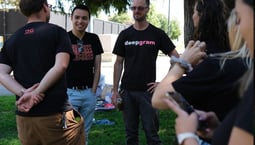
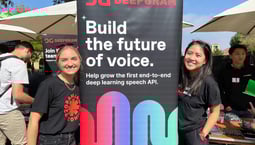
_1.jpeg)

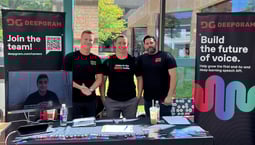


Deepgram Offices
Remote Workspace
Employees work remotely.
