


We’re seeking a Product Designer to join our Ground Control Station (GCS) team and shape the user experience of next-generation UAS control software. This role is ideal for a systems-minded designer with a passion for solving complex UX problems in mission-critical, real-time environments.
You’ll work alongside engineers, operators, and product teams to design intuitive workflows and spatial interfaces that allow users to plan, command, and monitor autonomous assets with confidence and clarity.
What you'll do:
- Lead design efforts for key GCS capabilities, ensuring user needs are met across the full development lifecycle.
- Collaborate with engineering, autonomy, product, and test teams to gather system constraints and translate them into user-centered design solutions.
- Influence cross-functional planning, roadmap prioritization, and long-term product vision.
- Drive the end-to-end design process—from concept, wireframes, and prototypes to detailed UI specs and implementation support.
- Regularly test and iterate on designs with real users, incorporating feedback to improve usability and mission effectiveness.
- Help define and maintain a coherent visual and interaction language that supports real-time control, situational awareness, and operational trust.
- Advocate for operator experience and usability in high-stakes environments where clarity, speed, and precision are critical.
- Contribute to the evolution of our design systems, tooling, and cross-platform interface strategy.
- Travel to test flights to perform operator research and support the rollout of new GCS features.
Required qualifications:
- Minimum of 5 years of design, HCI, or related experience with a Bachelor’s degree; or 4 years and a Master’s degree; or a PhD with 3 years of experience; or equivalent experience.
- 3+ years of experience leading end-to-end product design across complex features or products.
- Proven track record designing complex, interactive systems—especially in domains involving spatial data, control interfaces, or high information density.
- Demonstrated expertise in Figma as a primary design tool for creating scalable, system-driven designs.
- Deep experience working within cross-functional teams, synthesizing and input from Product Management and Engineering.
- Experience conducting usability testing and integrating user feedback into iterative design cycles.
- Excellent communication skills, with the ability to clearly articulate design rationale and tradeoffs.
- Ability to work efficiently, demonstrating bias for action in a fast-paced, ambiguous environment.
- Ability to obtain security clearance.
Preferred qualifications:
- Experience designing interfaces for real-time control systems (e.g., UAS, robotics, vehicles, or aviation platforms).
- Familiarity with military or mission-critical systems and operator workflows.
- Understanding of design constraints imposed by low-latency or high-performance software systems.
- Exposure to 2D/3D mapping, telemetry visualization, or command-and-control interfaces.
- Familiarity with web-based frontends (React, WebGL, etc.) or embedded UI technologies.
- Familiarization with, and experience implementing, Military Standards (MIL-STDs) to product design.
Skills Required
- Minimum of 7 years design/HCI experience with Bachelor's (or equivalent combinations of advanced degree and experience)
- 3+ years leading end-to-end product design across complex features or products
- Proven track record designing complex, interactive systems involving spatial data, control interfaces, or high information density
- Demonstrated expertise in Figma as a primary design tool
- Deep experience working within cross-functional teams (Product Management and Engineering)
- Experience conducting usability testing and integrating user feedback
- Excellent communication skills and ability to articulate design rationale and tradeoffs
- Ability to work efficiently with bias for action in fast-paced, ambiguous environments
- Experience designing interfaces for real-time control systems (UAS, robotics, vehicles, aviation platforms)
- Familiarity with military or mission-critical systems and operator workflows
- Understanding of design constraints imposed by low-latency or high-performance software systems
- Exposure to 2D/3D mapping, telemetry visualization, or command-and-control interfaces
- Familiarity with web-based frontends (React, WebGL) or embedded UI technologies
- Familiarization with and experience implementing Military Standards (MIL-STDs) to product design
What the Team is Saying


Shield AI Compensation & Benefits Highlights
-
Healthcare Strength — Healthcare coverage is described as excellent, with dental/vision and mental‑health support, and ancillary protections like life and disability appearing in benefit summaries. The breadth and perceived affordability of coverage are highlighted as a standout component of the package.
-
Parental & Family Support — Paid parental leave is featured alongside enhanced maternity benefits, fertility and childcare support, and onsite resources such as a Mother’s Room. These elements are positioned as competitive and above the minimal baseline for the company’s stage.
-
Equity Value & Accessibility — Equity is granted to all full‑time hires, with RSUs, double‑trigger tax timing, and tools to model scenarios (e.g., through Carta Tax). Communications also reference a transition from options to RSUs, reinforcing access and maturity of ownership programs.
Shield AI Insights

What We Do
At Shield AI, you won't wait years to see your work reach the field. You'll build hardware and software that operates in the real world right now, in the hands of the people who depend on it. Hivemind, our AI pilot, has been flying since 2018. It has flown more than 30 platforms, including an F-16, and it now sits under a U.S. Air Force production contract for Collaborative Combat Aircraft. When you write code or shape a system here, you contribute to technology with a proven flight record and a clear production future. V-BAT flies intelligence, surveillance, and reconnaissance missions with an operational record that stretches from Ukraine to the Indo-Pacific. It delivers eyes where they matter most, in the most demanding conditions on earth. The teams behind it watch their work get tested where the stakes are real. X-BAT takes its first flight this year. It's an AI-piloted fighter that needs no runway, built to operate where traditional aircraft can't. Join now and you help shape a program at its earliest, most formative stage. That's the kind of ground-floor work that defines a career. Do the most impactful work of your life, on problems that matter. Autonomy at this level asks a lot of you. You'll take on problems in perception, planning, and control that few teams anywhere are equipped to solve. You'll work across disciplines, from aerospace and robotics to machine learning and systems engineering, alongside people who hold themselves to an exacting standard and expect the same from you. Our mission is clear: protect service members and civilians with intelligent systems. That purpose runs through every decision, every design review, and every deployment. It's why the work here carries a weight you can feel. Ready to join our mission? Explore our open roles and find where you fit.
Why Work With Us
Founded in 2015 by a former Navy SEAL, Shield AI builds AI pilots and uncrewed aircraft. Veterans aren't an afterthought here, they're at every level. It's why the work carries weight: AI pilots and uncrewed aircraft flying real missions, from Ukraine to the Indo-Pacific, protecting service members and civilians.
Gallery
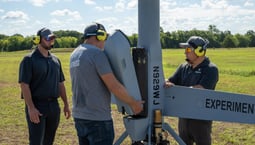
%203.jpg)

Shield AI Teams
.jpg)


Shield AI Offices
Hybrid Workspace
Employees engage in a combination of remote and on-site work.

