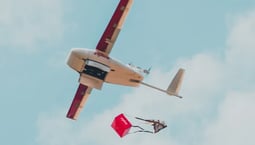
Zipline is the world’s largest and most experienced drone delivery service. We are on a mission to serve all humans equally by ensuring access to food, medicine and essential goods anytime, anywhere. We design, build, and operate the world’s largest autonomous logistics system, delivering critical supplies quickly and reliably. Today, Zipline operates on four continents, makes a delivery somewhere in the world every 30 seconds, and has completed millions of deliveries to date, including blood, vaccines, medical supplies, food, and retail products.
Our customers include the world’s largest and most prominent healthcare systems, governments, retailers, restaurants and global businesses who rely on us to save lives, reduce emissions, increase economic opportunity, and provide delivery from point A to point B as fast as possible. The drone is only 15% of what we’ve built to enable seamless, reliable, global operations.
Our system strengthens supply chains, reduces congestion, and gives people time back. With more than 140 million commercial autonomous miles safely flown, Zipline is redefining access to healthcare, consumer products, and food across the globe.
We operate at a global scale and are looking for practical problem solvers who thrive on real-world challenges and rapid growth. Our team is motivated by building systems that have a direct, meaningful impact on people’s lives and by scaling the future of logistics. We are seeking people who sculpt from first principles, enjoy facing adversity, and can do the impossible at record breaking speeds.
Zipline builds and operates autonomous delivery systems that move critical goods reliably and safely. Cameras and optical modules provide critical perception inputs used by our aircraft and autonomous systems. Their mechanical design directly affects image quality, calibration stability, environmental robustness, electromagnetic compatibility, and ultimately the system’s ability to operate safely.
As a Mechanical Design Engineer for Camera and Optical Modules, you will own the mechanical architecture and detailed design of camera assemblies from early concept through validation, production ramp, and fleet operation. You will integrate image sensors, lenses, optical windows and filters, electronics, flexes, connectors, thermal paths, shielding, seals, and cleaning or contamination-control features into compact, lightweight, production-ready assemblies.
This is a hands-on individual-contributor role. You will work at the boundary of mechanical engineering, optics, electronics, perception, thermal design, and high-volume manufacturing. Your designs must preserve alignment and image quality through vibration, temperature cycling, shock, contamination, weather exposure, and years of field operation.
What You'll Do- Own end-to-end mechanical design for camera and optical assemblies, including requirements, architecture, concept selection, CAD, drawings, specifications, tolerance analysis, BOMs, and production release.
- Translate perception, optical, electrical, environmental, and aircraft-level requirements into measurable mechanical requirements and acceptance criteria.
- Establish datum, alignment, and calibration strategies that control lens-to-sensor focus, tilt, decenter, optical-axis orientation, stereo baseline, and camera-to-vehicle boresight.
- Develop tolerance models that connect component and assembly variation to image-quality and perception outcomes, including focus retention, modulation transfer, calibration accuracy, and field-of-view stability.
- Design lightweight housings, mounts, lens barrels, optical-window interfaces, thermal paths, shields, seals, vents, and connector interfaces for high-volume production.
- Integrate image sensors, lenses, filters, PCBAs, SerDes electronics, flex circuits, connectors, heaters, cleaning devices, and local sensors into robust modules.
- Design for rain, dust, mud, insects, condensation, fogging, icing, UV exposure, cleaning chemicals, and other contamination modes that can degrade optical performance.
- Evaluate hydrophobic and oleophobic coatings, protective windows, heaters, air-based cleaning, ultrasonic cleaning, shutters, and other contamination-control approaches.
- Define EMI shielding, grounding, and bonding strategies across the housing, lens aperture, sensor PCB, flex, and connector interfaces. Ensure conductive features have intentional grounding and do not create resonant or floating structures.
- Perform first-principles analysis, hand calculations, tolerance analysis, structural FEA, thermal analysis, and vibration or fatigue assessments to establish design margins.
- Define and support mechanical, environmental, and image-quality testing across vibration, shock, thermal cycling, humidity, ingress, solar loading, contamination, and lifetime exposure.
- Lead investigations of prototype, production, and field failures. Identify root cause, implement corrective actions, and verify that recurrence rates decrease.
- Maintain clear interface-control documentation, design assumptions, analysis, validation evidence, and release records.
- Experience designing camera modules, optical instruments, perception sensors, robotics hardware, automotive electronics, aerospace hardware, or similarly compact electromechanical products.
- Strong mechanical fundamentals, including structural mechanics, thermal design, material selection, bolted joints, adhesive joints, sealing, vibration, fatigue, and tolerance analysis.
- Advanced CAD, GD&T, datum-strategy, drawing-release, and tolerance-stack skills.
- Practical understanding of camera and optical alignment concepts such as focus, tilt, decenter, boresight, field of view, stereo baseline, calibration stability, and image-quality sensitivity.
- Experience with relevant manufacturing processes such as precision machining, die casting, injection molding, stamping, optical bonding, adhesive dispensing, coating, and clean assembly.
- Track record of resolving difficult mechanical, optical, thermal, or intermittent field failures through disciplined root-cause analysis.
- Experience working directly with suppliers and manufacturing teams to improve yield, capability, cost, and assembly repeatability.
- Clear written and verbal communication, including the ability to document assumptions, residual risks, design margins, and release recommendations.
- This role is based in South San Francisco and requires regular hands-on work in the lab. Travel to suppliers, manufacturers, and test locations will be required as program needs dictate.
- Periodic off-hours support may be required during test campaigns, production ramps, or urgent field investigations.
Nice to Have
- Experience with automotive, aerospace, drone, or robotic camera systems.
- Experience correlating mechanical variation with optical metrics such as MTF, distortion, focus, or calibration error.
- Experience with camera cleaning systems, optical coatings, condensation mitigation, or contamination detection.
- Familiarity with GMSL, MIPI, camera SerDes, local image processing, or high-speed camera interconnects.
- Experience designing EMI shielding and grounding for camera modules and high-speed electronics.
- Experience developing mechanically stable stereo or multi-camera systems.
- Familiarity with automated optical alignment, calibration, and end-of-line image-quality testing.
What Success Looks Like
- Camera modules consistently meet image-quality, calibration, thermal, mass, and environmental requirements across manufacturing variation and operating life.
- Optical alignment and focus remain stable through vibration, shock, temperature cycling, contamination, and fleet use.
- Designs ramp to production while meeting agreed yield, cost, cycle-time, and supplier-capability targets.
- Cleaning and environmental-protection features measurably reduce obscured images, maintenance actions, and camera-related availability losses.
- Mechanical and EMI design changes reduce camera-related perception faults, GNSS desense risks, and field failures.
- The resulting architecture supports future camera generations, sensor changes, and cost reduction without requiring a complete mechanical redesign.
The starting cash range for this role is $135,000 - $225,000. Please note that this is a target, starting cash range for a candidate who meets the minimum qualifications for this role. The final cash pay for this role will depend on a variety of factors, including a specific candidate's experience, qualifications, skills, working location, and projected impact. The total compensation package for this role may also include: equity compensation; discretionary annual or performance bonuses; sales incentives; benefits such as medical, dental and vision insurance; paid time off; and more.
Zipline is an equal opportunity employer and prohibits discrimination and harassment of any type without regard to race, color, religion, age, sex, national origin, disability status, genetics, protected veteran status, sexual orientation, gender identity or expression, or any other characteristic protected by federal, state or local laws or our own sensibilities.
We value diversity at Zipline and welcome applications from those who are traditionally underrepresented in tech. If you like the sound of this position but are not sure if you are the perfect fit, please apply!
For government reporting purposes, we ask candidates to respond to the below self-identification survey. Completion of the form is entirely voluntary. Whatever your decision, it will not be considered in the hiring process or thereafter. Any information that you do provide will be recorded and maintained in a confidential file.
As set forth in Zipline ’s Equal Employment Opportunity policy, we do not discriminate on the basis of any protected group status under any applicable law.
Skills Required
- Experience designing camera modules, optical instruments, perception sensors, robotics hardware, automotive electronics, aerospace hardware, or similarly compact electromechanical products
- Strong mechanical fundamentals in structural mechanics, thermal design, material selection, bolted joints, adhesive joints, sealing, vibration, fatigue, and tolerance analysis
- Advanced CAD, GD&T, datum strategy, drawing release, and tolerance-stack skills
- Practical understanding of camera and optical alignment concepts including focus, tilt, decenter, boresight, field of view, stereo baseline, calibration stability, and image-quality sensitivity
- Experience with precision machining, die casting, injection molding, stamping, optical bonding, adhesive dispensing, coating, and clean assembly
- Track record of resolving difficult mechanical, optical, thermal, or intermittent field failures through root-cause analysis
- Experience working directly with suppliers and manufacturing teams to improve yield, capability, cost, and assembly repeatability
- Clear written and verbal communication, including documentation of assumptions, residual risks, design margins, and release recommendations
- Regular hands-on laboratory work in South San Francisco
- Travel to suppliers, manufacturers, and test locations as program needs dictate
- Periodic off-hours support during test campaigns, production ramps, or urgent field investigations
- Experience with automotive, aerospace, drone, or robotic camera systems
- Experience correlating mechanical variation with optical metrics such as MTF, distortion, focus, or calibration error
- Experience with camera cleaning systems, optical coatings, condensation mitigation, or contamination detection
- Familiarity with GMSL, MIPI, camera SerDes, local image processing, or high-speed camera interconnects
- Experience designing EMI shielding and grounding for camera modules and high-speed electronics
- Experience developing mechanically stable stereo or multi-camera systems
- Familiarity with automated optical alignment, calibration, and end-of-line image-quality testing
Zipline Compensation & Benefits Highlights
The following summarizes recurring compensation and benefits themes identified from responses generated by popular LLMs to common candidate questions about Zipline and has not been reviewed or approved by Zipline.
-
Healthcare Strength — Healthcare coverage is consistently described as comprehensive and high quality, with multiple plan choices, low out‑of‑pocket costs, and additions like HRA, One Medical, and fertility support.
-
Parental & Family Support — Parental and family leave is highlighted as generous and meaningfully used, reinforcing support for major life events.
-
Leave & Time Off Breadth — Paid time off, sick days, and holidays are portrayed as solid and broadly available, contributing to overall benefits depth.
Zipline Insights

What We Do
Zipline is the world's largest autonomous delivery network and is powered entirely by fixed-wing drones. Our fleet circles the equivalent distance of the equator every 2.5 days, and we have shipped hundreds of thousands of critical medical products across Rwanda, Ghana, and now beginning in the United States.
Why Work With Us
Zipline is the perfect intersection of super cutting-edge tech, deep social mission, and extremely compelling business case. Our small, scrappy, customer-obsessed, humble, and mission-driven team has set the bar for what is possible in the drone logistics industry globally, and has designed some incredibly elegant technology in the process.
Gallery