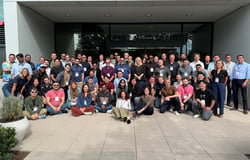
Digantara U.S. is a leading Space Surveillance and Intelligence company focused on ensuring orbital safety and sustainability. With expertise in space-based detection, tracking, identification, and monitoring, Digantara provides comprehensive domain awareness across regimes, allowing end users to have actionable intelligence on a single platform. At the core of its infrastructure lies a sophisticated integration of hardware and software capabilities aligned with the key principles of situational awareness: perception (data collection), comprehension (data processing), and prediction (analytics). This holistic approach empowers Digantara to monitor all Resident Space Objects (RSOs) in orbit, fostering comprehensive domain awareness.
Digantara U.S. is seeking an experienced and driven Astrodynamics Engineer to serve as the technical authority for orbital mechanics across the company's SDA programs.
The physical models, synthetic datasets, and estimated states that underpin these efforts trace back to this role spanning cislunar and multi-body dynamics as well as more conventional orbit determination in the LEO and GEO regimes. Because you will generate the synthetic datasets used to train and evaluate machine-learning models, you serve as both the source of that data and its most rigorous reviewer: identifying those failure modes before they reach a customer deliverable is part of the role.
You will act as a primary technical interface to the company's research institution partners, whose contributions span areas such as cislunar dynamical modeling, MOSS-based orbit determination, and CR3BP normal-form analysis. A central responsibility is making those collaborations concrete establishing agreed interfaces, conventions, and validation cases, and ensuring clear ownership boundaries early in each engagement.
Why Us?
Be part of a collaborative, innovative and mission-focused environment where your ideas and skills have significant, real-world impact.
Shape company culture, set the foundation for future success, build world-class teams.
Competitive salary, benefits and equity package.
Responsibilities:
Build and validate dynamical modeling environments spanning the company's mission regimes from conventional two-body and perturbed LEO/GEO propagation through multi-body cislunar dynamics (CR3BP and higher-fidelity models).
Generate representative synthetic observation datasets across orbit regimes and families, including realistic sensing geometry, visibility constraints, measurement noise, track gaps, and degraded-observation scenarios, for use in algorithm development and machine-learning model training and evaluation.
Incorporate publicly available ephemerides and reference datasets as independent validation cases against synthetic data generators.
Implement and characterize orbit-estimation chains appropriate to each problem with honest treatment of covariance and observability.
Characterize estimator convergence behavior, observability limits, and the conditions under which custody is achievable versus infeasible; document results.
Define anomalous dynamical behavior in physical terms, so that downstream detection and classification methods operate against a precise definition rather than an intuition.
Partner with data science and software staff to ensure training and evaluation datasets are dynamically meaningful, and to review model results against physical expectation.
Provide physics-derived inputs to CONOPS and systems-engineering activities revisit intervals, dynamically driven latency and timing constraints, and realistic bounds on what a given sensing and estimation architecture can conclude.
Serve as a primary technical point of contact for research institution partners supporting the company's astrodynamics work.
Qualifications:
MS or PhD in Aerospace Engineering, Astrodynamics, Applied Mathematics, or a related field, plus [3]+ years of relevant experience (PhD may substitute for a portion).
Demonstrated orbit determination experience across common estimation approaches batch least squares and sequential/Kalman-family estimators including rigorous treatment of covariance and observability.
Working knowledge of astrodynamics across regimes, including perturbed near-Earth dynamics (LEO/GEO) and multi-body dynamics (CR3BP, libration-point dynamics, invariant manifolds, periodic orbit families, and resonance structure).
Experience with sparse-observation and too-short-arc problems: admissible regions, initial orbit determination, and hypothesis generation and pruning.
Strong Python (or the ability to become strong quickly); comfort with C/C++, MATLAB, or Julia as needed for propagator and estimator development.
Familiarity with optical observation modeling: measurement types, error sources, and visibility and lighting constraints.
Must be able to obtain and hold a U.S. security clearance
Preferred Qualities:
Direct experience with cislunar or XGEO SDA problems, in addition to conventional LEO/GEO custody and catalog-maintenance work.
Familiarity with normal-form methods, Lie series, or other reduction techniques applied to multi-body dynamics.
Prior collaboration with university or research-institution partners on government-funded programs.
Experience generating synthetic datasets intended for machine-learning consumption, with awareness of the ways such datasets can leak structure.
Publication record in astrodynamics or SDA venues (AAS/AIAA, AMOS)
General Requirements:
Writing and delivering technical documents and briefings.
Verbal and written communication skills as well as organizational skills.
Must be a U.S. citizen.
Travel occasionally as necessary.
Digantara US is an Equal Opportunity Employer. We do not discriminate based on race, religion, color, ethnicity, gender, sexual orientation, gender identity, gender expression, age, marital or veteran status, pregnancy or disability, or any other attribute protected under applicable law. All employment decisions are strictly made on the basis of merit, competency & qualifications.
Job Location : Denver, Colorado, USA
Skills Required
- MS or PhD in Aerospace Engineering, Astrodynamics, Applied Mathematics, or a related field
- At least 3 years of relevant experience; a PhD may substitute for a portion
- Orbit determination experience using batch least squares and sequential or Kalman-family estimators
- Experience rigorously treating covariance and observability
- Working knowledge of perturbed near-Earth dynamics, including LEO and GEO regimes
- Working knowledge of multi-body dynamics, including CR3BP, libration-point dynamics, invariant manifolds, periodic orbit families, and resonance structure
- Experience with sparse-observation and too-short-arc problems, including admissible regions, initial orbit determination, and hypothesis generation and pruning
- Strong Python skills, or ability to become strong quickly
- Comfort with C, C++, MATLAB, or Julia for propagator and estimator development
- Familiarity with optical observation modeling, measurement types, error sources, and visibility and lighting constraints
- Ability to obtain and hold a U.S. security clearance
- U.S. citizenship
- Experience with cislunar or XGEO space domain awareness problems
- Familiarity with normal-form methods, Lie series, or other reduction techniques applied to multi-body dynamics
- Collaboration experience with university or research-institution partners on government-funded programs
- Experience generating synthetic datasets for machine-learning applications
- Publication record in astrodynamics or space domain awareness venues
- Technical writing and briefing experience
- Strong verbal, written, and organizational skills

What We Do
Digantara is an Indian company specializing in space situational awareness, intelligence, and surveillance. It develops infrastructure and data solutions for monitoring objects and traffic in Earth orbit, and is expanding its capabilities into missile defense.