Yext (NYSE: YEXT) is the enterprise agentic marketing platform. Built on the world's most comprehensive structured data platform for local businesses, Yext gives brands and their partners the visibility intelligence to win every moment of discovery – across AI and traditional search. Yext's API-first architecture connects structured data to APIs, MCP servers, and generative interfaces, so partners and developers can build purpose-built experiences on the same infrastructure powering Yext's own products. Thousands of brands and digital marketing partners in financial services, healthcare, retail, hospitality, and food rely on Yext to manage, measure, and optimize visibility at scale. For more information, visit yext.com.
The AI Transformation Office partners with departments across Yext to improve business outcomes through 30 to 60 day transformation sprints. As an AI Transformation Engineer, you build the production systems that make that real: retrieval, answer drafting, routing and evaluation on live data, plus the APIs, automations and pipelines around them. Each sprint ends with a handoff to the team that owns the outcome.
This is not a product-roadmap engineering role. You embed with department teams, learn how work actually gets done, and build with whatever fits. That is usually a workflow platform such as n8n first, and code only where the platform runs out. You care as much about whether someone else can run your work as whether it runs in production. You build and you teach, as one motion.
What You'll Do
Production LLM systems (40%)
- Build and run production LLM workflows in n8n and similar platforms: retrieval over ticket and documentation data, answer drafting and routing.
- Build APIs, integrations and data pipelines that connect CRM, support and operational systems.
- Build and calibrate confidence scoring so teams know when to trust an answer, and design the review steps and approval gates where a person decides.
- Protect the data you work with: scope what each workflow can read, handle PII and sensitive fields, and keep access logs.
- Ship every solution monitored, error-handled and version-controlled, not just functional.
Evals and quality (15%)
- Define evals before each build: test sets, groundedness and accuracy checks, and the thresholds that decide whether output ships or needs review.
- Report quality results to partner teams in plain terms.
- Track LLM spend and usage by team, manage API keys, and report run rate.
Knowledge transfer and enablement (20%)
- Pair-build with embedded team members so they learn by doing, not by watching.
- Write documentation that scales: runbooks, admin guides, architecture diagrams and decision logs.
- Train department champions at the right altitude: enough to maintain and extend, not enough to overwhelm.
- Build with handoff in mind from day one. The owning team should run each system day to day within 30 days of launch. They own workflow configuration, prompts, review queues and reports. You keep the retrieval, eval and scoring code until a second engineer can take it.
System design and architecture (15%)
- Design integration patterns that connect CRM, support and operational systems.
- Architect data flows that enable automation and AI-powered decisions.
- Evaluate new models and tools, and make build-vs-buy recommendations grounded in the team's real maintenance capacity.
Opportunity identification (10%)
- Spot automation and integration opportunities others miss by understanding how work actually gets done.
- Translate technical possibilities into language department stakeholders can evaluate.
- Estimate effort honestly and scope tightly: cut work that does not change the outcome, and say so early.
What You Have
- 5 to 8 years in software engineering, integration development or automation engineering.
- Production experience with a workflow platform such as n8n, Zapier or Tray.io, building automations that other teams rely on.
- Experience designing reliable autonomous agents: agent frameworks and patterns such as tool calling, orchestration, guardrails and human escalation, with eval feedback loops that keep output high quality and consistent.
- Python or TypeScript for the work a platform cannot do, with API design skills and an understanding of how software is operated: monitoring, error handling, version control and deployment discipline.
- Hands-on production use of LLM APIs (Anthropic, OpenAI or Google), including prompt design and structured outputs.
- Retrieval experience: vector databases such as Qdrant or pgvector, chunking and grounding.
- Experience measuring LLM output quality with test sets, graded review or evals.
- Experience handling sensitive data in production systems: PII, permissions and audit logging.
- A teaching instinct. You explain what you build and why, and you notice when someone is lost before they say so.
- Documentation discipline, and the ability to explain trade-offs to non-technical stakeholders without jargon.
Bonus Points
- MCP servers, agent frameworks or tool-calling design.
- Experience governing a shared LLM cost budget or API keys.
- CRM systems (Salesforce, HubSpot), data engineering or ETL, and warehouse analytics such as Snowflake.
- Familiarity with support, customer success or professional services operations.
- Experience building internal tools where the users are colleagues, not customers.
- Training, facilitation or mentoring experience, formal or informal.
- Comfort in ambiguous environments where requirements evolve as understanding deepens.
Flex Capabilities
You bring enough business context to understand why a process exists, not only how to automate it. You can contribute to prioritization, challenge assumptions about what is worth building, and sharpen your business instincts over time. We are a small team, and everyone stretches beyond their primary role.
What Success Looks Like
Each engagement agrees on key metrics before work starts, such as deflection rate, handle time or hours saved, and measures it against a baseline taken before launch.
30 days: You understand the systems landscape across the partner department and have identified three or more high-impact automation or integration opportunities. The first sprint has an agreed metric, baseline and eval set. Embedded team members see you as approachable and are already learning from working alongside you.
60 days: The first automation is live, meets the agreed quality threshold, and moves the agreed metric. At least one embedded team member can explain how it works and make minor changes without you. Documentation is current, not aspirational.
90 days: The first system is owned by the partner team day to day, and a second is live and stable. Embedded champions can maintain and extend them, and LLM spend is tracked by team. Handoff documentation is complete enough that a new engineer could onboard from it. The department refers to your work as "ours," not "the AI team's."
#LI-JB2
Pay ranges at Yext are established based on an analysis of salaries for positions with a similar level of accountability and impact in the relevant labor market. Salary levels are expected to change to reflect an employee’s job performance (results and impact) over time. Salaries at the time of hire are typically offered in the lower to middle of the above-referenced range in order to provide the opportunity to reflect performance-based increases over time. In addition to base salaries, employees at Yext are typically eligible for a comprehensive package of benefits including medical, dental and vision benefits; life insurance; short term and long-term disability; 401(k) retirement plan; and vacation and sick leave. Successful candidates may also be eligible for variable pay programs based on performance relative to goals and targets.
Yext is an equal opportunity employer committed to building a results-driven, engaging culture where every employee has the opportunity to contribute to the success of the Company, perform at the highest possible level, and grow their skills and capabilities. Yext welcomes employees and applicants of all backgrounds and demographics, and does not engage in discrimination on the basis of any protected characteristic recognized under applicable law. We also consider qualified applicants regardless of criminal histories, consistent with legal requirements. The Company believes a broad variety of life experiences across the Yext team is critical to its mission to help every business in the world be visible everywhere customers search. By seeking out fresh perspectives and fostering a positive interview experience and employee experience, Yext can remain at the forefront of innovation, and better serve its customers.
It is Yext’s policy to provide reasonable accommodations to people with disabilities as required by applicable law. If you have a disability that requires an accommodation in completing this application, interviewing, or participating in the employee selection process, please complete this form.
Security Alert
All legitimate Yext communications come from @yext.com email addresses. Messages from other domains (for example, @yext.team) are not authorized and are likely fraudulent. If you receive a message that seems suspicious, do not share personal information, click on links, or provide payment. Instead, please report the communication to [email protected].
Skills Required
- 5 to 8 years of experience in software engineering, integration development, or automation engineering
- Production experience with workflow platforms such as n8n, Zapier, or Tray.io
- Experience designing reliable autonomous agents using tool calling, orchestration, guardrails, human escalation, and evaluation feedback loops
- Proficiency in Python or TypeScript, including API design, monitoring, error handling, version control, and deployment practices
- Hands-on production experience with LLM APIs such as Anthropic, OpenAI, or Google, including prompt design and structured outputs
- Experience with retrieval systems, vector databases such as Qdrant or pgvector, chunking, and grounding
- Experience measuring LLM output quality using test sets, graded review, or evaluations
- Experience handling sensitive production data, including PII, permissions, and audit logging
- Ability to teach technical concepts and explain systems and trade-offs to non-technical stakeholders
- Strong documentation skills
- Experience with MCP servers, agent frameworks, or tool-calling design
- Experience managing shared LLM cost budgets or API keys
- Experience with CRM systems such as Salesforce or HubSpot, data engineering or ETL, and warehouse analytics such as Snowflake
- Familiarity with support, customer success, or professional services operations
- Experience building internal tools for colleagues
- Training, facilitation, or mentoring experience
- Comfort working in ambiguous environments with evolving requirements
What the Team is Saying


Yext Compensation & Benefits Highlights
-
Healthcare Strength — Health insurance is often described as comprehensive with strong coverage options and generally positive experiences. Plan breadth and quality are viewed as a relative strength of the package.
-
Parental & Family Support — Paid parental leave is frequently characterized as generous, with multiple mentions of extended leave periods and high satisfaction. This area consistently stands out as one of the most valued benefits.
-
Leave & Time Off Breadth — Time off is presented as flexible or unlimited alongside paid holidays and sick time. Employees often highlight the practicality and appeal of the PTO structure, contingent on workload and team norms.
Yext Insights

What We Do
Yext (NYSE: YEXT) is the enterprise agentic marketing platform. Built on the world's most comprehensive structured data platform for local businesses, Yext gives brands and their partners the visibility intelligence to win every moment of discovery – across AI and traditional search. Yext's API-first architecture connects structured data to APIs, MCP servers, and generative interfaces, so partners and developers can build purpose-built experiences on the same infrastructure powering Yext's own products. Thousands of brands and digital marketing partners in financial services, healthcare, retail, hospitality, and food rely on Yext to manage, measure, and optimize visibility at scale. For more information, visit yext.com.
Why Work With Us
At Yext, we bring together curious thinkers and passionate problem-solvers who want to make a real impact. We celebrate internal growth, open communication, and creative ownership in a One Team environment. Here, individual growth fuels collective success — and everyone has a voice in shaping what we build next.
Gallery








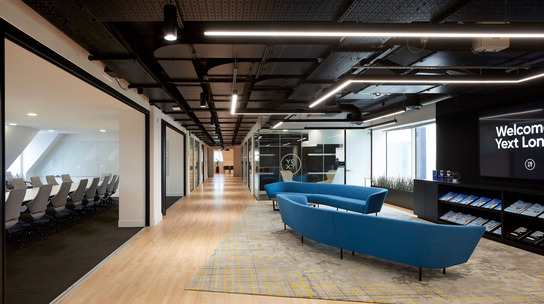
Yext Offices
Hybrid Workspace
Employees engage in a combination of remote and on-site work.