


In this role, you'll develop and deploy advanced machine learning models that solve real-world perception challenges for autonomous systems. You'll own major features from model development through deployment, working closely with machine learning researchers, perception engineers, autonomy engineers, and platform teams to bring cutting-edge AI capabilities into production. This is an ideal opportunity for engineers who enjoy solving difficult perception problems while building reliable, production-ready ML systems that operate on autonomous platforms in complex operational environments.
What You'll Do:
Model Development – Design, train, fine-tune, and maintain state-of-the-art vision, vision-language, and vision-language-action models that improve perception and decision-making for autonomous systems.
Data Pipelines & Model Training – Build scalable data pipelines, supervised fine-tuning (SFT) workflows, and evaluation loops that continuously improve model performance on mission-relevant tasks.
Model Deployment & Optimization – Deploy and optimize machine learning models for embedded hardware using technologies such as ONNX, TensorRT, and hardware-accelerated inference frameworks.
Perception & Autonomy Applications – Apply modern machine learning techniques to solve challenging perception and autonomy problems across aerial and other autonomous systems operating in complex, real-world environments.
Research-to-Production – Translate cutting-edge machine learning research into production-ready capabilities by balancing model performance, robustness, computational efficiency, and operational reliability.
Cross-functional Collaboration – Partner closely with perception, autonomy, platform, and software engineering teams to integrate machine learning capabilities into mission-ready autonomous systems.
Model Evaluation & Validation – Develop benchmarks, testing methodologies, and evaluation frameworks to measure model performance, identify failure modes, and guide future improvements.
Continuous Improvement – Improve training infrastructure, developer tooling, deployment workflows, and model lifecycle management to accelerate experimentation and production delivery.
Required Qualifications:
Typically requires a minimum of 5 years of related experience with a Bachelor’s degree; or 4 years and a Master’s degree; or 2 years with a PhD; or equivalent work experience.
Prioficiency of machine learning fundamentals.
Experience training an deploying ML models for computer vision in a production setting.
Strong understanding of 3D vision problems/algorithms.
Experience with machine learning frameworks such as PyTorch and TensorFlow.
Demonstrated expertise in deploying models using TensorRT and ONNX.
Proficiency in C++ and Python.
Strong analytical and problem-solving skills, with the ability to translate research into practical applications.
- Ability to obtain a SECRET clearance
Preferred Qualifications:
Experience with developing autonomous systems for defense customers.
Experience with training/finetuning vision-language models, vision-language-action models, and/or world models.
Contributions to open-source projects in machine learning or computer vision.
Track record of publications in leading computer vision and robotics conferences and journals (e.g., CVPR, ICCV/ECCV, RAL, ICRA).
Skills Required
- Typically requires minimum experience as described (e.g., 5 years with Bachelor's or equivalent combinations)
- Proficiency of machine learning fundamentals
- Experience training and deploying ML models for computer vision in a production setting
- Strong understanding of 3D vision problems/algorithms
- Experience with PyTorch and TensorFlow
- Demonstrated expertise deploying models using TensorRT and ONNX
- Proficiency in C++ and Python
- Strong analytical and problem-solving skills, translating research into practical applications
- Ability to obtain a SECRET clearance
- Experience developing autonomous systems for defense customers
- Experience training/finetuning vision-language, vision-language-action, or world models
- Contributions to open-source ML or computer vision projects
- Publications in leading CV/robotics conferences (CVPR, ICCV/ECCV, RAL, ICRA)
What the Team is Saying


Shield AI Compensation & Benefits Highlights
-
Healthcare Strength — Company materials highlight comprehensive medical, dental, and vision coverage with mental-health support and an EAP. Third-party benefits summaries also portray health coverage as a strong component of the package.
-
Retirement Support — Offerings include a 401(k) with employer matching, cited on the careers page and independent benefits directories. Multiple sources indicate a match exists, though exact formulas have varied over time and warrant confirmation.
-
Equity Value & Accessibility — Company communications describe equity for all full-time hires and stock benefits as part of total rewards. Independent listings also note company equity/RSUs as a standard element.
Shield AI Insights

What We Do
At Shield AI, you won't wait years to see your work reach the field. You'll build hardware and software that operates in the real world right now, in the hands of the people who depend on it. Hivemind, our AI pilot, has been flying since 2018. It has flown more than 30 platforms, including an F-16, and it now sits under a U.S. Air Force production contract for Collaborative Combat Aircraft. When you write code or shape a system here, you contribute to technology with a proven flight record and a clear production future. V-BAT flies intelligence, surveillance, and reconnaissance missions with an operational record that stretches from Ukraine to the Indo-Pacific. It delivers eyes where they matter most, in the most demanding conditions on earth. The teams behind it watch their work get tested where the stakes are real. X-BAT takes its first flight this year. It's an AI-piloted fighter that needs no runway, built to operate where traditional aircraft can't. Join now and you help shape a program at its earliest, most formative stage. That's the kind of ground-floor work that defines a career. Do the most impactful work of your life, on problems that matter. Autonomy at this level asks a lot of you. You'll take on problems in perception, planning, and control that few teams anywhere are equipped to solve. You'll work across disciplines, from aerospace and robotics to machine learning and systems engineering, alongside people who hold themselves to an exacting standard and expect the same from you. Our mission is clear: protect service members and civilians with intelligent systems. That purpose runs through every decision, every design review, and every deployment. It's why the work here carries a weight you can feel. Ready to join our mission? Explore our open roles and find where you fit.
Why Work With Us
Founded in 2015 by a former Navy SEAL, Shield AI builds AI pilots and uncrewed aircraft. Veterans aren't an afterthought here, they're at every level. It's why the work carries weight: AI pilots and uncrewed aircraft flying real missions, from Ukraine to the Indo-Pacific, protecting service members and civilians.
Gallery
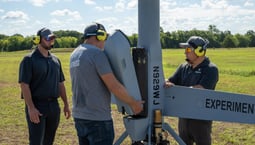
%203.jpg)

Shield AI Teams
.jpg)


Shield AI Offices
Hybrid Workspace
Employees engage in a combination of remote and on-site work.

